Third-Party Risk Policies in The Netherlands

A Historical Sketch 

Ben Ale | April 2023, Cambridge Scholars Publishing

It is not easy to keep the population safe in a country that is one of the most densely populated in the world, a hub of international transport over land and water and through the air, about one-third of which lies below sea level.

.

Third-party risk policies developed gradually in The Netherlands but became acute in the late 20th century as various industries increased their use and production of hazardous materials.

The Dutch government, considering its constitutional responsibility to protect the life, health and well-being of its people, must resolve the ongoing debate between the general population, who are exposed to these risks, and those profiting from the creation of said risks-the resultant policies are a product of this balancing act.

Lees verder →

Resilience Thinking

Sustaining Ecosystems and People in a Changing World

Brian Walker and David Salt | 2006

Increasingly, cracks are appearing in the capacity of communities, ecosystems, and landscapes to provide the goods and services that sustain our planet’s well-being. The response from most quarters has been for “more of the same” that created the situation in the first place: more control, more intensification, and greater efficiency. It is published by Island Press.

“Resilience thinking” offers a different understanding of the world and a new resource management approach. It embraces human and natural systems as complex entities continually adapting through cycles of change. It seeks to understand the qualities of a system that must be maintained or enhanced to achieve sustainability. It explains why greater efficiency alone cannot solve resource problems and offers a constructive alternative that opens up options rather than closing them down.

Lees verder →

Publieke waarden en risico’s in Straatsburg

De geboorte van een organisatie voor publiek risicomanagement (PRIMO)

Jack Kruf* | mei 2005

Vorige maand, op 1 april 2005, kwam het Executive Committee van UDITE, het netwerk van gemeentesecretarissen en gemeentelijk algemeen directeuren in Europa, bijeen in Straatsburg om ‘publiek risicomanagement’ als nieuw idee te bespreken. De gemeentesecretarissen keken gezamenlijk naar een nieuw gepresenteerde aanpak, die Alan Vendelbo, president van UDITE, bovenaan de agenda had geplaatst.

Het was vanaf het begin van de bijeenkomst duidelijk dat allen geloofden dat de benadering de rol en functie van de gemeentesecretaris zeer  versterken in het ondersteunen van de politiek, de maatschappij en de eigen organisatie. Actuele gebeurtenissen in de samenleving en het uit het niet in control zijn op budgetten en processen binnen tal van politiek-bestuurlijke projecten hebben het belang van proactief denken over publieke waarden, doelen en hun risico’s verhoogd. Hier volgt een korte persoonlijke impressie. Ik was erbij op deze dag.

Lees verder →

Creating Public Value

John O’Dea* | April 2014

Public value is defined as “using government assets to produce a good and just society”. The term was first mooted in 1995 by Mark H. Moore – Hauser Professor of Non-Profit Organisations at the Harvard Kennedy School of Government – in his book Creating Public Value (Harvard University Press). Public value in public sector management is the equivalent of shareholder value in private sector organisations. Shareholder value is a business term which implies that the ultimate measure of a company’s success is the extent to which it enriches its shareholders (owners) by paying dividends and/or causing its stock price to increase in value.

John O’Dea

By the same token, the ultimate measure of a government’s success is the extent to which it enriches society as a whole. The difference between public and private entities is that in the former, citizens are both the shareholders (as taxpayers) and the clients (as recipients of public services). Public services are distinctive because they are characterised by claims of rights by citizens that have been authorised and funded through a democratic process.

Lees verder →

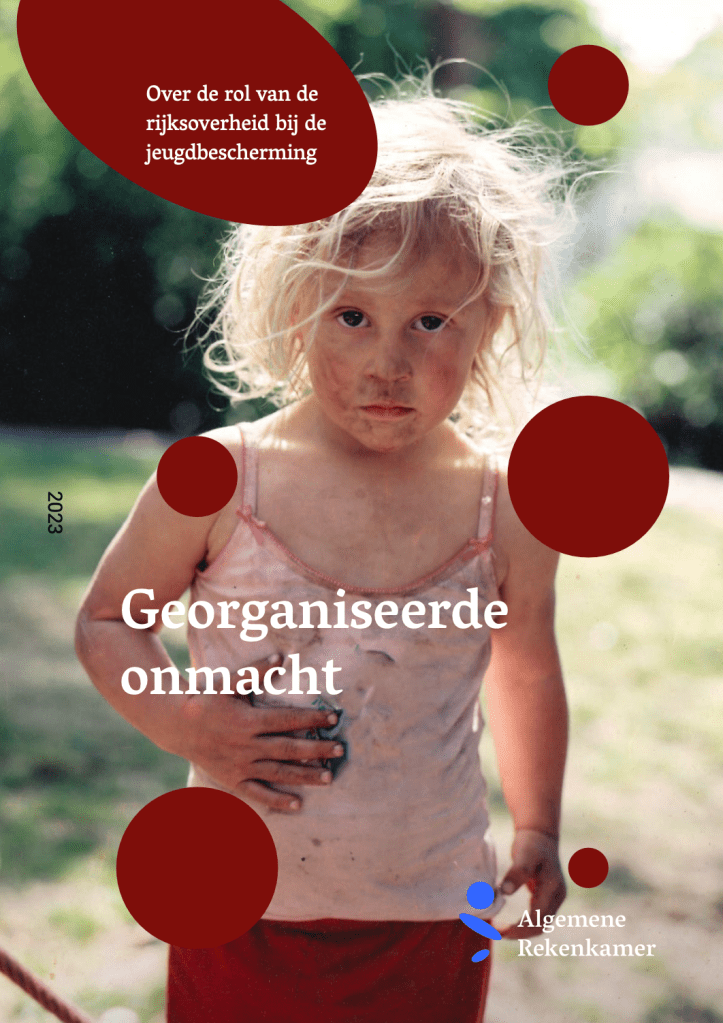
Georganiseerde onmacht

Over de rol van de rijksoverheid bij de jeugdbescherming

Algemene Rekenkamer | 2023

In 2015 is de verantwoordelijkheid voor jeugdbescherming overgeheveld naar gemeenten. Hiermee zouden de totale uitgaven aan jeugdzorg dalen, de wachttijden korter worden en de administratieve last voor hulpverleners afnemen. Dat is niet gelukt. Kinderen en kwetsbare gezinnen krijgen niet (tijdig) de hulp die ze nodig hebben. Verantwoordelijke bewindspersonen (de minister voor Rechtsbescherming en de staatssecretaris van Volksgezondheid, Welzijn en Sport) hebben hun rol als verantwoordelijke voor het wettelijke stelsel voor jeugdbescherming lange tijd onvoldoende ingevuld. Dit concludeert de Algemene Rekenkamer in het rapport Georganiseerde Onmacht.

Sinds de invoering van de Jeugdwet in 2015 moeten gemeenten de jeugdbescherming lokaal organiseren. Het idee van de minister en de staatssecretaris was dat gemeenten dichter bij kind en gezin staan en dus meer maatwerk kunnen leveren. In de praktijk leidt dit tot een onoverzichtelijke en onwerkbare situatie voor gemeenteambtenaren én hulpverleners.

Lees verder →