Managing the Unexpected

Assuring High Performance in an Age of Complexity.

Karl E. Weick and Kathleen M. Sutcliffe | August 2015 (original 2001)
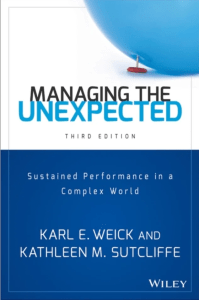
Improve your company’s ability to avoid or manage crises! ‘Managing the Unexpected’, Third Edition, is a thoroughly revised text that offers an updated look at the groundbreaking ideas explored in the first and second editions.

Revised to reflect events emblematic of the unique challenges that organisations have faced in recent years, including bank failures, intelligence failures, quality failures, and other organisational misfortunes, often sparked by organisational actions, this critical book focuses on why some organisations are better able to sustain high performance in the face of unanticipated change.

High-reliability organisations (HROs), including commercial aviation, emergency rooms, aircraft carrier flight operations, and firefighting units, are models of exceptional organisational preparedness. This essential text explains the development of unexpected events and guides you in improving your organisation’s reliability. In the original publication (2001), the authors introduced the powerful new concept of ‘Mindfulness’.

They set out the five qualities of the mindful organisation with the organisational skills required (including case studies) to achieve them:

  1. Orientation towards disruptions: consider mistakes as opportunities for improving one’s own operations.
  2. Reluctance to simplify: analyse and evaluate with care and completeness.
  3. Primary focus on execution: focus on delivery of products and services.
  4. Resilience: develop the ability to respond to change, rather than just anticipate or pre-empt it.
  5. Respect for expertise: use relevant knowledge in execution or with customers.

This edition offers updated, valuable content to professionals who want to strengthen their organisations’ preparedness and confidently face unexpected challenges.

Bibliography

Read also Review by Michael J. Novak for Office of Research, IRS.

Enacting resilience

Adventure racing as a microcosm of resilience organizing

Michelle Barton and Kathleen Sutcliffe | March 2023

In this inductive study we explore the relational microdynamics of organizational resilience in adventure racing. Drawing from an organizing lens, we frame resilience as an ongoing process by which organizational actors work together to absorb strain and maintain functioning within dynamically uncertain and adverse environments.

Adventure racing exemplifies such a context: stress, technological breakdowns, and untoward environmental conditions are both frequent and unpredictable. By analyzing and triangulating interview data from 103 members of 53 adventure racing teams, we found that racers experienced ongoing adversity punctuated by discrete acute shocks.

Lees verder →

JPMorganChase Letter to Shareholders

Jamie Dimon, Chairman and Chief Executive Officer | April 2026

“Dear Fellow Shareholders, In 2026, America is celebrating its 250th anniversary. Also, this year we are celebrating the 227th anniversary of JPMorgan Chase, which was founded in April 1799. This is the perfect time to rededicate ourselves to the values that made this great nation of ours — freedom, liberty, and opportunity — and to recognize that we all stand on our country’s shoulders.

The challenges we all face are significant. The list is long but at the top are the terrible ongoing war and violence in Ukraine, the current war in Iran and the broader hostilities in the Middle East, terrorist activity and growing geopolitical tensions, importantly with China. Our hearts go out to those whose lives are profoundly affected by these crises. We sincerely hope these global conflicts are properly resolved and that one day all of Europe and the Middle East will attain long-term stability and prosperity. Even in troubled times, we have confidence that America will do what it has always done — look to the values that have defined our singular nation and sustained our leadership of the free world…”

Lees verder →

Developing a Risk Maturity Model

A comprehensive risk maturity model for Dutch municipalities

Ignacio Jose Cienfuegos Spikin | 2013

Risk management is a trend in almost every sector. Public organisations such as local authorities are lagging behind in this area, but they now have a new support model at their disposal. Ignacio Cienfuegos Spikin, originally from Chile and a PhD graduate of the University of Twente in 2013, investigated the state of risk management within local authorities. He tested a ‘Risk maturity model’ he had developed across 72 local authorities. “The model provides valuable information to decision-makers”.

Ignacio Jose Cienfuegos Spikin: “Following the trend of organizations from almost every sector now, public entities such as municipalities have also started to develop risk management awareness in the last decades. Related to the pressure of a more demanding environment and the incidents that these organizations have experienced, this process has led to the development of special standards and the design of risk management policies by central governments.

Lees verder →

UN Global Risk Report

United Nations | July 2025

The first-ever United Nations Global Risk Report 2024 has been released, offering insights from over 1,100 experts and stakeholders on the most pressing global risks and the world’s preparedness to address them. The report, based on a global survey conducted in 2024, assesses the perceptions of these risks across societal, technological, economic, environmental, and political categories. It highlights the interconnectedness of these risks and emphasizes the need for a more united and multilateral approach to strengthen the world’s capacity to anticipate, adapt, and respond to future challenges, according to the report. 


António Guterres: “We are at a defining moment for humanity. In a year marked by converging global crises, the international community faces mounting pressure to strengthen our collective capacity to anticipate and respond to shared risks.

This report, drawing on data collected in 2024, offers a valuable snapshot of how stakeholders around the world—governments, the private sector, academia, and civil society—perceive global risks and assess the multilateral system’s readiness to address them.

Lees verder →