FORTE™

Framework for Good Governance
PRIMO startte in 2017 te Parijs met de ontwikkeling van een nieuwe aanpak om meer integraal de publieke besturing rondom een maatschappelijk vraagstuk te kunnen analyseren en te ontwerpen. De kern van deze aanpak is erop gericht om de kracht van een door het bestuur en de top van de organisatie geïnitieerde en geleide dialoog in strategische publieke vraagstukken te bevorderen.

Van vragenlijst naar brede aanpak
Wat begon met een simpele uitlijning van een vragenlijst, breidde zich geleidelijk aan uit naar een verdieping op het krachtenveld rondom deze dialoog. Geïnspireerd door de wetenschappelijke benadering van de hoogleraren Jeanne Liedtka (Design Thinking), Mark Moore (Public Value Management ), Ortwin Renn (Public Risk Management), Karl Weick & Kathleen Sutcliffe (High Reliability Organisation) en Peter Young (Risk Leadership), lijkt de eerste aanpak te leiden tot een bredere, die organisaties kan ondersteunen om zich ex ante te verdiepen op de sturingsprincipes en gerichte toepassing ervan bij vraagstukken in de praktijk.

Zoektocht naar indicatoren van goede sturing
Na het testen van de aanpak in de concrete praktijk van de bedrijfsvoering van alledag, ontstond het inzicht dat de aanpak leidde tot echte collectieve samenspraak en gedeelde inzichten met betrekking tot scenario’s, haalbaarheden, kritische succesfactoren en mogelijke afwijkingen (lees: risico’s) op de nagestreefde waarden.

Besloten werd besloten tot een wetenschappelijke aanpak. Deze werd  nodig geacht om het feitelijke fundament van de dialoog – die sinds de oprichting van PRIMO in 2005 is ontstaan op basis van 15 jaar  ervaringen en inzichten van met name gemeentesecretarissen en concerncontrollers in Europa – ook wetenschappelijk te kunnen ‘aantonen’ én te kunnen verbinden met gecertificeerde instrumenten. De zoektocht naar de indicatoren van goede besturing was ingezet.

Lees verder →
Design Thinking

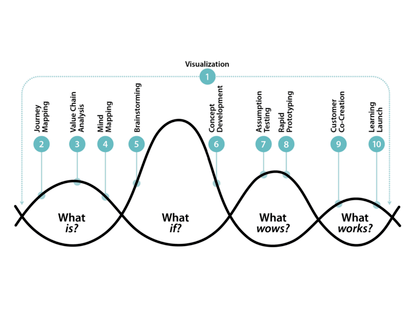
Professor Jeanne Liedtka at the University of Virginia’s Darden School of Business, conceptualises design thinking as ‘social technology’. Rather than treating it merely as a ‘soft skill’ or a creative luxury, her framework presents a structured, human-centred problem-solving process designed to mitigate cognitive biases, reduce corporate risk, and democratise innovation across teams. Her core model simplifies the design thinking process into four central questions and ten essential tools.

Liedtka’s model breaks down the innovation process into four successive stages, detailed in her foundational book Designing for Growth (Liedtka et al., 2011).

  • What is? (Experiencing Reality, to understand the current user ecosystem and identify core problems). This stage focuses entirely on the current state. Teams use empathy and customer context immersion to discover unarticulated, unmet needs rather than starting with company goals. Tools are 1) Visualisation, 2) Journey Mapping, 3) Value Chain Analysis, and 4) Mind Mapping.
  • What if? (Imagining Possibilities, to generate a broad spectrum of creative, hypothesis-driven solutions). This is the divergent ideation phase. Teams shift from data analysis to exploring possibilities, brainstorming new concepts, and imagining alternative futures. Tools are 5) Brainstorming, and 6) Concept Development.
  • What wows? (Choosing Excitement, to isolate the critical assumptions keeping a project risky and test them roughly). This stage bridges the gap between imagination and execution. Teams analyse the generated ideas to identify solutions that hit the sweet spot where customer enthusiasm intersects with organisational capability. Tools are 7) Assumption Testing, and 8) Rapid Prototyping.
  • What works? (Testing in Action, to iterate directly with users via quick, small-scale market experiments). The final stage relies on data-based experimentation. Teams build rapid prototypes and launch small, low-risk tests to gather real-world feedback. Tools are 9) Customer Co-Creation, and 10) Learning Launches.

The book Designing for Growth.

Bibliography

Liedtka, J., & Ogilvie , T. (2011). Designing for Growth: A Design Thinking Tool Kit for Managers. Columbia Business School Publishing

About ‘Public Risk’

Board of PRIMO Europe | April 2007

Introduction

During the founding of the idea of PRIMO in Strasbourg on the 1st of April 2005, the need for design principles related to the governance of public risk was extensively discussed. We, to be precise the executive committee of the European Association of Local Chief Executives UDITE, defined it as a form or way of working towards the prevention and reduction of possible hazards and risks (i.e. a measure of hazard) in our (European) cities, to build public trust on values like safety, quality of life, protection and coherence in society. In 2020, we reflect on and specify these principles.

A myriad to deal with

Based on experiences in this network we conclude that most of the public leaders and managers we meet – and if we ask them in our Public Risk Forum, round tables and thinktanks -, define risk all in their own way. It is a myriad of definitions and perceptions. We guess there are 100 different definitions of risk around, all based on unique principles, perspectives, angles, and driven towards further segmentation by a myriad of advisors, trainers, scientists (o, yes), and software developers.

Lees verder →

Enacting resilience

Adventure racing as a microcosm of resilience organizing

Michelle Barton and Kathleen Sutcliffe | March 2023

In this inductive study we explore the relational microdynamics of organizational resilience in adventure racing. Drawing from an organizing lens, we frame resilience as an ongoing process by which organizational actors work together to absorb strain and maintain functioning within dynamically uncertain and adverse environments.

Adventure racing exemplifies such a context: stress, technological breakdowns, and untoward environmental conditions are both frequent and unpredictable. By analyzing and triangulating interview data from 103 members of 53 adventure racing teams, we found that racers experienced ongoing adversity punctuated by discrete acute shocks.

Lees verder →

Public Value in Public Service Transformation

Working with change

OECD | December 2019

Since its founding in 2005, PRIMO Europe has focused on putting public value at the center, with good governance at its core (including effectiveness, design thinking, high-reliability organisation principles, scenario analysis, SWOT, the precautionary principle, premortem, and the FORTE Framework). Delivery of projects, programs, and policies is key to our network.

Public risk as a ‘possible harm to public value’ is considered a metaphor for the result of bad, not that, or not-so-good governance, and its attached leadership. Mark Moore’s definition of public value is the starting point for our products and services. This report addresses the key developments affecting our network of governors, managers, and their teams. An inspirational report.

Summary

“The rise of platform economies, new consumption patterns and innovative technologies are transforming both service delivery and people’s lives in general. Smart solutions are entering our everyday lives and digitalisation and datafication of everything is the norm. In political economy, short-term considerations seem to prevail, while long-term challenges with cascading effects (like climate change and demographic shifts) are already being felt. Governments around the world are facing an unprecedented transformation process, where systems that have worked and delivered results in prior decades are being questioned.

Lees verder →