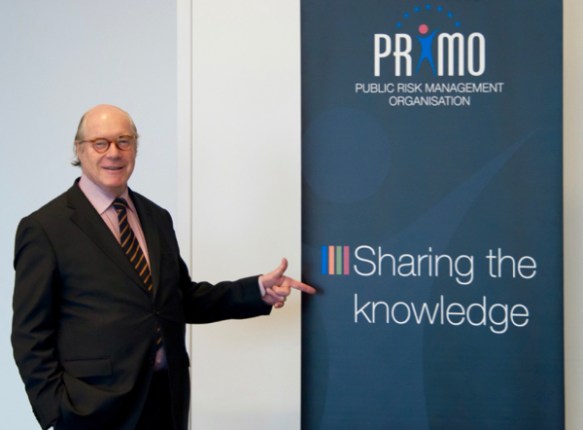
Uit handen van de president van PRIMO Europe, de heer Jack Kruf, ontving de heer Ronny Frederickx op 25 september 2017 in Parijs de PRIMO Risk Management Award 2017 voor zijn toewijding en bijdrage aan de ontwikkeling van publiek risicomanagement in Europa. De prijs werd toegekend voor zijn inspanningen om het bewustzijn rondom ‘good governance’ te vergroten en het belang van risicomanagement daarbij bij gemeenten in Europa naar voren te brengen.
Ronny Frederickx, President UDITE 2015-2017
Laudatio
“Het bestuur van PRIMO Europe reikt de PRIMO Risk Management Award 2017 uit aan Ronny Frederickx, President van UDITE, de Europese Vereniging van Gemeentesecretarissen, voor zijn jarenlange commitment om risicomanagement als vak in het publieke domein te integreren in de besturing én in de bedrijfsvoering van het Europese netwerk van gemeenten.
PRIMO is gestart met het diagnosticeren van voorliggende bestuurlijke programma’s, bezien vanuit de formule SK x OK x IV = R (Kruf & Redert, 2019). In dit geval is het Coalitieakkoord tussen D66, VVD en CDA: ‘Aan de slag, Bouwen aan een beter Nederland‘ onder de loep genomen door gerichte samenspraak binnen en waardering door ons netwerk.
Dit regeerakkoord krijgt vanuit het netwerk een 4 voor stimulerende kaders, een 2 voor organisatiekracht en een 5 voor investerend vermogen. Dat betekent een R-index van 4 x 2 x 5 = 40. Dat is erg laag. Een score van 350 wordt gezien als minimum voor een goed resultaat. Het gaat hierbij om het regeerakkoord als geheel.
Opvallend is dat het akkoord een gedegen analyse van vigerende trends en ontwikkelingen, een analyse van de eigen sterktes en zwaktes, van mogelijke publieke risico’s als ‘mogelijke schade aan het in dit akkoord gestelde publieke waarden’, een premortem of een scenarioanalyse in het geheel ontbeert.
In 2024, the PRIMO Europe board confirmed its portfolio. The portfolio was considered complete and promising for further development. The focus is that products and services should refocus more than ever on establishing public values and helping members become better equipped to be more effective in decision-making. It is the conviction that, based on experiences over the last few years with our roundtables, think tanks, and education, the perspective on risk has shifted towards true delivery, effectiveness, success, and performance.
Our members need models, tools, and techniques that provide genuine insight into matters, challenges, and issues related to public values and deliver effective solutions. The more general path of promoting frameworks or focusing on generic culture change is less favored. For effective navigation in times of high dynamics, a greater focus on systems thinking and resilience is needed. In view of the current positioning and development of risk management within the public domain, the conclusion is drawn that the needs of organisations working in or for the public domain have broadened considerably to include offering quality, safety, security, performance, precaution, continuity and reliability.
We entered our news and reports into our database, combined them with our surveys related to the FORTE® Framework, a scan of our LinkedIn network posts and asked our AI companion to summarize the headlines as of 23 March 2026.
The results are highly recognisable and comparable with recent surveys by the United Nations, the European Commission, and the World Economic Forum. The results are, in our view, the starting point for action; however, the question arises, by whom exactly?. The fact is that the government and its political leaders are the main players involved in public values and play a dominant role in causing public risks, as mentioned. It seems that leadership itself is under the microscope, and the main factor behind the subtitle of this reporting: ‘the Risk of Leadership’.
Definitions
We used the following definitions.
“Public value refers to the value created by the government through laws, regulations, services, and any other action. In a democratic society, this value is defined by the public itself. Value is determined by citizens’ preferences expressed in a variety of ways, and thus it provides a rough yardstick against which to gauge the public institutions and government policies.” Moore (1995).
Public Risk is defined as ‘possible harm to a chosen public value’, as derived from Kates & Kasperson (1983) and Renn & Klinke (2002).
Public Values
Based on recent Eurobarometer surveys and European public debates (2024-2025), the public values most mentioned as being at stake for European citizens are fundamentally linked to democracy, security, and social cohesion. These values are seen as vital to maintaining stability in a turbulent geopolitical environment. The most frequently mentioned public values at stake include:
During the Local Government Risk Conference on 17 January 2018 at the Provincial Government Building in Utrecht, a group of experts discussed the key aspects of governance and control as they relate to municipal organisations.
Jack P. Kruf during his keynote speech at the Provincial Government Building in Utrecht. (2018), Risk & Compliance Platform Europe
In his keynote, Jack Kruf advocated for a much stronger link between policy content and policy direction. Given the multitude of interests and stakeholders, the segmentation of expertise and levels of government, as well as the fragmentation of knowledge surrounding issues, he believes that local authorities would be wise to take more time for an ex ante governance clause.
What council would not want its programme to be implemented optimally and effectively? According to him, this does, however, require genuine dialogue and engagement with all stakeholders at the outset. So not just more programme adoptions that focus purely on content, but also explicitly highlight their governance.
Governance in itself – in programmes and agreements by councils and executive bodies – therefore demands our full attention. The quality of public governance has become part of the quality of the public sphere and, consequently, of the public debate. We can no longer avoid explicitly addressing and embedding governanceex ante.
According to Kruf, this governance section is much more than the current ‘risk management and resilience’ section. The latter merely lifts a corner of the veil, and even then only in financial terms. Not unimportant, but resilience is no longer exclusive; it is often purely financially focused, written from a defensive and safeguarding perspective, and does not really address other relevant governance variables, relationships, and connections that play a role in the genuine administration and management of the city, its innovation, and development.
Resilience is good, but not inspiring enough and, moreover, technically wholly inadequate to enable us to discover and dare to explore new paths and set out on them. He quotes a councillor and a mayor from the network:
“Resilience is a theoretical exercise that paints a false picture of reality. I’ve never understood it. More than once, it has served as a smokescreen under which a project was sold.” – Councillor.
“Resilience serves to enable the council to account for its actions in broad terms, rather than to steer them. In practice, other forces – including political ones – determine whether a project is or should be feasible.” – Mayor.
According to Kruf, the new, much broader governance section should describe and (administratively) set out how the council’s programme itself can be steered and managed, and what specific roles the council, the executive committee, and the civil service organisation play in this, alongside social actors and institutions. The section should highlight all elements of governance necessary for performance, results and success. According to him, there are five elements that must be present simultaneously for this to be effective. These are:
Sound financial design and compliance, going hand in hand and, above all, realistic.
A focus by the administration and senior management on the target group (the citizen, the neighbourhood, the young person), on the objective and on the actual delivery of products and services.
Public leadership and stewardship that connects and stands up for its cause.
Tools and organisational capacity to bring plans to fruition.
Focus on the environment: horizontally towards fellow local authorities, market parties and relevant interest groups; vertically towards higher-level authorities, towards sections of society and towards the natural environment and its carrying capacity.
When launching a new programme, a municipal executive could ask its municipal secretary and group controller to draw up a proposal for this governance section. As leading experts in command and control, they are ideally placed to advise the executive on this matter. Indeed, they may be better suited to do so, as they understand the entire landscape. In this section, the five points mentioned above are linked to the executive’s programme.
It goes without saying that governance itself also requires investment. The world is changing, as are the players, and so too must governance. Sometimes this involves the appropriate structuring of a project, process or programme, but it may also concern the development of new roles, thinking in terms of new scenarios, the reorganisation of organisational units, entering into different forms of collaboration or contractual arrangements, or communicating differently with citizens and businesses. Governance itself must then also be budgeted for, regarded as a critical success factor, and embedded. Quality governance costs money, but it also delivers greater returns and can no longer be regarded as merely an afterthought to the substance.
The governance section is, in anticipation of the council’s own in-control statement to be issued in the near future, actually a logical concept. Governance itself thus becomes a fully-fledged factor within the political and administrative sphere. Something that was sorely needed, however contradictory this may sound. Governance too often appears to be a stepchild, resulting in significant public risks.
Kruf cites several examples in his argument. He also quotes from the World Economic Forum’s Global Risks Report 2018, published on the same day. The governance section could broaden the basis for lawful action, both administratively and within the civil service. After all, every euro of taxpayers’ money must be handled with care. And good governance helps with that, he is convinced.
In Kruf’s view, a council programme with a sound and widely supported governance section serves as an inspiration for the success not only of the municipality as an organisation, its executive or council, but also of the municipality as a community of citizens, businesses and institutions, as well as the municipality as a geographical area. In his view, ‘control’ will take on a much more proactive role than it currently does. The reactive role is ‘out’, the proactive role is ‘in’. Control should be able and allowed to play that role. In the coming years, the field of control could evolve into that of governance architecture.
This calls for a new mindset among managers, namely the willingness to bring this knowledge to the forefront of the process. That is not the case at present. Utilising the knowledge, insights, expertise, and skills of (group) controllers and managing directors may well be essential for developing the necessary management capacity. The link between substance and integrated business management, in other words. More, therefore, than just finance and compliance. This is not only challenging but, in fact, calls for a broad reassessment of the expertise of both command and control.
The world has entered a new dynamic. And we know – as Herman Gorter opened his 1889 book ‘Mei’: “A new spring and a new sound…”. In this new spring, substance and governance must be much better linked. The integrated governance section can help with this.
Kruf, J. (2018). PRIMO bepleit Besturingsparagraaf: Van weerstandsparagraaf naar corporate sturing. In J.P. Kruf & E.J. Frank. Publiek Risico: Essays, Stichting Civitas Naturalis, 2020,pp. 708–713.
Kaleidoscope is an internationally developed educational program that provides a holistic, dialogue-oriented approach to public risk. Discussing relevant themes such as cybersecurity, social cohesion, city management, adaptation to climate change, proper water management, and added-value through partnership, and getting familiar with the best concepts, methods, and techniques to manage risk, and learning from authoritative scientists and practitioners.
The program provides insight into how public values and risks intersect, as well as how to design effective governance mechanisms. The education program consists of three main perspectives and is offered in a modular format with capita selecta:
Craftsmanship of risk management (general overview of risks, drivers, frameworks, techniques).
Establishment and governance of specific values (i.e., topic-related approach of risk, resilience, scenarios, from the organisation and client perspective).
Personal skills (how to act, interact, communicate, learn, and develop yourself).
Tom Baele, Luc Verhulst en Tom Wustenberghs | april 2013
De bijeenkomst in de raadszaal van de gemeente Temse biedt een uitgebreide kijk op risicomanagement binnen publieke organisaties. De vraag staat centraal hoe het beheer van risico’s in het publieke domein in te richten, Daarbij staat het creëren van publieke waarde centraal. Er worden diverse concepten en benaderingen die overheden tegenkomen bij het realiseren van hun doelen, besproken. Luc Verhulst, gemeentesecretaris van Temse, is gastheer. Tom Wustenberghs, voorzitter van PRIMO Vlaanderen is dagvoorzitter. Een verslag.
Wapen van Vlaanderen
Inleiding
De presentatie door Jack Kruf, president van PRIMO Europe begint met een inleiding die erop gericht is om inzicht en overzicht te bieden met betrekking tot het (nieuwe) vakgebied publiek risicomanagement. De toon wordt gezet door te wijzen op de noodzaak van een holistische benadering van steden en hun geschiedenis. Dit wordt gelinkt aan de bredere context van risicomanagement, dat in feite ondersteunend en vooral dienend is aan de versterking van goed rentmeesterschap door de gemeentesecretaris en zijn managementteam.