The Public Design Evidence Review: Public Value

UK Cabinet Office | July 2025

PRIMO: “We talk a great deal about what is going wrong. About the countless threats of today and the risks of tomorrow facing our society, our ecosystems and our climate. A constant stream of analyses and opinions appears every day in the media and on social media. They are all true and reflect concern and even anger. There is criticism of our political leaders, who, in the eyes of many, are not making much of a difference, because they are heavily influenced by powerful lobbies representing large corporations and oligarchs. A veritable deluge of emotions.

I advocate a renaissance of public value, its design and its management. In other words, reconsidering and acting from the ground up. This publication is right up our street. This report examines the concept of ‘public value’, its origins, how it is measured and its application in public administration, with an emphasis on the need for professionalisation to improve the delivery of public value.

PRIMO shifts its focus from risk (potential damage to public value) to the value itself. This is because it places a much stronger emphasis on managing that value and highlights the wide range of factors that influence that management. It also makes better use of Mark H. Moore’s leading expertise in public administration and his scholarly approach. Furthermore, it places greater emphasis on the here and now, rather than on tomorrow and the day after. It focuses more on certainties and knowledge, and less on so-called uncertainties. It puts us in the driving seat rather than leaving us drowning in the immense abyss of what might happen. It puts our hands on the wheel.

The Public Design Evidence Review (PDER) explores the role and value of design in the public sector. An overview of the report package can be found below.

“This document is the second of three literature reviews commissioned by the cross-government Policy Design Community and written by an interdisciplinary team of academics. It discusses the concept of public value, its origins, measurement, and application in public administration, emphasising the need for professionalisation to enhance public value delivery. The wider project was commissioned as a non-exhaustive exploration of the relationship between public design and public value. It was conducted within rapid timeframes and prioritised cross-disciplinary working.

Lees verder →
Certificate in ESG Risk Management

September 2026

PRIMO Res Publica is happy to support and promote a new online course, focused on the topic of ESG, the Environmental, Social, and Governance framework used by investors and businesses to evaluate an organisation’s ethical and sustainable impact. In the view of our foundation, this framework is one of the highest ethical starting points, set of constraints and forms, like the Sustainable Development Goals developed by the United Nations, that lead to establishing public values. The risks related to these values are essential to measure, understand and act upon.

This course gives a perfect overview of the world of ESG and SDG and is highly recommended for all employees, managers and governors not only in business but even more so in the public and non-profit organisations. It is our Earth and the lives of the people, communities and our children and grandchildren that count. You are invited.

“The Certificate in ESG Risk Management is now open. It is the first certificate SRLA has co-awarded — with the Malta Association of Risk Management and ATCS Consultancy Ltd — and as someone on this list, you can take it for €200 instead of €250 with the code SRLA2026, until 30 September.

Lees verder →

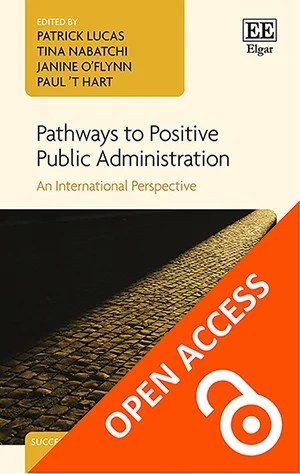
Pathways to Positive Public Administration

An International Perspective

Edited by Patrick Lucas, Tina Nabatchi, Janine O’Flynn, and Paul ’t Hart | 2024

In an era of low trust in government and a pervasive negativity bias, this volume goes against the grain. It examines the foundations, practices and tools of a distinctly positive strand of public administration (PPA).

This book asserts that there is a perennial need for social, evidence-based learning on what to aspire to and what works in public administration. Responding to this need, scholars from five continents present research designed to do just that. Employing an array of frameworks and methods, they present studies of high-performing policies and programs, exploring what makes them tick and what can be learned from their design and delivery. Taken together, the 27 contributions make a powerful case for the added value of PPA as an intellectual and practical endeavour.

Lees verder →

Risico’s in de financiële verhoudingen

Omgaan met onzekerheden

Raad voor het Openbaar Bestuur | april 2026

“De Raad voor het Openbaar Bestuur (ROB) waarschuwt dat financiële risico’s een steeds dominantere rol spelen in het beleid van zowel het Rijk als gemeenten. In een nieuwe essaybundel, uitgebracht voor de Dag van de Financiële Verhoudingen 2026, schetst de ROB hoe deze focus op risico’s de uitvoering van maatschappelijke opgaven in de weg zit.

Maatschappelijke opgaven

Overheden worden betaald met belastinggeld. Dat vraagt dat ze verstandig omgaan met de middelen die hun ter beschikking zijn gesteld. Tegelijk wordt van hen gevraagd maatschappelijke doelstellingen te realiseren, zoals voldoende woningen, uitkeringen voor inwoners die daar recht op hebben, maar ook bijdragen aan de verduurzaming, het natuurbeleid en infrastructuur.

Lees verder →

R-index = 40 voor Kabinetsprogramma ‘Aan de slag’

PRIMO Res Publica | april 2026

PRIMO is gestart met het diagnosticeren van voorliggende bestuurlijke programma’s, bezien vanuit de formule SK x OK x IV = R (Kruf & Redert, 2019). In dit geval is het Coalitieakkoord tussen D66, VVD en CDA: ‘Aan de slag, Bouwen aan een beter Nederland‘ onder de loep genomen door gerichte samenspraak binnen en waardering door ons netwerk.

Dit regeerakkoord krijgt vanuit het netwerk een 4 voor stimulerende kaders, een 2 voor organisatiekracht en een 5 voor investerend vermogen. Dat betekent een R-index van 4 x 2 x 5 = 40. Dat is erg laag. Een score van 350 wordt gezien als minimum voor een goed resultaat. Het gaat hierbij om het regeerakkoord als geheel.

Opvallend is dat het akkoord een gedegen analyse van vigerende trends en ontwikkelingen, een analyse van de eigen sterktes en zwaktes, van mogelijke publieke risico’s als ‘mogelijke schade aan het in dit akkoord gestelde publieke waarden’, een premortem of een scenarioanalyse in het geheel ontbeert.

Lees verder →

Rotterdams politiek-bestuurlijk waardenkader algoritmes 2025

Begeleidend schrijven 14 april 2025, ter achtergrond bij het raadsvoorstel

Gemeente Rotterdam | april 2025

“De technologische ontwikkelingen op het gebied van algoritmen en AI (kunstmatige intelligentie) gaan snel. Om de dienstverlening naar de Rotterdammer te borgen en te verbeteren, maakt de gemeente gebruik van algoritmetoepassingen. De gemeente erkent dat dit risico’s met zich meebrengt. Daarom wordt gewerkt aan de hand van een algoritmegovernance. Deze governance is in 2022 vastgesteld.

Op 13 mei 2024 schrijft de Rekenkamer in het vervolgonderzoek naar algoritmes over de rol van het bestuur: “We hebben het de titel ‘Kleur bekennen’ gegeven, om duidelijk te maken dat ondanks alle verbeteringen die de rekenkamer heeft vastgesteld, er ook nog het nodige moet gebeuren om tot een verantwoorde ontwikkeling en inzet van algoritmes te komen. Het belangrijkste is het besef dat ethische risico’s om politieke afwegingen vragen. Als de politiek de kaders niet stelt, dan moeten ambtenaren afwegen wat goed of fout, eerlijk of oneerlijk, gewenst of ongewenst, acceptabel of een brug te ver is. Dat is niet goed en vormt een (onnodig) risico, zoals de afgelopen jaren is gebleken bij verschillende overheidsorganisaties.”

Lees verder →

Portfolio en

In 2024, the PRIMO Europe board confirmed its portfolio. The portfolio was considered complete and promising for further development. The focus is that products and services should refocus more than ever on establishing public values and helping members become better equipped to be more effective in decision-making. It is the conviction that, based on experiences over the last few years with our roundtables, think tanks, and education, the perspective on risk has shifted towards true delivery, effectiveness, success, and performance.

Our members need models, tools, and techniques that provide genuine insight into matters, challenges, and issues related to public values and deliver effective solutions. The more general path of promoting frameworks or focusing on generic culture change is less favored. For effective navigation in times of high dynamics, a greater focus on systems thinking and resilience is needed. In view of the current positioning and development of risk management within the public domain, the conclusion is drawn that the needs of organisations working in or for the public domain have broadened considerably to include offering quality, safety, security, performance, precaution, continuity and reliability.

Lees verder →