An analysis of current and emerging risks
European Commission Joint Research Centre (JRC) | 2025
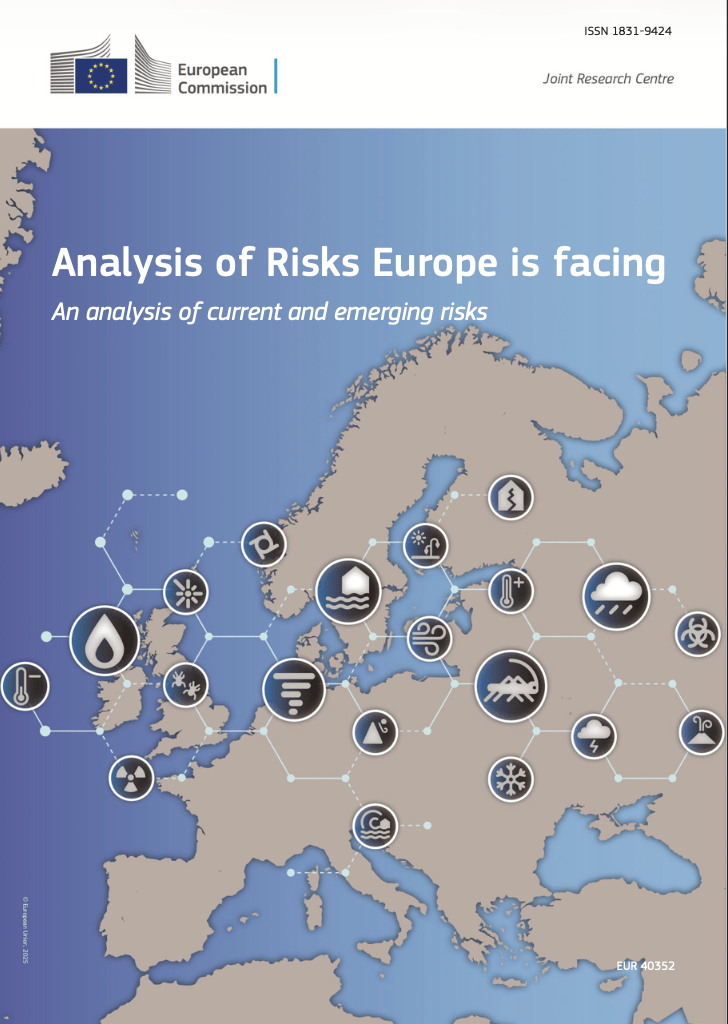
“As Europe stands at the nexus of intensifying global uncertainties, this flagship report on Current and Emerging Risks in Europe marks a critical step in shaping a more prepared and resilient Union. It offers an integrated scientific analysis of 47 diverse risks-from climate-driven disasters and pandemics to cyber threats and geopolitical instability-highlighting the urgent need for cross-sectoral, whole-of-society action.
Our Member States rightly expect the European Union to anticipate risks and threats and protect them from cascading crises through a coordinated and proactive approach to addressing the evolving risk landscape.
From rising temperatures and floods to disinformation campaigns and systemic technological disruptions, the nature of risk has evolved. Risks no longer occur in isolation-they intersect, compound, and ripple through societies and economies with far-reaching consequences. The challenges we face transcend borders demanding a unified, forward-looking response.
That is why the European Commission and the High Representative presented the EU Preparedness Union Strategy. This report provides scientific underpinning that could be used to develop its first key action: a comprehensive EU-level risk and threat assessment. In doing so, it also supports broader policy frameworks, including the Union Civil Protection Mechanism and its Disaster Resilience Goals as well as the European Climate Adaptation Strategy.
The journey towards the publication of the report has benefited from a strong collaborative effort between the Joint Research Centre (JRC) and the Directorate-General for European Civil Protection and Humanitarian Aid Operations (DG ECHO), reflecting the need to closely integrate science and policy to address today’s complex risk landscape. The JRC played a vital role in delivering the science behind this vision. The JRC continues to translate complex data into actionable foresight. Its efforts-reflected in this report-form the analytical backbone of Portfolio 14 of the new JRC Work Programme 2025–2027, which is dedicated to enhancing societal resilience and our collective anticipation and preparedness for systemic risks.
This report demonstrates how better science can lead to and support better governance. It identifies common drivers of risk such as fragile governance, geopolitical tension, and climate change, factors that undermine our ability to respond to emergencies and protect vital societal functions. It makes clear that resilience is not a sectoral issue—it is a shared responsibility that must be embedded across policy, economy, and society. The findings of this report have also informed the development of DG ECHO’s Capacity Progress Report on the Response Capacities of the Union Civil Protection Mechanism, highlighting the importance of a comprehensive and coordinated approach to addressing capacity gaps in civil protection and disaster risk management.
A Fragmented but Rich Risk Landscape

The risk landscape in Europe is well documented, with extensive reporting by both EU institutions and the European Union Member States. The report identifies a fragmented landscape across risk definitions and classification, methodologies, and standards. These heterogeneities pose challenges but also offer an opportunity. The richness and depth of sector-specific knowledge provide a solid foundation for designing a more comprehensive and coherent EU-wide risk assessment framework. Rather
than seeking uniformity, the objective should be to promote interoperability — respecting the diversity of existing approaches while enabling shared analysis and collective action.
As Commissioners for Research, Innovation and Startups, and for Equality, Preparedness and Crisis Management, we believe this report serves not only as a wake-up call, but as a roadmap. It calls on Member States, EU institutions, industry, and civil society to act together, to think systemically, and to prepare collectively. Europe’s strength lies in its unity and its capacity to act with foresight. We count on this report to inform our next steps toward an EU comprehensive risks and threats assessment.
This report presents an analysis of current and emerging risks in Europe, highlighting the need for a proactive and coordinated approach to risk anticipation, risk assessment and risk governance. In response to the increasingly complex and interconnected risk landscape, the European Commission and the High Representative have launched the EU Preparedness Union Strategy. This report aims to support the strategy’s objectives by providing a scientific and evidence-based foundation for policy and operational decisions. It examines 47 risks and explores concepts such as cross-border and emerging risks, as well as High-Impact Low-Probability (HILP) events. The report’s methodology involved a wide-ranging review of EU institutions’ reports, scientific publications, and stakeholder consultations, and provides a multi-faceted perspective on Europe’s risk environment. A EU-wide risk assessment framework is crucial; this report supports its development by fostering a shared understanding of different risks and methodologies to assess them, laying the groundwork for a more comprehensive and integrated multi-hazard risk assessment framework.”
Ekaterina Zaharieva, European Commissioner for Startups, Research and Innovation
Hadja Lahbib, European Commissioner for Crisis Management and Civil Protection
Bibliography
Lentini, A., Eklundo, G., Corbane, C., Asikainen, T., Ronco, M. et al. (2025). Analysis of Risks Europe is facing – An analysis of current and emerging risks. Publications Office of the European Union, Luxembourg. https://data.europa.eu/doi/10.2760/0176850, JRC141673.


Pingback: Canon of PRIMO | PRIMO Res Publica