FORTE™

Framework for Good Governance
PRIMO startte in 2017 te Parijs met de ontwikkeling van een nieuwe aanpak om meer integraal de publieke besturing rondom een maatschappelijk vraagstuk te kunnen analyseren en te ontwerpen. De kern van deze aanpak is erop gericht om de kracht van een door het bestuur en de top van de organisatie geïnitieerde en geleide dialoog in strategische publieke vraagstukken te bevorderen.

Van vragenlijst naar brede aanpak
Wat begon met een simpele uitlijning van een vragenlijst, breidde zich geleidelijk aan uit naar een verdieping op het krachtenveld rondom deze dialoog. Geïnspireerd door de wetenschappelijke benadering van de hoogleraren Jeanne Liedtka (Design Thinking), Mark Moore (Public Value Management ), Ortwin Renn (Public Risk Management), Karl Weick & Kathleen Sutcliffe (High Reliability Organisation) en Peter Young (Risk Leadership), lijkt de eerste aanpak te leiden tot een bredere, die organisaties kan ondersteunen om zich ex ante te verdiepen op de sturingsprincipes en gerichte toepassing ervan bij vraagstukken in de praktijk.

Zoektocht naar indicatoren van goede sturing
Na het testen van de aanpak in de concrete praktijk van de bedrijfsvoering van alledag, ontstond het inzicht dat de aanpak leidde tot echte collectieve samenspraak en gedeelde inzichten met betrekking tot scenario’s, haalbaarheden, kritische succesfactoren en mogelijke afwijkingen (lees: risico’s) op de nagestreefde waarden.

Besloten werd besloten tot een wetenschappelijke aanpak. Deze werd  nodig geacht om het feitelijke fundament van de dialoog – die sinds de oprichting van PRIMO in 2005 is ontstaan op basis van 15 jaar  ervaringen en inzichten van met name gemeentesecretarissen en concerncontrollers in Europa – ook wetenschappelijk te kunnen ‘aantonen’ én te kunnen verbinden met gecertificeerde instrumenten. De zoektocht naar de indicatoren van goede besturing was ingezet.

Lees verder →
SWOT

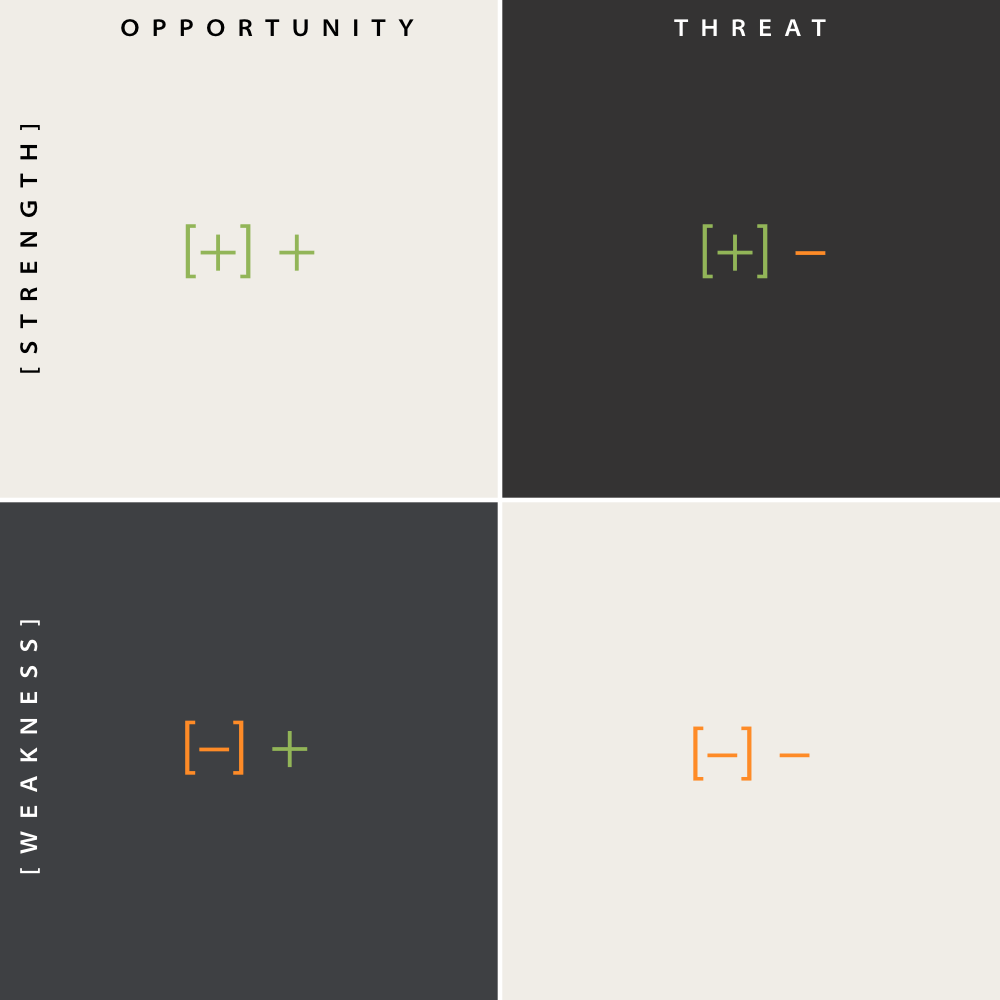
PRIMO encourages this method for preparing decision-making in and for the public domain. It brings two worlds together: the internal world of an organisation, group or community and that of its external world. Internally, there are Strengths and Weaknesses. Externally, there are trends and developments which can emerge for the organisation, group or community as Opportunities or Threats. The method aligns internal capabilities with external autonomous realities.

Strengths (S): Core competencies, unique resources, proprietary technology, strong brand equity, or physical/financial assets that provide a competitive advantage.

Weaknesses (W): Resource gaps, operational inefficiencies, high debt, talent deficiencies, or vulnerabilities that place the organisation, group or community at disadvantage.

Opportunities (O): Favourable macro-environmental trends, emerging market niches, technological shifts, or regulatory changes the organisation, group or community can use to develop or improve its approach, values and governance.

Threats (T): Supply chain disruptions, aggressive competitor moves, cybersecurity issues, unfavourable shifts in consumer behaviour, or economic downturns that endanger stability.

It is the art of cross-examining the quadrants

Strengths + Opportunities: it represents the ideal position for an organisation. It uses its internal core strengths to directly act on external trends and developments which emerge as an opportunity. The key question is how to use the strength to capture the opportunity. To what extent will our strengths enable us to take advantage of opportunities?

Strengths + Threats: This cell focuses on leveraging internal strengths to neutralize, avoid, or defend against external threats or competitive forces. The key question is how to use the strength to minimise the threat. To what extent will our strengths enable us to
defend against threats?

Opportunities + Weaknesses: This cell looks at external market opportunities that the organisation cannot currently exploit due to internal weaknesses. The key question is how to fix or overcome these weaknesses to pursue the opportunity. To what extent will our weaknesses prevent us from taking advantage of opportunities?

Threats + Weaknesses: This is the most critical and vulnerable cell. It identifies scenarios where external threats directly align with internal weaknesses. Strategies here are defensive, focusing on risk mitigation, restructuring, or liquidation. The key question is how to minimise weaknesses and avoid threats. To what extent will our weaknesses prevent us from protecting against threats?

Design Thinking

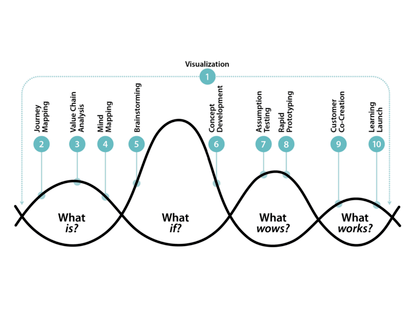
Professor Jeanne Liedtka at the University of Virginia’s Darden School of Business, conceptualises design thinking as ‘social technology’. Rather than treating it merely as a ‘soft skill’ or a creative luxury, her framework presents a structured, human-centred problem-solving process designed to mitigate cognitive biases, reduce corporate risk, and democratise innovation across teams. Her core model simplifies the design thinking process into four central questions and ten essential tools.

Liedtka’s model breaks down the innovation process into four successive stages, detailed in her foundational book Designing for Growth (Liedtka et al., 2011).

  • What is? (Experiencing Reality, to understand the current user ecosystem and identify core problems). This stage focuses entirely on the current state. Teams use empathy and customer context immersion to discover unarticulated, unmet needs rather than starting with company goals. Tools are 1) Visualisation, 2) Journey Mapping, 3) Value Chain Analysis, and 4) Mind Mapping.
  • What if? (Imagining Possibilities, to generate a broad spectrum of creative, hypothesis-driven solutions). This is the divergent ideation phase. Teams shift from data analysis to exploring possibilities, brainstorming new concepts, and imagining alternative futures. Tools are 5) Brainstorming, and 6) Concept Development.
  • What wows? (Choosing Excitement, to isolate the critical assumptions keeping a project risky and test them roughly). This stage bridges the gap between imagination and execution. Teams analyse the generated ideas to identify solutions that hit the sweet spot where customer enthusiasm intersects with organisational capability. Tools are 7) Assumption Testing, and 8) Rapid Prototyping.
  • What works? (Testing in Action, to iterate directly with users via quick, small-scale market experiments). The final stage relies on data-based experimentation. Teams build rapid prototypes and launch small, low-risk tests to gather real-world feedback. Tools are 9) Customer Co-Creation, and 10) Learning Launches.

The book Designing for Growth.

Bibliography

Liedtka, J., & Ogilvie , T. (2011). Designing for Growth: A Design Thinking Tool Kit for Managers. Columbia Business School Publishing

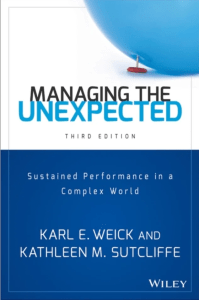
Managing the Unexpected

Assuring High Performance in an Age of Complexity.

Karl E. Weick and Kathleen M. Sutcliffe | August 2015 (original 2001)

Improve your company’s ability to avoid or manage crises! ‘Managing the Unexpected’, Third Edition, is a thoroughly revised text that offers an updated look at the groundbreaking ideas explored in the first and second editions.

Revised to reflect events emblematic of the unique challenges that organisations have faced in recent years, including bank failures, intelligence failures, quality failures, and other organisational misfortunes, often sparked by organisational actions, this critical book focuses on why some organisations are better able to sustain high performance in the face of unanticipated change.

High-reliability organisations (HROs), including commercial aviation, emergency rooms, aircraft carrier flight operations, and firefighting units, are models of exceptional organisational preparedness. This essential text explains the development of unexpected events and guides you in improving your organisation’s reliability. In the original publication (2001), the authors introduced the powerful new concept of ‘Mindfulness’.

They set out the five qualities of the mindful organisation with the organisational skills required (including case studies) to achieve them:

  1. Orientation towards disruptions: consider mistakes as opportunities for improving one’s own operations.
  2. Reluctance to simplify: analyse and evaluate with care and completeness.
  3. Primary focus on execution: focus on delivery of products and services.
  4. Resilience: develop the ability to respond to change, rather than just anticipate or pre-empt it.
  5. Respect for expertise: use relevant knowledge in execution or with customers.

This edition offers updated, valuable content to professionals who want to strengthen their organisations’ preparedness and confidently face unexpected challenges.

Bibliography

Read also Review by Michael J. Novak for Office of Research, IRS.

Premortem

Gary Klein (bron: https://www.gary-klein.com/)

PRIMO heeft een shortlist van methoden en technieken die zij haar leden adviseert inzake het verkrijgen van precisie in besturing en management. Premortem is één van hen. Read in English

Volgens Gary Klein mislukken projecten in een spectaculair tempo. Een van de redenen is dat te veel mensen hun bedenkingen niet willen uiten tijdens de zo belangrijke planningsfase. Door het veilig te maken voor andersdenkenden die goed op de hoogte zijn van de onderneming en zich zorgen maken over de zwakke punten ervan om zich uit te spreken, kun je de kans op succes van een project vergroten.

Gary Klein op zijn eigen website: “Deze methode wordt veel gebruikt in het bedrijfsleven en in managementdomeinen. Een premortem is een oefening die meestal begint nadat een team is geïnformeerd over een plan. De teamleider vraagt zijn of haar team om zich voor te stellen dat het voorgestelde plan is mislukt. Als team draagt iedereen bij aan een oefening waarin potentiële bedreigingen en hindernissen voor het plan worden gegenereerd. Het doel van de PreMortem Method of Risk Assessment is om de slagingskans van het plan te vergroten.”

In feite is premortem een debiasing techniek, goed uitgelegd hier door Daniel Kahneman. 

Bibliografie

Klein, G. (2007). Performing a Project Premortem. Harvard Business Review, September issue.

Gary Klein website: https://www.gary-klein.com/premortem (seen on 2nd of June 2024).

Lees ook

Mitchell, D., Russo, J., & Pennington, N. (1989). Back to the Future: Temporal perspective in the explanation of events. Journal of Behavioral Decision Making, Vol. 2, 25-38