Professor Jeanne Liedtka at the University of Virginia’s Darden School of Business, conceptualises design thinking as ‘social technology’. Rather than treating it merely as a ‘soft skill’ or a creative luxury, her framework presents a structured, human-centred problem-solving process designed to mitigate cognitive biases, reduce corporate risk, and democratise innovation across teams. Her core model simplifies the design thinking process into four central questions and ten essential tools.
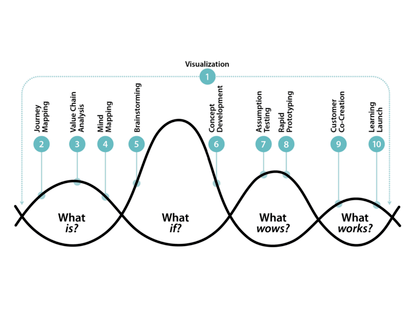
Liedtka’s model breaks down the innovation process into four successive stages, detailed in her foundational book Designing for Growth (Liedtka et al., 2011).
- What is? (Experiencing Reality, to understand the current user ecosystem and identify core problems). This stage focuses entirely on the current state. Teams use empathy and customer context immersion to discover unarticulated, unmet needs rather than starting with company goals. Tools are 1) Visualisation, 2) Journey Mapping, 3) Value Chain Analysis, and 4) Mind Mapping.
- What if? (Imagining Possibilities, to generate a broad spectrum of creative, hypothesis-driven solutions). This is the divergent ideation phase. Teams shift from data analysis to exploring possibilities, brainstorming new concepts, and imagining alternative futures. Tools are 5) Brainstorming, and 6) Concept Development.
- What wows? (Choosing Excitement, to isolate the critical assumptions keeping a project risky and test them roughly). This stage bridges the gap between imagination and execution. Teams analyse the generated ideas to identify solutions that hit the sweet spot where customer enthusiasm intersects with organisational capability. Tools are 7) Assumption Testing, and 8) Rapid Prototyping.
- What works? (Testing in Action, to iterate directly with users via quick, small-scale market experiments). The final stage relies on data-based experimentation. Teams build rapid prototypes and launch small, low-risk tests to gather real-world feedback. Tools are 9) Customer Co-Creation, and 10) Learning Launches.
Bibliography
Liedtka, J., & Ogilvie , T. (2011). Designing for Growth: A Design Thinking Tool Kit for Managers. Columbia Business School Publishing

