To understand what is happening, make sense of the publications (from different sciences and schools), interpret the frameworks and translate the myriad of languages related to public governance of value and risk, it is wise to reduce the dictionary with concepts as are starting points of our organisation and for our members and network.
It serves as a compass in diagnosis, design, and decision-making. These tools are theoretical concepts and practical aids that help to get not lost in translation. Especially the dictionary of risk is a thick one with hundreds of interpretations. Many pretend to be or want to be the standard.
Geert Haisma, Robert ’t Hart en Jack Kruf * | april 2007
Den Haag, Parkhotel, 13 april 2007. Dit essay bespreekt de uitkomsten van de ronde tafel georganiseerd om te spreken – vanuit gemeentelijk perspectief – over de uitvoerbaarheid van het nieuwe regeerakkoord Samen Werken, Samen Leven. Immers in dit akkoord wordt ‘de gemeente’ 49 keer genoemd.
Den Haag, Parkhotel,
Tijdens de ronde tafel is er door een vijftiental gemeentesecretarissen, VNG-directeur Ralph Pans en VGS-voorzitter Piet Buijtels onder leiding van Yourie Albrecht openlijk gediscussieerd. De algemene bevinding van de bijeenkomst is dat, bij de huidige wettelijke en financiële afspraken tussen kabinet en gemeenten, circa een kwart van de voornemens niet en een kwart moeilijk uitvoerbaar is.
What can the world of public governance learn from archery? Archery is a mature sport that has developed dramatically since its inception. Because of this, the sport itself has undergone many changes and improvements.
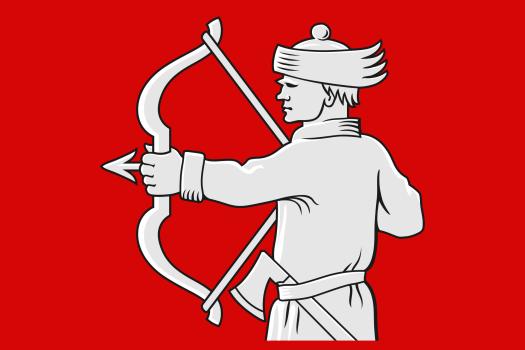
De Lieksa-vlag (Lieksa lippu) is de officiële vlag van de Finse stad Lieksa (bron: Wikipedia)
In governance and public administration, we may learn from the archery world to select and curate the basic skills perceived as essential by professional archers. After all, governance is a form of archery, metaphorically spoken.
There are parallels: a good governor has the skills of a good archer in effectively reaching the target. After all, both professions are about precision. Here, we focus on the archer. I collected some skills from the archery world. I leave it to the reader to find similarities with the governance world.
A summary of skills
Archery is a broad set of fundamental skills necessary to be an experienced archer. Among the skills and abilities archers need are mental strength, aerobic endurance, balance and coordination, reaction time, motivation & self-confidence, skill/technique, agility, flexibility, strength & power.
The most obvious is the need for a high level of upper body strength and flexibility. An archer needs to be able to shoot arrows accurately and repeat that action without suffering fatigue. We elaborate on some of the skills.
Anyone who watches the television news has seen images of firefighters rescuing people from burning buildings and paramedics treating bombing victims. How do these individuals make the split-second decisions that save lives? Most studies of decision-making based on artificial tasks assigned in laboratory settings view people as biased and unskilled.
Gary Klein is one of the developers of the naturalistic decision-making approach, which views people as inherently skilled and experienced. It documents human strengths and capabilities that have been downplayed or ignored so far.
Besturen met akkoorden is in deze tijd van politieke versnippering en complexe vraagstukken een onmisbaar instrument. Het is niet mogelijk effectief beleid te maken dat kan rekenen op draagvlak zonder akkoorden te sluiten met maatschappelijke organisaties, bedrijven en burgers. Dat stelt de Raad voor het Openbaar Bestuur in het adviesrapport Akkoord?! Besturen met akkoorden als evenwichtskunst.
In het advies heeft de Raad voor het Openbaar Bestuur het proces van een aantal akkoorden geanalyseerd en tien aanbevelingen geformuleerd om dit proces te optimaliseren.
According to Klein (2007), “Projects fail at a spectacular rate. One reason is that too many people are reluctant to speak up about their reservations during the all-important planning phase. By making it safe for dissenters who are knowledgeable about the undertaking and worried about its weaknesses to speak up, you can improve a project’s chances of success.”
The Harvard Business Review article: “In a premortem, team members assume that the project they are planning has just failed—as so many do—and then generate plausible reasons for its demise. Those with reservations may speak freely at the outset, so that the project can be improved rather than autopsied.”
Deborah J. Mitchell, J. Edward Russo, Nancy Pennington | March 1989
Prospective hindsight involves generating an explanation for a future event as if it had already happened; i.e., one goes forward in time, and then looks back. This research found that “imagining that an event has already occurred, increases the ability to correctly identify reasons for future outcomes by 30%” (Klein, 2007)
In order to examine how shifts in perspective might influence people’s perceptions of events, we investigated two possible factors: temporal perspective (whether an event is set in the future or past) and uncertainty (whether the event’s occurrence is certain or uncertain).