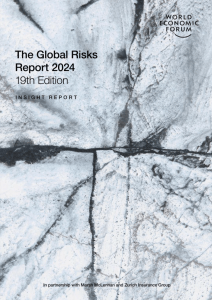
Global Risks Report 2024

World Economic Forum, in partnership with Marsh McLennan and Zurich Insurance Group | January 2024

The Global Risks Report explores some of the most severe risks we may face over the next decade against rapid technological change, economic uncertainty, a warming planet and conflict. As cooperation comes under pressure, weakened economies and societies may only require the smallest shock to overcome the tipping point of resilience.

• Het Global Risks Report verkent een aantal van de grootste risico’s waarmee we de komende tien jaar geconfronteerd kunnen worden: snelle technologische veranderingen, economische onzekerheid, een opwarmende planeet en conflicten. Terwijl samenwerking onder druk komt te staan, hebben verzwakte economieën en samenlevingen misschien maar de kleinste schok nodig om het omslagpunt van veerkracht te overwinnen. 
The report summarises a mix of trends and developments that can possibly influence the quality of life for citizens, society and natural ecosystems. These will impact local communities and deserve a place in the orientation and diagnosis.

• Het rapport geeft een overzicht van een mix van trends en ontwikkelingen die mogelijk van invloed zijn op de kwaliteit van leven voor burgers, de samenleving en natuurlijke ecosystemen. Deze zullen van invloed zijn op lokale gemeenschappen en verdienen een plaats in de oriëntatie en diagnose.
Lees verder →

Nørby Committee’s Report

Copenhagen Stock Exchange | 2001

Following the release of the Cadbury Report in 1992, Denmark formulated their recommendations for good corporate governance. In 2001 The Nørby Committee’s Report on Corporate Governance in Denmark was published.

“Over the past 15-20 years, the international arena has witnessed a significant public debate about which major principles should be employed to govern companies. The general term for these principles is corporate governance, a concept that is difficult to translate into Danish. In our opinion the concept can be defined as:

“The goals, according to which a company is managed, and the major principles and frameworks which regulate the interaction between the company’s managerial bodies, the owners as well as other parties, who are directly influenced by the company’s dispositions and business (in this context jointly referred to as the company’s stakeholders). Stakeholders include employees, creditors, suppliers, customers and the local community.””

Lees verder →

The UK Government Resilience Framework

HM Government, Cabinet Office | 2022

The professionalism and commitment of the people who contribute to the UK’s resilience is extraordinary, and we have a well-established framework for civil protection in the UK. But the last few years have exposed the need to build on these solid foundations and strengthen our resilience to prevent, mitigate, respond to and recover from the nation’s risks.

That is why the UK Government committed, in the Integrated Review, to a new Resilience Strategy: The UK Government Resilience Framework (pdf) or online.

Lees verder →

Publiek management op de grens van chaos en orde

Over leidinggeven en organisateren in complexiteit

Geert Teisman | 2005, Boom

Moderne, complexe samenlevingen balanceren op de grens van chaos en orde. Er is behoefte aan orde, maar tegelijkertijd bestaat er weerstand tegen een overdosis aan regels en wetten. Er is behoefte aan innovatie, maar ook angst voor ongewenste ontwikkelingen. De leidinggevende in de complexe samenleving die orde nastreeft, loopt het risico een verstard systeem te creëren. De leidinggevende die slechts oog heeft voor ontwikkeling en innovatie, zorgt mogelijk voor vluchtige oplossingen.

‘Publiek management op de grens van chaos’ en orde onderscheidt deze twee typen leidinggevenden, kort gezegd de ordezoeker en de ontwikkelaar en laat vervolgens zien hoe ze zich tot elkaar verhouden. Aan de hand van voorbeelden uit de praktijk wordt duidelijk dat complexe samenlevingen vragen om een evenwichtige combinatie van en interactie tussen beide vormen van leiderschap.

Dit boek is geschreven voor professionals die de publieke zaak zijn toegedaan en de hedendaagse complexiteit beter willen begrijpen en managen.

Bibliografie

Teisman, G. (2005). Publiek management op de grens van chaos en orde: Over leidinggeven en organisateren in complexiteit. Schiedam: Boom.

The Big Beautiful Municipality?

Harrie Scholtens* | 2013

Times are changing. This will happen in every society and has to be recognised. However difficult it is to say goodbye to the past, we must realise that the past is behind us. Of course, we have to learn from it, but we must also look forward and prepare society for the constantly changing future. Of course, this also happens in governmental structures—slowly, but it does happen.

Harrie Scholtens

The responsibilities of the governmental levels will change throughout the years as a result of changes in society, the needs and questions of inhabitants, new technologies, et cetera. All of these changes, therefore, require more expertise from governmental organisations: expertise which can be found in cooperation, but also, for instance, in the merging of municipalities and their organisations of civil servants. Larger organisations will offer more opportunities for civil servants to invest in their knowledge and skills. These aspects, including the talents of the other category of civil servants, are needed to handle the changes in these larger organisations.

Lees verder →

Third-Party Risk Policies in The Netherlands

A Historical Sketch 

Ben Ale | April 2023, Cambridge Scholars Publishing

It is not easy to keep the population safe in a country that is one of the most densely populated in the world, a hub of international transport over land and water and through the air, about one-third of which lies below sea level.

.

Third-party risk policies developed gradually in The Netherlands but became acute in the late 20th century as various industries increased their use and production of hazardous materials.

The Dutch government, considering its constitutional responsibility to protect the life, health and well-being of its people, must resolve the ongoing debate between the general population, who are exposed to these risks, and those profiting from the creation of said risks-the resultant policies are a product of this balancing act.

Lees verder →

Publieke waarden en risico’s in Straatsburg

De geboorte van een organisatie voor publiek risicomanagement (PRIMO)

Jack Kruf* | mei 2005

Vorige maand, op 1 april 2005, kwam het Executive Committee van UDITE, het netwerk van gemeentesecretarissen en gemeentelijk algemeen directeuren in Europa, bijeen in Straatsburg om ‘publiek risicomanagement’ als nieuw idee te bespreken. De gemeentesecretarissen keken gezamenlijk naar een nieuw gepresenteerde aanpak, die Alan Vendelbo, president van UDITE, bovenaan de agenda had geplaatst.

Het was vanaf het begin van de bijeenkomst duidelijk dat allen geloofden dat de benadering de rol en functie van de gemeentesecretaris zeer  versterken in het ondersteunen van de politiek, de maatschappij en de eigen organisatie. Actuele gebeurtenissen in de samenleving en het uit het niet in control zijn op budgetten en processen binnen tal van politiek-bestuurlijke projecten hebben het belang van proactief denken over publieke waarden, doelen en hun risico’s verhoogd. Hier volgt een korte persoonlijke impressie. Ik was erbij op deze dag.

Lees verder →