Emerging Systemic Risks in the 21st Century

The Organisation for Economic Co-operation and Development (OECD) | 2003

What is new about major risks in the 21st century? Recent years have witnessed a host of large-scale disasters of various kinds throughout the world: hugely damaging windstorms and flooding in Europe and ice storms in Canada; new diseases infecting both humans (AIDS, the Ebola virus) and animals (BSE); terrorist attacks such as those of 11 September 2001 in the United States and the Sarin gas attack in Japan; major disruptions to critical infrastructures caused by computer viruses or simply technical failure.

These are just some of the extremely costly disasters that have struck over the past few years. And yet, it is not just the nature of major risks that seems to be changing, but also the context within which they appear and society’s capacity to manage them. The forces shaping these changes are many and varied. For example, weather conditions appear to be becoming increasingly extreme.

Lees verder →

Thinking, Fast and Slow

Daniel Kahneman | 2013

In this fascinating treatise by a giant in the field of decision research, the mind is a hilariously muddled compromise between incompatible modes of thought.

Psychologist Kahneman positions a brain governed by two clashing decision-making processes. The largely unconscious System 1, he contends, makes intuitive snap judgments based on emotion, memory, and hard-wired rules of thumb and the painfully conscious System 2 laboriously checks the facts and does the math but is so “lazy” and distractible that it usually defers to System 1.

Kahneman uses this scheme to frame a scintillating discussion of his findings in cognitive psychology and behavioural economics and of the ingenious experiments that tease out the irrational, self-contradictory logics that underlie our choices.

All the factors described play a direct and indirect role in public governance. All public leaders and managers should be aware of the thoroughly described systems of our brains and behaviour. They make things clear and understandable. The book is an epiphany.

Bibliography

Kahneman, D. (2013) Thinking, Fast and Slow. New York: Farrar, Straus and Giroux

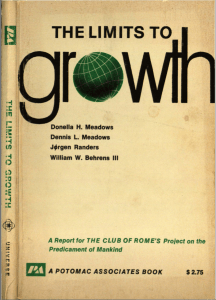
The Limits to Growth

Club of Rome | 1972

In March 1972, a report by a group of young scientists at the Massachusetts Institute of Technology (MIT) commissioned by Aurelio Peccei, founder of The Club of Rome, shook the world. The report excels in system thinking and modelling and in that it is more actual than ever.

Today, 50 years after its publication, “The Limits to Growth” is considered one of the most important and controversial environmental books of all time and it continues to influence conversations around sustainability and our continued existence on this finite planet. Below is the story behind this ground-breaking publication.

Published 1972 – The message of this book still holds today: The earth’s interlocking resources – the global system of nature in which we all live – probably cannot support present economic and population growth rates much beyond the year 2100, if that long, even with advanced technology. In the summer of 1970, an international team of researchers at the Massachusetts Institute of Technology began a study of the implications of continued worldwide growth.

They examined the five basic factors that determine and, in their interactions, ultimately limit growth on this planet-population increase, agricultural production, nonrenewable resource depletion, industrial output, and pollution generation. The MIT team fed data on these five factors into a global computer model. Then it tested the model’s behaviour under several sets of assumptions to determine alternative patterns for mankind’s future. The Limits to Growth is the nontechnical report of their findings.

The book also contains a message of hope: Man can create a society in which he can live indefinitely on earth if he imposes limits on himself and his production of material goods to achieve a state of global equilibrium with population and production in carefully selected balance.


The Limits to Growth, 1972 – key messages:

    • With existing policies, the physical limits to growth would likely be exceeded within one generation.
    • The most likely outcome of reaching these limits would be overshooting them, followed by systems decline.
    • The findings, however, also suggested a viable alternative to these outcomes – one in which population growth and material production could be brought into balance with planetary limits.
    • The fourth conclusion was that it would realistically take 50 to 100 years, or even more, to make this alternative outcome a reality.
    • Finally, the team found that every year action is delayed toward reaching the alternative outcome, decreasing the number of options available to avoid overshoot and collapse.

Bibliography

Meadows, D. H., Meadows, D. L., Randers, J. & Behrens, W. W. (1972). The limits to growth: A report for the Club of Rome’s project on the predicament of mankind. New York: Universe Books.

Limits to Growth (digital scan version, source: https://donellameadows.org)

Short History
Brundtland Report

United Nations | April 1987

The first explicit common reference to sustainable development was in the 1987 Brundtland Report Our Common Future of the United Nations Commission on Environment and Development.

In this report, sustainable development was defined as: “development that meets the needs of the present without compromising the ability of future generations to meet their own needs”. In 1987 the need for cooperating on this was high.

Lees verder →

Millennium Development Goals

United Nations | 2000

One way to improve global governance of society and nature’s public domain is to work on governance codes. Another is to pursue goals on global public policy issues. The United Nations set the Millennium Development Goals (MDGs) in 2000.

In September 2000, building upon a decade of major United Nations conferences and summits, world leaders came together at United Nations Headquarters in New York to adopt the United Nations Millennium Declaration.

They committed their nations to a new global partnership to reduce extreme poverty and set out a series of time-bound targets – with a deadline of 2015. They were the first attempt to formulate global targets and are the predecessors of the Sustainable Development Goals SDGs. 

Download Millennium Declaration.