Judgment under Uncertainty: Heuristics and Biases

Biases in judgments reveal some heuristics of thinking under uncertainty

Amos Tversky and Daniel Kahneman | 1974

This article described three heuristics that are employed in making judgments under uncertainty: (i) representativeness, which is usually employed when people are asked to judge the probability that an object or event A belongs to class or process B; (ii) availability of instances or scenarios, which is often employed when people are asked to assess the frequency of a class or the plausibility of a particular development; and (iii) adjustment from an anchor, which is usually employed in numerical prediction when a relevant value is available.

These heuristics are highly economical and usually effective, but they lead to systematic and predictable errors. A better understanding of these heuristics and the biases they lead to could improve judgments and decisions in situations of uncertainty.

Lees verder

Rethinking Public Governance

Jacob Torfing* | 2023, Edward Elgar Publishing

In this innovative book, Jacob Torfing, a leading scholar, critically evaluates emerging ideas, practices and institutions, transforming how public governance is perceived, theorised and conducted in practice.

A novel rethinking of how current societies are governed, this book will inspire students, scholars and practitioners of political science, public policy, regulation and governance, and public administration management to reconsider how public governance and administration may be organised in the future to present innovative solutions to societal problems.

Identifying cutting-edge developments in public governance, this incisive book analyses new forms of political leadership, public management, public organisation, administrative steering, cross-boundary collaboration, public regulation and societal problem-solving. Examining some of the most significant instances of public governance transformation, chapters explore the effects of transformations from sovereign to interactive political leadership, from national to multi-level governance, and from hard to soft power.

Lees verder

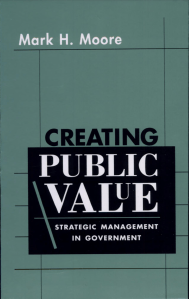
Creating Public Value

Strategic management in government

Mark H. Moore | 1995

Public Value is a theory for public management advanced by Professor Mark Moore of the Harvard Kennedy School. Over the previous two decades, staff and students at Harvard’s Kennedy School of Government, where Moore taught, engaged in conversations about producing excellence in public management.

“Public value refers to the value created by the government through laws, regulations, services and any other action. In a democratic society, this value is defined by the public themselves. Value is determined by citizens preferences expressed in a variety of ways and thus it provides a rough yard stick against which to gauge the public institutions and government policies.”

A seminal figure in the field of public management, Mark Moore presents his summation of 15 years of research, observation, and teaching on what public-sector executives should do to improve the performance of public enterprises.

Lees verder

Prospect Theory

An analysis of decision under risk

Daniel Kahneman and Amos Tversky | 1979

This paper presents a critique of expected utility theory as a descriptive model of decision making under risk, and develops an alternative model, called prospect theory.

Choices among risky prospects exhibit several pervasive effects that are inconsistent with the basic tenets of utility theory. In particular, people underweight outcomes that are merely probable in comparison with outcomes that are obtained with certainty. This tendency, called the certainty effect, contributes to risk aversion in choices involving sure gains and to risk seeking in choices involving sure losses.

In addition, people generally discard components that are shared by all prospects under consideration. This tendency, called the isolation effect, leads to inconsistent preferences when the same choice is presented in different forms.

An alternative theory of choice is developed, in which value is assigned to gains and losses rather than to final assets and in which probabilities are replaced by decision weights.

The value function is normally concave for gains, commonly convex for losses, and is generally steeper for losses than for gains.

Decision weights are generally lower than the corresponding probabilities, except in the range of low probabilities. Overweighting of low probabilities may contribute to the attractiveness of both insurance and gambling.

Bibliography

Kahneman, D. and Tversky, A. (1979) ‘Prospect Theory: An Analysis of Decision Under Risk’. Econometrica, 47, 263-291.

Download essay.

Maatschappelijke bestuurskunde

Hoe verbindende bestuurskundigen (kunnen) inspelen op maatschappelijke vraagstukken

Tom Overmans, Marlies Honingh & Mirko Noordegraaf  (red.) | Boombestuurskunde.

Het vakgebied bestuurskunde heeft zich de afgelopen jaren bewezen. Via opleidings- en onderzoeksprogramma’s, academische netwerken, internationale verbanden, publicaties, symposia en prijzen wordt gewerkt aan de versterking van het openbaar bestuur. Door de jaren heen is het bereik van bestuurskundigen gegroeid. De bestuurskunde draait niet enkel om de overheid, maar richt zich tevens op maatschappelijke dienstverlening, publiek-private samenwerking, coproductie van beleid en diensten en publieke waardecreatie. De laatste tijd werken bestuurskundigen bovendien aan maatschappelijke impact.

Deze bundel gaat een stap verder. De auteurs laten zien dat het tijd is voor een meer ‘maatschappelijke’ bestuurskunde, die zich nadrukkelijker en zichtbaarder richt op de analyse en aanpak van maatschappelijke vraagstukken. Dat is meer dan ‘maatschappelijke impact maken’. Dat is je verbinden aan andere academische disciplines en maatschappelijke velden, waarin de aanpak van concrete issues centraal staat. Denk aan klimaatadaptatie, duurzame landbouw, energietransitie, migratie, wonen, kansengelijkheid, georganiseerde misdaad, houdbare zorg en digitalisering.

Lees verder

Myopic Voters and Natural Disaster Policy

Andrew Healy, Loyola Marymount University, and Neil Malhotra, Stanford University | 2009

In our democratic system, citizens vote for their representative politicians, elected councils, public leaders, governors, and governing councils. But what about citizens’ perceptions of how risks are handled by their leaders, and what about citizens’ appreciation of proactive thinking by councillors related to public risks when it comes to voting?

Quote: “Do voters effectively hold elected officials accountable for policy decisions? Using data on natural disasters, government spending, and election returns, we show that voters reward the incumbent presidential party for delivering disaster relief spending, not investing in disaster preparedness spending. These inconsistencies distort the incentives of public officials, leading the government to underinvest in disaster preparedness, thereby causing substantial public welfare losses.”

“We estimate that $1 spent on preparedness is worth about $15 in terms of the future damage it mitigates.”

“By estimating both the determinants of policy decisions and the consequences of those policies, we provide more complete evidence about citizen competence and government accountability.”

Bibliography

Healy, A. and Malhotra, N. (2009) Myopic Voters and Natural Disaster Policy. American Political Science Review: Vol. 103, No. 3 August

Download the scientific article

Thinking in Systems

Donella Meadows, Diana Wright (ed.) | 2008

In the years following her role as the lead author of the International bestseller Limits to Growth – the first book to show the consequences of unchecked growth on a finite planet – Donella Meadows remained a pioneer of environmental and social analysis until her untimely death in 2001.

"So, what is a system? A system is a set of things—people, cells, molecules, or whatever—interconnected in such a way that they produce their own pattern of behavior over time. The system may be buffeted, constricted, triggered, or driven by outside forces. But the system’s response to these forces is characteristic of itself, and that response is seldom simple in the real world."

- Donella Meadows (2008)

Thinking in Systems is a concise and crucial book offering insight into problem-solving from personal to global scales. Edited by the Sustainability Institutes Diana Wright, this essential primer brings systems thinking out of the realm of computers and equations and into the tangible world, showing readers how to develop the systems-thinking skills that thought leaders across the globe consider critical for 21st-century life.

Some of the biggest problems facing the world, including war, hunger, poverty, and environmental degradation, are system failures. They cannot be solved by fixing one piece in isolation from the others because even seemingly minor details have enormous power to undermine the best efforts of too-narrow thinking. While readers will learn the conceptual tools and systems thinking methods, the book’s heart is grander than the methodology.

"Managers are not confronted with problems that are independent of each other, but with dynamic situations that consist of complex systems of changing problems that interact with each other. I call such situations messes. . . . Managers do not solve problems, they manage messes."

- Russel L. Ackoff (1979)

Donella Meadows was known as much for nurturing positive outcomes as she was for delving into the science behind global dilemmas. She reminds readers to pay attention to what is important, not just what is quantifiable, to stay humble, and to stay a learner. In a world growing ever more complicated, crowded, and interdependent, Thinking in Systems helps readers avoid confusion and helplessness, the first step toward finding proactive and effective solutions.

Bibliography

Ackoff, R. (1979) ‘The Future of Operational Research Is Past’. Journal of the Operational Research Society 30, no. 2: 93–104.

Meadows, D. (Wright, D. ed) (2008) Thinking in Systems. Vermont, US: Chelsea Green Publishing Co.