On the alignment of content and governance
Michel Klompmaker | 2018
During the Local Government Risk Conference on 17 January 2018 at the Provincial Government Building in Utrecht, a group of experts discussed the key aspects of governance and control as they relate to municipal organisations.
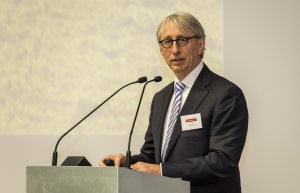
In his keynote, Jack Kruf advocated for a much stronger link between policy content and policy direction. Given the multitude of interests and stakeholders, the segmentation of expertise and levels of government, as well as the fragmentation of knowledge surrounding issues, he believes that local authorities would be wise to take more time for an ex ante governance clause.
What council would not want its programme to be implemented optimally and effectively? According to him, this does, however, require genuine dialogue and engagement with all stakeholders at the outset. So not just more programme adoptions that focus purely on content, but also explicitly highlight their governance.
Governance in itself – in programmes and agreements by councils and executive bodies – therefore demands our full attention. The quality of public governance has become part of the quality of the public sphere and, consequently, of the public debate. We can no longer avoid explicitly addressing and embedding governance ex ante.
According to Kruf, this governance section is much more than the current ‘risk management and resilience’ section. The latter merely lifts a corner of the veil, and even then only in financial terms. Not unimportant, but resilience is no longer exclusive; it is often purely financially focused, written from a defensive and safeguarding perspective, and does not really address other relevant governance variables, relationships, and connections that play a role in the genuine administration and management of the city, its innovation, and development.
Resilience is good, but not inspiring enough and, moreover, technically wholly inadequate to enable us to discover and dare to explore new paths and set out on them. He quotes a councillor and a mayor from the network:
“Resilience is a theoretical exercise that paints a false picture of reality. I’ve never understood it. More than once, it has served as a smokescreen under which a project was sold.” – Councillor.
“Resilience serves to enable the council to account for its actions in broad terms, rather than to steer them. In practice, other forces – including political ones – determine whether a project is or should be feasible.” – Mayor.
According to Kruf, the new, much broader governance section should describe and (administratively) set out how the council’s programme itself can be steered and managed, and what specific roles the council, the executive committee, and the civil service organisation play in this, alongside social actors and institutions. The section should highlight all elements of governance necessary for performance, results and success. According to him, there are five elements that must be present simultaneously for this to be effective. These are:
- Sound financial design and compliance, going hand in hand and, above all, realistic.
- A focus by the administration and senior management on the target group (the citizen, the neighbourhood, the young person), on the objective and on the actual delivery of products and services.
- Public leadership and stewardship that connects and stands up for its cause.
- Tools and organisational capacity to bring plans to fruition.
- Focus on the environment: horizontally towards fellow local authorities, market parties and relevant interest groups; vertically towards higher-level authorities, towards sections of society and towards the natural environment and its carrying capacity.
When launching a new programme, a municipal executive could ask its municipal secretary and group controller to draw up a proposal for this governance section. As leading experts in command and control, they are ideally placed to advise the executive on this matter. Indeed, they may be better suited to do so, as they understand the entire landscape. In this section, the five points mentioned above are linked to the executive’s programme.
It goes without saying that governance itself also requires investment. The world is changing, as are the players, and so too must governance. Sometimes this involves the appropriate structuring of a project, process or programme, but it may also concern the development of new roles, thinking in terms of new scenarios, the reorganisation of organisational units, entering into different forms of collaboration or contractual arrangements, or communicating differently with citizens and businesses. Governance itself must then also be budgeted for, regarded as a critical success factor, and embedded. Quality governance costs money, but it also delivers greater returns and can no longer be regarded as merely an afterthought to the substance.
The governance section is, in anticipation of the council’s own in-control statement to be issued in the near future, actually a logical concept. Governance itself thus becomes a fully-fledged factor within the political and administrative sphere. Something that was sorely needed, however contradictory this may sound. Governance too often appears to be a stepchild, resulting in significant public risks.
Kruf cites several examples in his argument. He also quotes from the World Economic Forum’s Global Risks Report 2018, published on the same day. The governance section could broaden the basis for lawful action, both administratively and within the civil service. After all, every euro of taxpayers’ money must be handled with care. And good governance helps with that, he is convinced.
In Kruf’s view, a council programme with a sound and widely supported governance section serves as an inspiration for the success not only of the municipality as an organisation, its executive or council, but also of the municipality as a community of citizens, businesses and institutions, as well as the municipality as a geographical area. In his view, ‘control’ will take on a much more proactive role than it currently does. The reactive role is ‘out’, the proactive role is ‘in’. Control should be able and allowed to play that role. In the coming years, the field of control could evolve into that of governance architecture.
This calls for a new mindset among managers, namely the willingness to bring this knowledge to the forefront of the process. That is not the case at present. Utilising the knowledge, insights, expertise, and skills of (group) controllers and managing directors may well be essential for developing the necessary management capacity. The link between substance and integrated business management, in other words. More, therefore, than just finance and compliance. This is not only challenging but, in fact, calls for a broad reassessment of the expertise of both command and control.
The world has entered a new dynamic. And we know – as Herman Gorter opened his 1889 book ‘Mei’: “A new spring and a new sound…”. In this new spring, substance and governance must be much better linked. The integrated governance section can help with this.
Bibliography
Klompmaker, M. (2018, 25 januari). Integrale Besturingsparagraaf. Risk Compliance Platform Europe. Geraadpleegd op 17 december 2024, van https://www.riskcompliance.nl/news/integrale-besturingsparagraaf/
Kruf, J. (2018). PRIMO bepleit Besturingsparagraaf: Van weerstandsparagraaf naar corporate sturing. In J.P. Kruf & E.J. Frank. Publiek Risico: Essays, Stichting Civitas Naturalis, 2020, pp. 708–713.




 PRIMO Res Publica