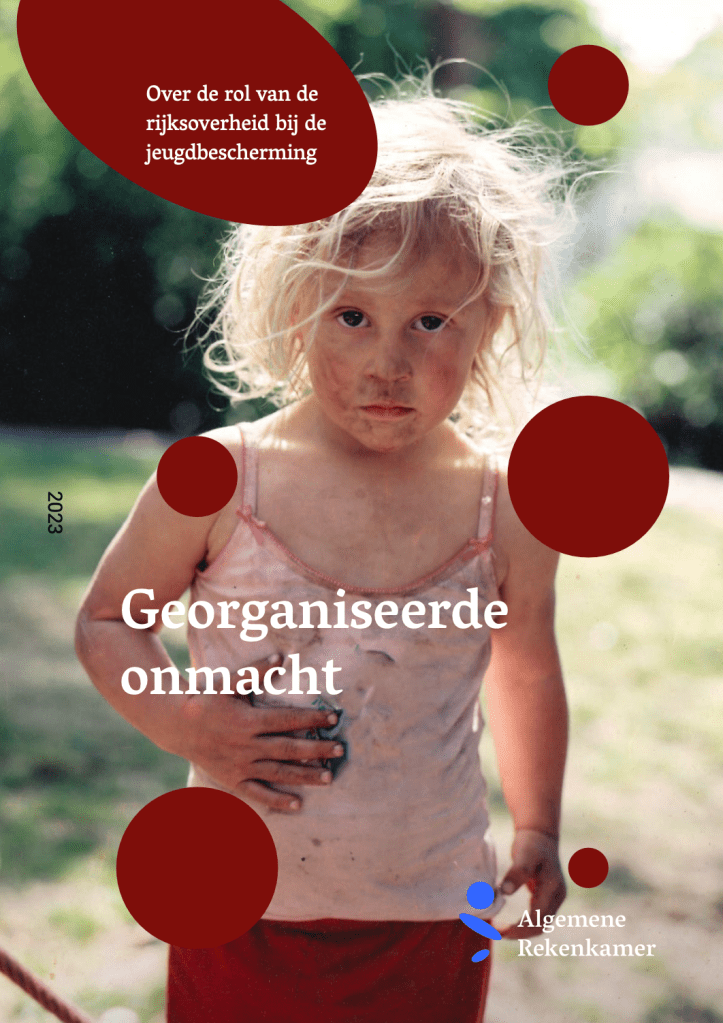
Georganiseerde onmacht

Over de rol van de rijksoverheid bij de jeugdbescherming

Algemene Rekenkamer | 2023

In 2015 is de verantwoordelijkheid voor jeugdbescherming overgeheveld naar gemeenten. Hiermee zouden de totale uitgaven aan jeugdzorg dalen, de wachttijden korter worden en de administratieve last voor hulpverleners afnemen. Dat is niet gelukt. Kinderen en kwetsbare gezinnen krijgen niet (tijdig) de hulp die ze nodig hebben. Verantwoordelijke bewindspersonen (de minister voor Rechtsbescherming en de staatssecretaris van Volksgezondheid, Welzijn en Sport) hebben hun rol als verantwoordelijke voor het wettelijke stelsel voor jeugdbescherming lange tijd onvoldoende ingevuld. Dit concludeert de Algemene Rekenkamer in het rapport Georganiseerde Onmacht.

Sinds de invoering van de Jeugdwet in 2015 moeten gemeenten de jeugdbescherming lokaal organiseren. Het idee van de minister en de staatssecretaris was dat gemeenten dichter bij kind en gezin staan en dus meer maatwerk kunnen leveren. In de praktijk leidt dit tot een onoverzichtelijke en onwerkbare situatie voor gemeenteambtenaren én hulpverleners.

Lees verder

Toezien op publieke belangen

Naar een verruimd perspectief of rijkstoezicht

Wetenschappelijke Raad voor het Regeringsbeleid (WRR) | 2013

Tot ongeveer twintig jaar geleden was toezicht een weinig spectaculair en nauwelijks zichtbaar onderdeel van het openbaar bestuur. Toezicht was vooral een zaak van individuele inspecteurs die doorgaans buiten het zicht van de openbaarheid op een vaak informele wijze hun toezichtdomein trachtten te disciplineren. Maar die tijd is voorbij. Door de voortgaande verschuiving en spreiding van taken en verantwoordelijkheden en door toenemende verwachtingen van het toezicht in de samenleving, zijn het belang en de zichtbaarheid van toezicht enorm gegroeid. Na een incident zijn in de media en de politiek dikwijls de eerste vragen: waar was het toezicht? Waarom heeft het toezicht niet of niet eerder ingegrepen?

De vele uitdagingen waarmee het toezicht geconfronteerd wordt en de nogal eens problematische relatie tussen samenleving en toezicht waren voor de WRR aanleiding tot een nadere beschouwing. Centraal stond daarbij de vraag:

Hoe treedt de overheid in beleid en praktijk de uitdagingen die op het rijkstoezicht afkomen tegemoet en hoe kan de maatschappelijke meerwaarde van dat toezicht worden bevorderd?

Overheidstoezicht vervult in allerlei vormen en gedaanten een belangrijke rol bij het verwezenlijken van beleidsdoelstellingen en het borgen van publieke belangen; het is een steunbeer van de samenleving, een ‘basisinstitutie’ die ertoe doet.

Lees verder

Environmental Protection Agency (EPA)

US Government | December 1970

This organisation was founded as an independent executive agency of the United States federal government tasked with environmental protection matters. Beginning in the late 1950s and through the 1960s, US Congress reacted to increasing public concern about the impact that human activity could have on the environment.

Logo by Chermayeff & Geismar Associates

In 1959 congress passed the Resources and Conservation Act to establish a Council on Environmental Quality in the Executive Office of the President and declared a national environmental policy, which required the preparation of an annual environmental report. The groundwork for the Environment Protection Agency was laid.

Lees verder

Silent Spring

Rachel Carson | 1962

This sensational book, Silent Spring (1962) by Rachel Carson, warned of the dangers to all natural systems from the misuse of chemical pesticides such as DDT, and questioned the scope and direction of modern science, initiating the contemporary environmental movement.

Silent Spring began with a “fable for tomorrow” – a true story using a composite of examples drawn from many real communities where the use of DDT had caused damage to wildlife, birds, bees, agricultural animals, domestic pets, and even humans. Carson used it as an introduction to a very scientifically complicated and already controversial subject. This “fable” made an indelible impression on readers and was used by critics to accuse Carson of being a fiction writer rather than a scientist.

Lees verder

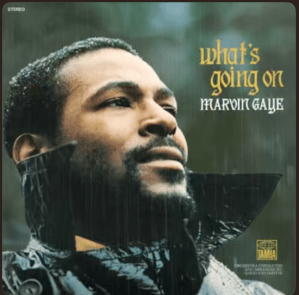
Mercy Mercy Me (The Ecology)

Marvin Gaye | 1971

Woah, ah, mercy, mercy me
Ah, things ain’t what they used to be (ain’t what they used to be)
Where did all the blue skies go?
Poison is the wind that blows
From the north and south and east

(Listen to song on Apple Music or Spotify)

Woah, ah, mercy, mercy me
Ah, things ain’t what they used to be (ain’t what they used to be)
Where did all the blue skies go?
Poison is the wind that blows
From the north and south and east

Woah, mercy, mercy me, yeah
Ah, things ain’t what they used to be (ain’t what they used to be)
Oil wasted on the ocean and upon our seas
Fish full of mercury

Oh Jesus, yeah, mercy, mercy me, ah
Ah, things ain’t what they used to be (ain’t what they used to be)
Radiation underground and in the sky
Animals and birds who live nearby are dying

Hey, mercy, mercy me, oh
Hey, things ain’t what they used to be
What about this overcrowded land?
How much more abuse from man can she stand?

Oh, na, na, na
Oh, oh, oh, oh, oh
Hey, ooh, woo

Bibliography

Gaye, M. (1971) Mercy Mercy Me (The Ecology). Album: What’s Goin on. Detroit: Motown.

Creating Public Value

Strategic management in government

Mark H. Moore | 1995

Public Value is a theory for public management advanced by Professor Mark Moore of the Harvard Kennedy School. Over the previous two decades, staff and students at Harvard’s Kennedy School of Government, where Moore taught, engaged in conversations about producing excellence in public management.

“Public value refers to the value created by the government through laws, regulations, services and any other action. In a democratic society, this value is defined by the public themselves. Value is determined by citizens preferences expressed in a variety of ways and thus it provides a rough yard stick against which to gauge the public institutions and government policies.”

A seminal figure in the field of public management, Mark Moore presents his summation of 15 years of research, observation, and teaching on what public-sector executives should do to improve the performance of public enterprises.

Lees verder

Uncertain safety

WRR Scientific Council for Government Policy | 2008

In view of the vulnerability of humans, society and the natural environment, a proactive approach to uncertainties is required. A precautionary approach will create new responsibilities for the government, the private sector and consumers, as well as new activities. In its report Uncertain safety (Report no. 82, 2008), the WRR recommends inserting the new precautionary principle in the Constitution.

Not so much risks as uncertainties

The classical risk approach has limitations as a result of social developments (food safety, new technologies and climate change, for example) and progressive scientific insights. Society is not so much confronted with risks as with uncertainties. These uncertainties have to be addressed in an organised manner.

Lees verder