A Research Agenda for Governance

Guy Peters, Jon Pierre, Eva Sørensen, Jacob Torfing* | 2022

This incisive Research Agenda for Governance, published by Edward Elgar Publishing**, draws together unique contributions from leading scholars to examine the two distinct models of governance: the traditional model, based on the state and exercise of control through law and bureaucracy, and an alternative model centred on the collaboration of public and private sector actors.

Introducing the essential principles and rationale of these alternative models of governance, both of which can be seen operating at all levels of government in democratic as well as non-democratic regimes, the chapters evaluate the strengths and weaknesses of the two systems. Drawing conclusions from critical areas of inquiry, including multi-level governance, the nature of governance in democratic and authoritarian regimes, and digital innovations in governance, the book offers a richly detailed insight into the respective workings of the models of governing by control and by collaboration.

Lees verder

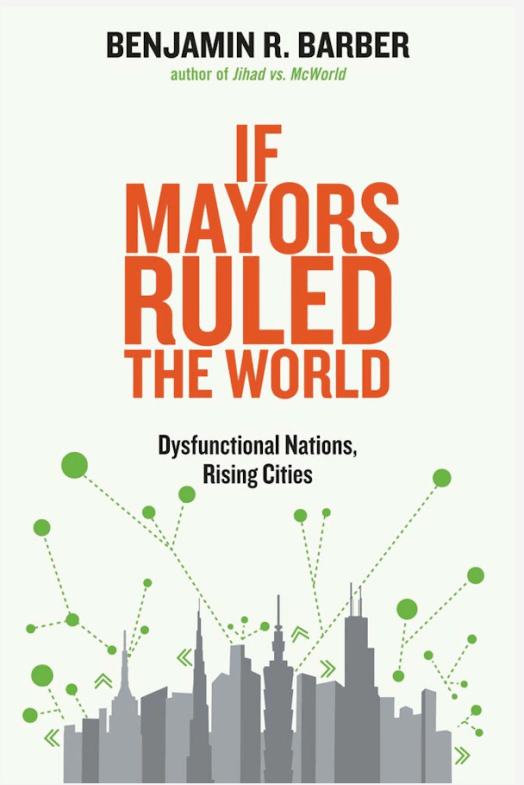
If Mayors Ruled the World

Benjamin R. Barber | 2013

The world’s nations seem paralysed by the challenges of our time—climate change, terrorism, poverty, and the trafficking of drugs, guns, and people. The problems are too big, entrenched, and divisive for the nation-state. Is the nation-state, once democracy’s best hope, dysfunctional and obsolete today? According to Benjamin R. Barber, author of this book, the answer is yes.

Barber asserts that cities, and the mayors that run them, offer the best new forces of good governance: “Why cities? Cities already occupy the commanding heights of the global economy. They are home to more than half of the world’s population, a proportion which will continue to grow.

Lees verder

Simpler: The Future of Government

Cass Sunstein | 2014

Governments everywhere are undergoing a quiet and profound revolution: they’re getting simpler, more cost-effective, and focused on improved outcomes, not politics. For four years, one of the leading lights of that revolution, Cass Sunstein, as President Obama’s “Regulatory Czar,” oversaw the brilliant and successful effort to give every American a better government.

For Americans, the future of government arrived in 2009. The government became simpler, smarter, and worked better. Cass Sunstein, America’s “regulatory czar” under President Barack Obama, was at the centre of it all. Drawing on state-of-the-art work in behavioural psychology and economics, Sunstein helped save the country more than $91 billion and an unknown number of lives.

Lees verder

Multi-level governance

Jack Kruf | december 2022

Multi-level governance is an essential part of navigating the public domain. As in nature, there are influences moving up and down between the layers of the ecosystem. As city manager, I experienced the coming and going, for example, of national policy plans, rules, and legislation downwards and financial and political influences upwards, as well as the cooperation between different layers of government on complex projects or programmes. But what exactly is multi-level governance? Where does the term come from? How is it used? A short study.

It is an approach in political science and public administration theory that originated from studies on European integration. According to Piattoni (2001), political scientists Liesbet Hooghe and Gary Marks developed the concept of multi-level governance in the early 1990s.

Lees verder

Myopic Voters and Natural Disaster Policy

Andrew Healy, Loyola Marymount University, and Neil Malhotra, Stanford University | 2009

In our democratic system, citizens vote for their representative politicians, elected councils, public leaders, governors, and governing councils. But what about citizens’ perceptions of how risks are handled by their leaders, and what about citizens’ appreciation of proactive thinking by councillors related to public risks when it comes to voting?

Quote: “Do voters effectively hold elected officials accountable for policy decisions? Using data on natural disasters, government spending, and election returns, we show that voters reward the incumbent presidential party for delivering disaster relief spending, not investing in disaster preparedness spending. These inconsistencies distort the incentives of public officials, leading the government to underinvest in disaster preparedness, thereby causing substantial public welfare losses.”

“We estimate that $1 spent on preparedness is worth about $15 in terms of the future damage it mitigates.”

“By estimating both the determinants of policy decisions and the consequences of those policies, we provide more complete evidence about citizen competence and government accountability.”

Bibliography

Healy, A. and Malhotra, N. (2009) Myopic Voters and Natural Disaster Policy. American Political Science Review: Vol. 103, No. 3 August

Download the scientific article

Thinking in Systems

Donella Meadows, Diana Wright (ed.) | 2008

In the years following her role as the lead author of the International bestseller Limits to Growth – the first book to show the consequences of unchecked growth on a finite planet – Donella Meadows remained a pioneer of environmental and social analysis until her untimely death in 2001.

"So, what is a system? A system is a set of things—people, cells, molecules, or whatever—interconnected in such a way that they produce their own pattern of behavior over time. The system may be buffeted, constricted, triggered, or driven by outside forces. But the system’s response to these forces is characteristic of itself, and that response is seldom simple in the real world."

- Donella Meadows (2008)

Thinking in Systems is a concise and crucial book offering insight into problem-solving from personal to global scales. Edited by the Sustainability Institutes Diana Wright, this essential primer brings systems thinking out of the realm of computers and equations and into the tangible world, showing readers how to develop the systems-thinking skills that thought leaders across the globe consider critical for 21st-century life.

Some of the biggest problems facing the world, including war, hunger, poverty, and environmental degradation, are system failures. They cannot be solved by fixing one piece in isolation from the others because even seemingly minor details have enormous power to undermine the best efforts of too-narrow thinking. While readers will learn the conceptual tools and systems thinking methods, the book’s heart is grander than the methodology.

"Managers are not confronted with problems that are independent of each other, but with dynamic situations that consist of complex systems of changing problems that interact with each other. I call such situations messes. . . . Managers do not solve problems, they manage messes."

- Russel L. Ackoff (1979)

Donella Meadows was known as much for nurturing positive outcomes as she was for delving into the science behind global dilemmas. She reminds readers to pay attention to what is important, not just what is quantifiable, to stay humble, and to stay a learner. In a world growing ever more complicated, crowded, and interdependent, Thinking in Systems helps readers avoid confusion and helplessness, the first step toward finding proactive and effective solutions.

Bibliography

Ackoff, R. (1979) ‘The Future of Operational Research Is Past’. Journal of the Operational Research Society 30, no. 2: 93–104.

Meadows, D. (Wright, D. ed) (2008) Thinking in Systems. Vermont, US: Chelsea Green Publishing Co.

Systems Thinking for Curious Managers

With 40 new Management f-LAWS 

Russell L. Ackoff | 2009

This gem of a book introduces the extraordinary world of systems thinking and its ‘Dean’, Russell L. Ackoff, to curious and enquiring managers, teachers, business people – anyone, anywhere who works in an organisation.

Finished just before Professor Ackoff’s death late in 2009, “Systems Thinking for Curious Managers” opens the door to a joined-up way of thinking about things that have profoundly influenced thinkers and doers in the fields of business, politics, economics, biology, and psychology.

Lees verder