Publieke waarden en risico’s in Straatsburg

De geboorte van een organisatie voor publiek risicomanagement (PRIMO)

Jack Kruf* | mei 2005

Vorige maand, op 1 april 2005, kwam het Executive Committee van UDITE, het netwerk van gemeentesecretarissen en gemeentelijk algemeen directeuren in Europa, bijeen in Straatsburg om ‘publiek risicomanagement’ als nieuw idee te bespreken. De gemeentesecretarissen keken gezamenlijk naar een nieuw gepresenteerde aanpak, die Alan Vendelbo, president van UDITE, bovenaan de agenda had geplaatst.

Het was vanaf het begin van de bijeenkomst duidelijk dat allen geloofden dat de benadering de rol en functie van de gemeentesecretaris zeer  versterken in het ondersteunen van de politiek, de maatschappij en de eigen organisatie. Actuele gebeurtenissen in de samenleving en het uit het niet in control zijn op budgetten en processen binnen tal van politiek-bestuurlijke projecten hebben het belang van proactief denken over publieke waarden, doelen en hun risico’s verhoogd. Hier volgt een korte persoonlijke impressie. Ik was erbij op deze dag.

Lees verder
Creating Public Value

John O’Dea* | April 2014

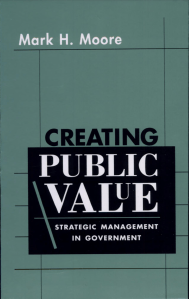
Public value is defined as “using government assets to produce a good and just society”. The term was first mooted in 1995 by Mark H. Moore – Hauser Professor of Non-Profit Organisations at the Harvard Kennedy School of Government – in his book Creating Public Value (Harvard University Press). Public value in public sector management is the equivalent of shareholder value in private sector organisations. Shareholder value is a business term which implies that the ultimate measure of a company’s success is the extent to which it enriches its shareholders (owners) by paying dividends and/or causing its stock price to increase in value.

John O’Dea

By the same token, the ultimate measure of a government’s success is the extent to which it enriches society as a whole. The difference between public and private entities is that in the former, citizens are both the shareholders (as taxpayers) and the clients (as recipients of public services). Public services are distinctive because they are characterised by claims of rights by citizens that have been authorised and funded through a democratic process.

Lees verder

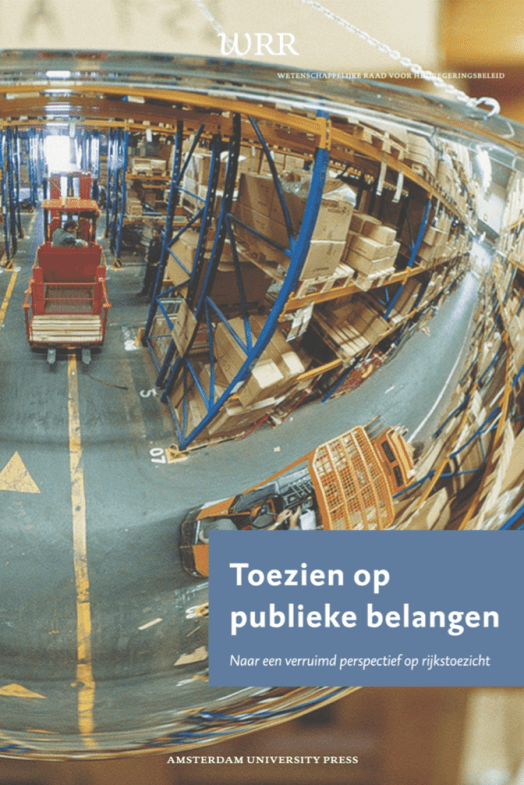
Toezien op publieke belangen

Naar een verruimd perspectief of rijkstoezicht

Wetenschappelijke Raad voor het Regeringsbeleid (WRR) | 2013

Tot ongeveer twintig jaar geleden was toezicht een weinig spectaculair en nauwelijks zichtbaar onderdeel van het openbaar bestuur. Toezicht was vooral een zaak van individuele inspecteurs die doorgaans buiten het zicht van de openbaarheid op een vaak informele wijze hun toezichtdomein trachtten te disciplineren. Maar die tijd is voorbij. Door de voortgaande verschuiving en spreiding van taken en verantwoordelijkheden en door toenemende verwachtingen van het toezicht in de samenleving, zijn het belang en de zichtbaarheid van toezicht enorm gegroeid. Na een incident zijn in de media en de politiek dikwijls de eerste vragen: waar was het toezicht? Waarom heeft het toezicht niet of niet eerder ingegrepen?

De vele uitdagingen waarmee het toezicht geconfronteerd wordt en de nogal eens problematische relatie tussen samenleving en toezicht waren voor de WRR aanleiding tot een nadere beschouwing. Centraal stond daarbij de vraag:

Hoe treedt de overheid in beleid en praktijk de uitdagingen die op het rijkstoezicht afkomen tegemoet en hoe kan de maatschappelijke meerwaarde van dat toezicht worden bevorderd?

Overheidstoezicht vervult in allerlei vormen en gedaanten een belangrijke rol bij het verwezenlijken van beleidsdoelstellingen en het borgen van publieke belangen; het is een steunbeer van de samenleving, een ‘basisinstitutie’ die ertoe doet.

Lees verder

Creating Public Value

Strategic management in government

Mark H. Moore | 1995

Public Value is a theory for public management advanced by Professor Mark Moore of the Harvard Kennedy School. Over the previous two decades, staff and students at Harvard’s Kennedy School of Government, where Moore taught, engaged in conversations about producing excellence in public management.

“Public value refers to the value created by the government through laws, regulations, services and any other action. In a democratic society, this value is defined by the public themselves. Value is determined by citizens preferences expressed in a variety of ways and thus it provides a rough yard stick against which to gauge the public institutions and government policies.”

A seminal figure in the field of public management, Mark Moore presents his summation of 15 years of research, observation, and teaching on what public-sector executives should do to improve the performance of public enterprises.

Lees verder

Brundtland Report

United Nations | April 1987

The first explicit common reference to sustainable development was in the 1987 Brundtland Report Our Common Future of the United Nations Commission on Environment and Development.

In this report, sustainable development was defined as: “development that meets the needs of the present without compromising the ability of future generations to meet their own needs”. In 1987 the need for cooperating on this was high.

Lees verder

PRIMO Risk Management Award 2019: Paul Hofstra

Uitgereikt te Rotterdam op 18 september 2020 aan Paul Hofstra.

The board of PRIMO Netherlands and the board of PRIMO Europe have awarded the PRIMO Risk Management Award 2019 to Paul Hofstra for his courage and leadership at the intersection of public value, public risk and governance.

Paul Hofstra

The award is based, on the one hand, on his mature leadership as a board member and director of the Rotterdam Court of Audit and, on the other, on his professional contributions to the precise and essential application of the principles of risk management, as set out, for example, in the reports Heat Without a Pipeline and Public Value Under Pressure.

Lees verder

Public value under pressure

Headlines from ten years of audit reports

City of Rotterdam | 2019

The Audit Office has investigated the substantive similarities (‘common themes’) found in the conclusions of 42 reports it published on the municipality of Rotterdam between 2009 and 2019.

Administrative overconfidence and excessive regulation

The council is repeatedly overconfident in its plans and consequently takes on too many (financial) risks. Furthermore, the council often relies too heavily on rules and procedures, paying too little attention to practical implementation issues and residents’ everyday lives. These and other conclusions are set out in the Audit Office’s report ‘Public value under pressure’, a summary of dozens of investigations carried out by the Rotterdam Audit Office in the municipality of Rotterdam since 2009.

Lees verder