Myopic Voters and Natural Disaster Policy

Andrew Healy, Loyola Marymount University, and Neil Malhotra, Stanford University | 2009

In our democratic system, citizens vote for their representative politicians, elected councils, public leaders, governors, and governing councils. But what about citizens’ perceptions of how risks are handled by their leaders, and what about citizens’ appreciation of proactive thinking by councillors related to public risks when it comes to voting?

Quote: “Do voters effectively hold elected officials accountable for policy decisions? Using data on natural disasters, government spending, and election returns, we show that voters reward the incumbent presidential party for delivering disaster relief spending, not investing in disaster preparedness spending. These inconsistencies distort the incentives of public officials, leading the government to underinvest in disaster preparedness, thereby causing substantial public welfare losses.”

“We estimate that $1 spent on preparedness is worth about $15 in terms of the future damage it mitigates.”

“By estimating both the determinants of policy decisions and the consequences of those policies, we provide more complete evidence about citizen competence and government accountability.”

Bibliography

Healy, A. and Malhotra, N. (2009) Myopic Voters and Natural Disaster Policy. American Political Science Review: Vol. 103, No. 3 August

Download the scientific article

Thinking in Systems

Donella Meadows, Diana Wright (ed.) | 2008

In the years following her role as the lead author of the International bestseller Limits to Growth – the first book to show the consequences of unchecked growth on a finite planet – Donella Meadows remained a pioneer of environmental and social analysis until her untimely death in 2001.

"So, what is a system? A system is a set of things—people, cells, molecules, or whatever—interconnected in such a way that they produce their own pattern of behavior over time. The system may be buffeted, constricted, triggered, or driven by outside forces. But the system’s response to these forces is characteristic of itself, and that response is seldom simple in the real world."

- Donella Meadows (2008)

Thinking in Systems is a concise and crucial book offering insight into problem-solving from personal to global scales. Edited by the Sustainability Institutes Diana Wright, this essential primer brings systems thinking out of the realm of computers and equations and into the tangible world, showing readers how to develop the systems-thinking skills that thought leaders across the globe consider critical for 21st-century life.

Some of the biggest problems facing the world, including war, hunger, poverty, and environmental degradation, are system failures. They cannot be solved by fixing one piece in isolation from the others because even seemingly minor details have enormous power to undermine the best efforts of too-narrow thinking. While readers will learn the conceptual tools and systems thinking methods, the book’s heart is grander than the methodology.

"Managers are not confronted with problems that are independent of each other, but with dynamic situations that consist of complex systems of changing problems that interact with each other. I call such situations messes. . . . Managers do not solve problems, they manage messes."

- Russel L. Ackoff (1979)

Donella Meadows was known as much for nurturing positive outcomes as she was for delving into the science behind global dilemmas. She reminds readers to pay attention to what is important, not just what is quantifiable, to stay humble, and to stay a learner. In a world growing ever more complicated, crowded, and interdependent, Thinking in Systems helps readers avoid confusion and helplessness, the first step toward finding proactive and effective solutions.

Bibliography

Ackoff, R. (1979) ‘The Future of Operational Research Is Past’. Journal of the Operational Research Society 30, no. 2: 93–104.

Meadows, D. (Wright, D. ed) (2008) Thinking in Systems. Vermont, US: Chelsea Green Publishing Co.

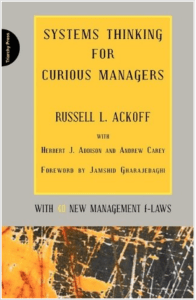
Systems Thinking for Curious Managers

With 40 new Management f-LAWS 

Russell L. Ackoff | 2009

This gem of a book introduces the extraordinary world of systems thinking and its ‘Dean’, Russell L. Ackoff, to curious and enquiring managers, teachers, business people – anyone, anywhere who works in an organisation.

Finished just before Professor Ackoff’s death late in 2009, “Systems Thinking for Curious Managers” opens the door to a joined-up way of thinking about things that have profoundly influenced thinkers and doers in the fields of business, politics, economics, biology, and psychology.

Lees verder →

Comparative risk analysis of technological hazards (a review)

Robert W. Kates and Jeanne X. Kasperson | 1983

Hazards are threats to people and what they value, and risks are measures of hazards. Comparative analyses of the risks and hazards of technology can be traced to Starr (1969) but are rooted in recent trends in technological evolution, hazard identification, risk perception, and societal activities.

These trends have spawned an interdisciplinary quasi-profession with new terminology, methodology, and literature. A review of 54 English-language monographs and book-length collections published between 1970 and 1983 identified seven recurring themes:

i. Overviews of the field of risk assessment.

ii. Efforts to estimate and quantify risk.

iii. Discussions of risk acceptability.

iv. Perception.

v. Analyses of regulation.

vi. Case studies of specific technological hazards.

vii. Agenda for research.

Within this field, science occupies a unique niche, for many technological hazards transcend the realm of ordinary experience and require expert study. Scientists can make unique contributions to each area of hazard management, but their primary contribution is in the practice of basic science.

Beyond that, science needs to further risk assessment by understanding the more subtle processes of hazard creation, establishing conventions for estimating risk and presenting and handling uncertainty.

Scientists can inform the discussion of tolerable risk by placing risks in comparative contexts, studying the evaluation process, and participating as knowledgeable individuals, but they cannot decide the issue. Science can inform the hazard management process by broadening the range of alternative control actions and modes of implementation and devising methods to evaluate their effectiveness.

Bibliography

Kates, R. W., & Kasperson, J. X. (1983). Comparative risk analysis of technological hazards (a review). Proceedings of the National Academy of Sciences, 80(22), 7027-7038.https://doi.org/10.1073/pnas.80.22.7027

Starr, C. (1969). Social benefit versus technological risk: what is our society willing to pay for safety?. Science, 165(3899), 1232-1238.

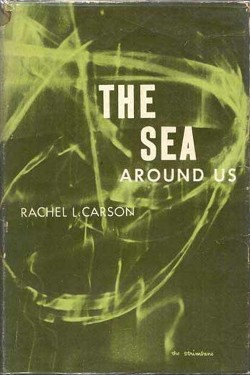
The Sea Around Us

Rachel Carson | July 1951

Here is the strange story of the seas – how they were born, how life emerged from them, and the marine world within them. Rachel Carson’s writing teems with images – the newly-formed Earth cooling beneath an endlessly overcast sky; volcanic action throwing up huge masses on the ocean floor to create immense mountains and desolate canyons; giant squid battling sperm whales hundreds of fathoms below the surface.

A new chapter by Jeffrey Levinton brings the science of “The Sea Around Us” up to date. Levinton incorporates the most recent thinking on continental drift, coral reefs, the spread of the ocean floor, the deterioration of the oceans, the mass extinction of sea life, and many other topics. First published in 1951, this work won the 1952 National Book Award.

“Published in 1951, The Sea Around Us is one of the most remarkably successful books ever written about the natural world. Rachel Carson’s rare ability to combine scientific insight with moving, poetic prose catapulted her book… It inspired an Academy Award-winning documentary and won the 1952 National Book Award and the John Burroughs Medal. This classic work remains as fresh today as when it first appeared.”

Today, with the oceans endangered by the dumping of medical waste and ecological disasters such as the Exxon oil spill in Alaska, this illuminating volume provides a timely reminder of both the fragility and the importance of the ocean and the life that abounds within it. Anyone who loves the sea, or who is concerned about our natural environment, will want to read this classic work.

Bibliography

Carlson, R. (1951) The Sea Around Us. Oxford: Oxford University Press