PRIMO Nederland founded

Risk management: the Achilles heel of local government

Jos Moerkamp (2006), translation Jack Kruf)| December 2006

The greatest risk faced by public authorities is realising, after the event, that risks have been overlooked. Managing risks not only reduces the likelihood of a disaster but, more importantly, makes it visible. That is why risk management belongs at the heart of the municipal organisation. That is precisely what PRIMO Nederland aims to achieve. It was formally founded in The Hague on the 6th of October 2006.

Anyone who associates local authorities and provincial councils with risks thinks first and foremost of financial debacles (the Ceteco affair in South Holland, local authorities acting as banks, construction fraud on a national scale) and, of course, disasters. New legislation (such as the Fido Act, which has curbed the risks taken by local authorities in investing and borrowing) and substantial investments by government inspectorates in enforcement and supervision have undoubtedly helped reduce risks.

Nevertheless, risk management is currently causing quite a stir. At the end of September 2006, during the annual conference of the Association of Municipal Secretaries, PRIMO Nederland was launched. PRIMO stands for Public Risk Management Organisation; PRIMO Nederland is part of PRIMO Europe, with members from fifteen countries.

Why is risk management on the rise in local and regional government? In other words, what is so new about it? Hasn’t risk assessment been part of policy-making and implementation for ages?

Jack Kruf, chair of PRIMO Nederland and municipal secretary of Roosendaal, does not deny this. ‘Seen in this light, you could view the history of humanity as the management of risks. For the Netherlands, this translates primarily to this day into managing the risks posed by water to our survival. It is no coincidence that water management is perhaps the most developed form of risk management we know. Constructing the right dykes is a complex science. We can calculate exactly what a dyke must look like to limit the risk of flooding or a breach to a predetermined probability. Managing the risks posed by water is in our DNA.’

In many other areas, however, risk management within the government is still in its infancy, according to Kruf. ‘We do not always look at it systematically or at the right level. Governments make numerous decisions without systematically calculating the risks beforehand. It is only during implementation that the risks come to light. Whereas risk management should take place at the strategic level of the organisation.’ An increasing number of managers and directors within local authorities shared this observation. All the more so as risks at the local level have increased further in recent years. With the introduction of dualism, the concept of ‘governance’ also became a topic of discussion.

Transparency in governance, oversight and accountability are central

‘This requires well-considered risk management,’ says Kruf. ‘The alderman is now much more accountable to the council, whereas before the dualism system, he was an extension of it. Expectations regarding day-to-day administration – and therefore also of the civil service organisation that supports it – have changed drastically. The alderman must be ‘in control’, delivering results and meeting schedules. There is no longer any room for ‘talking one’s way out of things’. All of this is only possible if you can properly assess the risks in advance.’

A second ‘boost’ to risk management in local authorities is the decentralisation of tasks. ‘Local authorities have been given significantly more policy and financial responsibilities. Usually, task transfer occurs without the resources being transferred on a one-to-one basis. Add the new policy areas with limited resources to the need to drastically adapt our organisations to these developments, and you can see significant risks looming.’ Add to this the increased complexity of projects, the growing interdependence between policy areas, and the expanding chain of responsibility for social issues, and it is clear that, certainly at the local level, the need for risk management is increasing significantly.

Moreover, this list makes it clear that risk management is not solely the preserve of controllers. On the contrary. ‘Society also demands politicians and administrators who stick their necks out, who listen more closely to what citizens want. That desire calls for administrators who dare to take risks. The challenge is to support administrators so they take calculated risks. You want to show the councilor that everything has been mapped out, that the risks have been analyzed, that, of course, things can still go wrong, but that he does know in advance what he is getting into.’

Bibliography

Moerkamp J. (2006). PRIMO Nederland established: Risk management – the Achilles’ heel of decentralised government. B&G Magazine, October 2006.
Rapport Stern

PRIMO France | novembre 2005

L’originalité du rapport Stern réside dans sa tentative de chiffrer le « coût de l’inaction en matière d’environnement ». Ainsi, si l’on agissait aujourd’hui pour stabiliser les émissions de gaz carbonique à 550 ppm (parties par million), niveau requis pour une hausse des températures de « seulement » 3 °C, l’investissement annuel nécessaire serait de l’ordre de 1 % du PIB mondial. Mais, « si nous ne renversons pas la tendance actuelle, le coût pourrait s’élever au minimum à 5 % du futur PIB » dans un futur proche, prévient Sir Stern.

L’économiste britannique estime que si l’on agit au plus vite, les retombées des mesures visant à lutter contre le réchauffement climatique ne devraient pas trop nuire à la compétitivité et à la croissance. Il insiste sur le fait que l’on peut « mener de pair la croissance et la lutte contre le changement climatique ».

Lees verder →

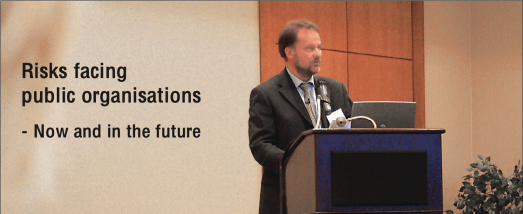
Les risques confrontent les organisations

Aujourd’hui et à l’avenir.

Philippe Auzimour et Allan Vendelbo | novembre 2005

Les inondations, les incendies dans les écoles, le chômage, le développement urbain et la sécurité informatique comptent parmi les enjeux de risque majeurs et complexes auxquels sont confrontés les organismes publics. Ces enjeux sont essentiels pour tout dirigeant du secteur public qui doit faire face à des risques qui touchent non seulement son organisme, mais aussi, souvent, l’ensemble de la communauté. Mais quelle est la meilleure façon de gérer ces risques majeurs ? La gestion des risques dans le secteur public doit-elle viser à les minimiser en toutes circonstances ? Ou bien cette approche empêchera-t-elle les organismes publics d’innover ? Bien que les budgets serrés du secteur public limitent souvent la possibilité d’adopter une approche proactive, on ne peut pas ignorer le fait que les risques présentent de multiples facettes et comportent également des aspects positifs.

Allan Vendelbo, President UDITE

Ces points de vue ont été maintes fois soulevés et reconnus par les professionnels et les experts lors de la conférence PRIMO qui s’est tenue à Copenhague le 25 novembre 2005. Bien que la conférence n’ait apporté aucune réponse claire à ces questions, leur importance était évidente pour tous.

150 participants venus de 10 pays européens et des États-Unis ont pris part à la première conférence internationale PRIMO. Certains partenaires privés de PRIMO Danemark ont présenté leur expertise en matière de gestion des risques lors de présentations organisées pendant les pauses entre les interventions de la conférence. Des bannières déployables arboraient les logos colorés de sociétés d’assurance, de ressources humaines, d’informatique et de finance.

Lees verder →

Programme de l’UNESCO sur les ressources en eau

 PRIMO France | 3 novembre 2005

Le programme mondial pour l’évaluation des ressources en eau, pour le développement, le renforcement des capacités et l’environnement est une initiative de l’UNESCO.

Des évaluations régulières sur l’utilisation durable des ressources en eau font l’objet d’un rapport.

Lire le rapport

Managing the unexpected (2001)

Assuring high performance in an age of complexity

Karl Weick and Kathleen Sutcliffe | 2001

One of the significant challenges any business or organisation can face is dealing with the unexpected. While traditional managerial practices such as planning are designed to manage unexpected threats, they often worsen things. How do you organise for high performance in a setting with overwhelming potential for error and disaster?

In this book, the authors look to high-reliability organisations (HROs)—aircraft carriers, nuclear power plants, firefighting crews, and others—for the answer. HROs have developed ways of acting that provide a template for all organisations that want to be more reliable in managing the unexpected. This book shows executives and upper-level managers how to manage under trying conditions.

The authors reveal how HROs create a collective mindfulness that enhances the ability to discover and correct errors before they escalate into a crisis. By discussing this principle and the practices that can be applied, the authors show how to anticipate and respond to threats with flexibility rather than rigidity.

Their practical, solutions-oriented approach includes numerous case studies demonstrating “mindful” practices and enables readers to assess and implement mindfulness in their organisations. 


Bibliography 

Weick, K. E., & Sutcliffe, K. M. (2001). Managing the unexpected: Assuring high performance in an age of complexity. San Francisco: Jossey-Bass. 


Result in Times of Transition

On public values, strategic steering, and system change

PRIMO Europe and TIAS | februari 2020

Tilburg University and PRIMO Europe offer a concise program on strategic management. In line with the findings of national and international reports, senior managers in the public sector are facing a combination of transitions. These transitions are taking place simultaneously and call for careful consideration. This involves rethinking strategy, innovating in value creation, and restructuring the management of systems.

Masterclass: ‘Achieving Results in Times of Transition’ by PRIMO Europe and TIAS.

The Tilburg Institute of Governance (TIG), the Tilburg School of Economics and Management (TiSEM), both part of Tilburg University and Public Risk Management Organization (PRIMO) Europe, the only independent international network for the development and dissemination of products and services related to the steering of values and risks within the public sector in Europe, are entering into a strategic alliance in an international context, thus including the Netherlands.

Lees verder →