Global Risks to the Business Environment

World Economic Forum | 2005

Global Risks to the Business Environment: “This paper, the output of two workshops organised by the World Economic Forum in collaboration with Merrill Lynch, reviews major, global risks facing business leaders today, and examines how those risks differ from the challenges of the past. Some key points:

1) Global Risks and Business

At a time when risks not specific to business are having an unprecedented effect on the corporate world, it is crucial for business leaders to understand the environment in which their business operates, in order to survive, remain competitive and grasp opportunities.
2) An Increasingly Turbulent and Complex World

Today’s risks are much more interconnected than in the past. They are much more volatile and can disrupt markets throughout the world with almost instantaneous precision. Such risks can be difficult to anticipate and respond to, even for the most seasoned business leaders.

3) The Global Risks

We identify 36 “global” risks, classified into four categories: economic, geopolitical, societal and environmental. This report details the prevailing consensus reached at our workshop discussions as to the ten risks most likely to have a major or extreme impact on business:
• Instability in Iraq
• Terrorism
• Emerging fiscal crises
• Disruption in oil supplies
• Radical Islam
• Sudden decline in China’s growth
• Pandemics – infectious diseases
• Climate change
• Weapons of mass destruction (WMD)
• Unrestrained migration and related tensions

4) Risk Mapping – Connecting the “Dots” and Spotting the Patterns

In an interconnected world, global risks should not be considered on a stand-alone basis; it is important to understand how they can trigger, amplify or buffer one another.

5) Dealing with Global Risks

Seldom can global risks be addressed by a single business entity, industry or country, and many institutional mechanisms are proving fairly ineffectual as they struggle to cope with the challenge. There is also a large discrepancy between the immediate time horizon employed by most business and political leaders and the long-term approach required to tackle risks on a global scale. As a result, our capacity to address risk is jeopardized; a myopic tendency – or worse, denial – prevails. Finally, of equal concern is the problem that some major risks are being passed on to those least able to solve them – or with least responsibility for creating them.”
Global Risks to the Business Environment

Risicoperceptie van gemeentesecretarissen

Bert van de Velden, Leo ’t Hart en Franc Weerwind* | 2004, VGS en Marsh

Anticiperend op het per 1 januari 2004 in te voeren Besluit Begroting en Verantwoording provincies en gemeenten (BBV) is medio 2003, bij een aantal gemeentesecretarissen het idee ontstaan om aandacht te geven aan het onderwerp risicomanagement. Dit idee is vervolgens uitgewerkt en besproken met het bestuur van de VGS. Hierbij is afgesproken om binnen het kader van risicomanagement onderzoek te doen naar de risicoperceptie van gemeentesecretarissen.

Bij publieke besluitvorming spelen veel aspecten een rol. Visie, nut en noodzaak, uitvoerbaarheid, (financiële) haalbaarheid en handhaafbaarheid zijn voorbeelden van die aspecten. Risicomanagement is een ander perspectief dat bij deze besluitvorming een rol kan spelen.

Lees verder →

The environment and bilateral development aid

Brian Johnson and Robert O. Blake | 1979

Since January 1977, the International Institute for Environment and Development (IIED) has been conducting a research program on the environmental policies and programs of major development aid organizations. The first of IIED’s studies in this field, a report on environmental procedures and practices in nine multilateral development agencies, was completed in 1978 and published as a book titled “Banking on the Biosphere?” (Lexington Books, New York, 1979).

This study aroused considerable interest, and, as a result, IIED decided to conduct a parallel policy review of six bilateral aid agencies. This “assessment project” began in May 1978 with the agreement and support of the aid agencies of Canada, the Federal Republic of Germany, the Netherlands, Sweden, and the United States. The study’s aim was:

  • To assess the extent to which policies, procedures and programs of the six bilateral agencies promote sustainable, environ­mentally sound development.
  • To examine the constraints to improved environmental performance in these agencies, that might be necessary to remove or substantially reduce these constraints.
Lees verder →

Cadbury Report

Cadbury committee | 1992, London Stock Exchange, en • nl

This report is a milestone in corporate governance. It is 1992. The Cadbury Report about “Financial Aspects of Corporate Governance” has been published. This groundbreaking report – chaired by Sir Adrian Cadbury – led to improvements in governance standards. It was a reaction to the Bank of Credit and Commerce International scandal in 1991.

• Dit rapport is een mijlpaal in het corporate besturing. Het is 1992. Het Cadbury Report over “Financial Aspects of Corporate Governance” wordt gepubliceerd. Baanbrekend – voorgezeten door Sir Adrian Cadbury – en het leidde tot verbeteringen in de normen voor deugdelijk bestuur. Het was een reactie op het schandaal in 1991 bij de Bank of Credit and Commerce International.

The report made specific recommendations on good corporate governance, which it described as ”best practice” or ”code of conduct.” It was highly influential in developing organisational codes regarding external shareholders’ accountability. It is the start of a new line of thinking about good governance, also in the public context. • Het rapport deed specifieke aanbevelingen voor goed ondernemingsbestuur, die het omschreef als “best practice” of “gedragscode”. Het rapport was zeer invloedrijk bij het ontwikkelen van organisatiecodes met betrekking tot de verantwoordingsplicht van externe aandeelhouders. Het is het begin van een nieuwe manier van denken over goed bestuur, ook in de publieke context.

This interview with Sir Adrian Cadbury gives the precise focus and the intention to look further into the essence of corporate governance. • Dit interview met Sir Adrian Cadbury geeft de precieze focus en de intentie om verder te kijken naar de essentie van corporate governance.

The report stipulated “the continuing concern about standards of financial reporting and accountability, … which has kept corporate governance in the public eye.” Some findings and recommendations (a personal selection) tell the story of the search for codes, checks and balances [quote]:

    • By adhering to the Code, listed companies will strengthen their control over their businesses and public accountability. In so doing, they will be striking the right balance between meeting the standards of corporate governance now expected of them and retaining the essential spirit of enterprise. 
    • Every public company should be headed by an effective board that can lead and control the business. 
    • However, the framework in which auditors operate is not well designed in certain respects to provide the objectivity that shareholders and the public expect of auditors in carrying out their function. 
    • The new system has only recently been established, and its full impact has yet to be felt. In the following paragraphs, we endorse the steps being taken and recommend additional action to strengthen public confidence in the audit approach. 
    • We believe that there should be an extension of the audit, which will add to users of accounts and bring it closer into line with public expectations. 
    • So far as reporting fraud is concerned, the present legal position is that confidentiality is an implied term of an auditor’s contract, and there is a public interest in maintaining confidential client relationships. Normally, therefore, it is the auditor’s duty to report fraud to senior management. However, there is also a public interest in fraud being dealt with expeditiously and this may entail disclosing matters to a proper authority. [unquote]

• Het rapport vermeldde “de voortdurende bezorgdheid over normen voor financiële verslaggeving en verantwoording, … die corporate governance in de publieke belangstelling heeft gehouden.” Enkele bevindingen en aanbevelingen (een persoonlijke selectie) vertellen het verhaal van de zoektocht naar codes, checks and balances [citaat]:

    • Door de Code na te leven zullen beursgenoteerde ondernemingen hun controle over hun bedrijf en hun publieke verantwoording versterken. Op die manier vinden ze het juiste evenwicht tussen het voldoen aan de normen van corporate governance die nu van hen worden verwacht en het behouden van de essentiële ondernemingsgeest.
    • Elke beursgenoteerde onderneming moet worden geleid door een effectieve raad van bestuur die de onderneming kan leiden en controleren.
    • Het kader waarbinnen auditors werken is in bepaalde opzichten echter niet goed ontworpen om de objectiviteit te bieden die aandeelhouders en het publiek verwachten van auditors bij het uitvoeren van hun functie.
    • Het nieuwe systeem is pas onlangs ingevoerd en de volledige impact ervan moet nog merkbaar worden. In de volgende paragrafen onderschrijven we de stappen die worden genomen en bevelen we aanvullende maatregelen aan om het vertrouwen van het publiek in de controleaanpak te versterken.
    • Wij zijn van mening dat de controle moet worden uitgebreid, wat de gebruikers van de rekeningen ten goede zal komen en de controle meer in overeenstemming zal brengen met de verwachtingen van het publiek.
    • Wat het melden van fraude betreft, is de huidige rechtspositie dat vertrouwelijkheid een impliciete voorwaarde is van het contract van een auditor en dat er een algemeen belang is bij het onderhouden van vertrouwelijke relaties met cliënten. Normaal gesproken is het daarom de plicht van de auditor om fraude te melden aan het senior management. Het is echter ook in het algemeen belang dat fraude snel wordt aangepakt en dit kan betekenen dat zaken moeten worden gemeld aan een bevoegde autoriteit. [unquote]

Download the Cadbury Report.

Integrale Circulaire Economie Rapportage 2021

Jack Kruf | november 2021, B&G Magazine

BNG Bank: “Begin 2021 heeft het Planbureau voor de Leefomgeving de eerste Integrale Circulaire Economie Rapportage (ICER 2021) gepubliceerd. Het rapport schetst de voortgang van de transitie naar een circulaire economie in Nederland. Erevoorzitter van PRIMO Europe – Jack Kruf –  heeft deze omvangrijke maar zeer informatieve rapportage samengevat op majeure risico’s, zoals zij door de auteurs zijn verwoord.”

De Nederlandse regering wil in 2050 een volledig circulaire economie hebben bereikt. Monitoring van de voortgang van deze transitie is gewenst. Deze rapportage is een belangrijke mijlpaal in dit proces. Welke interventies heeft de overheid in Nederland gedaan om de transitie naar een circulaire economie op gang te brengen en te versnellen? Wat zijn de acties van maatschappelijke partijen?

Lees verder →

Risks facing Organisations

Now and in the future.

Philip Auzimour en Allan Vendelbo | november 2005

Flooding, school fires, unemployment, urban development and IT safety are some of the large and complicated risk issues for public organisations. These issues are essential to any public CEO who is faced with risks that not only involve the organisation itself but often the whole community. Still, what is the best way to address these significant risks? Should public risk management aim to minimise risks at all times? Or will this approach keep the public organisations from innovating? Although tight budgets in the public sector often set a limit for a proactive approach, the fact that risks have many facets and also positive aspects cannot be ignored. 

Allan Vendelbo, President UDITE

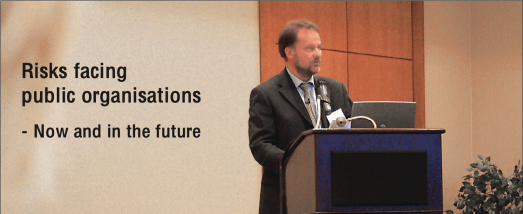
These views were repeatedly brought up and recognised by practitioners and experts at the PRIMO conference in Copenhagen on 25 November 2005. Although the conference offered no straight answers to the questions, their importance was clear to everybody. 

150 participants from 10 European countries and the US joined the first international PRIMO conference. Some of PRIMO Denmark’s private partners presented their expertise in risk management at pitches in the breaks between the conference talks. Pull-ups flashed colourful logos of insurance, HR, IT and finance companies. 

Lees verder →

Public value under pressure

Headlines from ten years of audit reports

City of Rotterdam | 2019

The Audit Office has investigated the substantive similarities (‘common themes’) found in the conclusions of 42 reports it published on the municipality of Rotterdam between 2009 and 2019.

Administrative overconfidence and excessive regulation

The council is repeatedly overconfident in its plans and consequently takes on too many (financial) risks. Furthermore, the council often relies too heavily on rules and procedures, paying too little attention to practical implementation issues and residents’ everyday lives. These and other conclusions are set out in the Audit Office’s report ‘Public value under pressure’, a summary of dozens of investigations carried out by the Rotterdam Audit Office in the municipality of Rotterdam since 2009.

Lees verder →