Beleid én Wetenschap in Utrecht

Provincie Utrecht en Utrecht Universiteit | februari 2024, nl • en

De regio Utrecht als een levend laboratorium voor wereldwijde transities. Een Fellowship bouwt de brug tussen beleid en wetenschap. • The Utrecht region as a living laboratory for global transitions. A Fellowship builds the bridge between policy and science.

Uit gevoerde discussies, geleid door Copernicus Institute of Sustainable Development komt naar voren de grote uitdagingen om succesvolle transities op lokale en regionale schaal te realiseren en tegelijkertijd bij te dragen aan bredere wereldwijde transities. De integratie van nieuwe wetenschappelijke inzichten met het formuleren van strategie en beleid wordt gevoeld als essentieel  transities binnen gemeente en provincie te kunnen versnellen. • Discussions led by the Copernicus Institute of Sustainable Development revealed the major challenges of achieving successful transitions at local and regional scales while contributing to broader global transitions. Integrating new scientific insights with formulating strategy and policy is essential to accelerating transitions within municipalities and provinces.


De Verenigde Naties hebben ‘Aligning Governance to the Challenges of Global Sustainability’ aangewezen als een kernprobleem van de 21e eeuw. 

• The United Nations has identified ‘Aligning Governance to the Challenges of Global Sustainability’ as a key problem of the 21st century.


Uitdagingen / challenges

De regio Utrecht kent grote duurzaamheidsuitdagingen, zoals de energietransitie, de circulaire economie, duurzame voedselsystemen en aanpassing aan klimaatverandering. Healthy urban living wordt gebruikt als overkoepelend beleidsconcept. Overheden en andere belanghebbenden gebruiken een transitieaanpak waarin verschillende experimenten worden uitgevoerd in een proeftuinomgeving. Stedelijke experimenten laten een verschuiving zien van het uitvoeren van lokale pilots naar het testen van innovaties op wijkschaal. Op deze schaal neemt de complexiteit aanzienlijk toe. De provincie Utrecht heeft zich onlangs gepresenteerd als proeftuin voor de duurzaamheids- en gezondheidsdoelen voor 2050 zoals gedefinieerd in de Europese Green Deal.

• The Utrecht region has large sustainability challenges, such as the energy transition, the circular economy, sustainable food systems, and adaptation to climate change. Healthy urban living is used as an umbrella policy concept. Governments and other stakeholders use a transition approach in which various experiments are carried out in a living lab setting. Urban experiments show a shift from carrying out local pilots to testing innovations on a neighbourhood scale. On this scale, the complexity increases significantly. The province of Utrecht has recently presented itself as a living lab for the sustainability and health objectives for 2050 as defined in the European Green Deal.

Fellowship

Een samenwerking dus van wetenschap en overheid om te vernieuwen. Vanaf 1 februari 2024 zijn de Provincie Utrecht en de Departement Bestuurs- en Organisatiewetenschap (USBO) van Universiteit Utrecht een drie-jarige overeenkomst aangegaan – via een Fellowship – om de grens tussen wetenschap en beleid te overbruggen. • Therefore a collaboration of science and government to innovate. From 1 February 2024, the Province of Utrecht and the Department of Management and Organisational Science (USBO) of Utrecht University entered into a three-year agreement – through a Fellowship – to bridge the boundary between science and policy.

De aanpak is transdisciplinair: er zijn diverse wetenschappers bij betrokken, naast belanghebbenden zoals bewonersgroepen, maatschappelijke organisaties, kennisinstellingen, organisaties op de campus, gemeenten en provincie. • The approach is transdisciplinary: it involves several scientists, in addition to stakeholders such as resident groups, civil society organisations, knowledge institutions, campus organisations, municipalities and the province.

SF x MF x IP = R

Jack Kruf and Hans Redert | January 2019

Based on interviews with directors and managers in the public domain, we have developed the following ‘simple’ formula to determine the likelihood of governance outcomes. The formula is developed from our position and role as city manager in the public domain of the province, region, city, village, district, neighbourhood, or street.

SF x MF x IP = R

At the start, of course, there is always a preliminary Issue to be resolved. After all, otherwise, there is nothing to govern. In the highly politically driven landscape of the public domain, examples of issues can be found in the daily headlines of papers and magazines. We do not elaborate on this, but we faced many issues in our interviews where the formula was ‘launching’ itself.

Lees verder →

Nørby Committee’s Report

Copenhagen Stock Exchange | 2001

Following the release of the Cadbury Report in 1992, Denmark formulated their recommendations for good corporate governance. In 2001 The Nørby Committee’s Report on Corporate Governance in Denmark was published.

“Over the past 15-20 years, the international arena has witnessed a significant public debate about which major principles should be employed to govern companies. The general term for these principles is corporate governance, a concept that is difficult to translate into Danish. In our opinion the concept can be defined as:

“The goals, according to which a company is managed, and the major principles and frameworks which regulate the interaction between the company’s managerial bodies, the owners as well as other parties, who are directly influenced by the company’s dispositions and business (in this context jointly referred to as the company’s stakeholders). Stakeholders include employees, creditors, suppliers, customers and the local community.””

Lees verder →

The UK Government Resilience Framework

HM Government, Cabinet Office | 2022

The professionalism and commitment of the people who contribute to the UK’s resilience is extraordinary, and we have a well-established framework for civil protection in the UK. But the last few years have exposed the need to build on these solid foundations and strengthen our resilience to prevent, mitigate, respond to and recover from the nation’s risks.

That is why the UK Government committed, in the Integrated Review, to a new Resilience Strategy: The UK Government Resilience Framework (pdf) or online.

Lees verder →

Risk Governance: towards and integrative approach

A framework by International Risk Governance Council

Ortwin Renn, with annexes by Peter Graham | 2005

In this comprehensive white paper Risk Governance: Towards an integrative approach – coordinated and edited by Professor Ortwin Renn – the International Risk Governance Council (IRGC) brought together: “an integrated analytic framework for risk governance which provides guidance for the development of comprehensive assessment and management strategies to cope with risks, in particular at the global level. The framework integrates scientific, economic, social and cultural aspects and includes the effective engagement of stakeholders.” 

In this article the headlines are summarized. In the light of history this framework is noteworthy and marks the next phase in thinking of the risk concepts. It focuses on “the improvement of risk governance strategies for risks with international implications and which have the potential to harm human health and safety, the economy, the environment, and/or the fabric of society at large.”

Lees verder →

12 Principes van Goede Besturing

Raad van Europa | 2008

De Raad van Europa heeft 12 principes voor goede besturing vastgesteld. Zij dienen als uitgangspunten, randvoorwaarden en richtlijnen bij het effectief handelen in publieke zaken. Het is een nobele set van principes en een aansporing voor bestuur, bestuurder, organisatie, manager en medewerker.

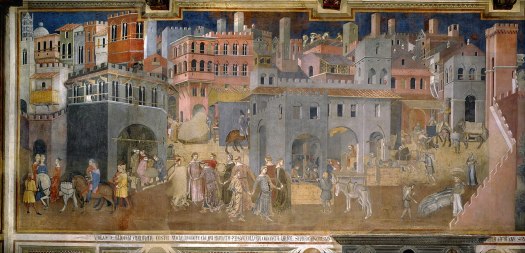
Ambrogio Lorenzetti (1338 – 1339). De effecten van goed bestuur. [Deel uit ‘De allegorie van goed en slecht bestuur’]. Siena, Sala dei Nove.
  1. Deelname, vertegenwoordiging, eerlijk verloop van verkiezingen.
  2. Responsiviteit.
  3. Efficiëntie en effectiviteit.
  4. Openheid en transparantie.
  5. Rechtsstaat.
  6. Ethisch handelen.
  7. Competentie en capaciteit.
  8. Innovatie en openheid voor verandering.
  9. Duurzaamheid en langetermijnvisie.
  10. Deugdelijk financieel beheer.
  11. Mensenrechten, culturele diversiteit en sociale cohesie.
  12. Verantwoordingsplicht.

De overlevering leert ons dat hiervoor een hoog organiserend vermogen nodig is van de bestuurders en managers die de principes geacht worden te hanteren. Siena werd in de veertiende eeuw – toen een staat, geen stad – erg goed geleid. Persoonlijke kwaliteiten dus. Anders gezegd: Siena kwam tot bloei omdat er goede bestuurders zaten. Het is spannend om te weten waar mechanismen van bijsturing zitten en hoe deze werken, indien niet voldaan wordt aan één of meer van de principes.

Wat was hun geheim, wat hun competenties? Een addendum bij deze principes inzake de noodzakelijke competenties is eigenlijk gewenst. Wij weten: zonder goede mensen, geen succes.

A Research Agenda for Governance

Guy Peters, Jon Pierre, Eva Sørensen, Jacob Torfing* | 2022

This incisive Research Agenda for Governance, published by Edward Elgar Publishing**, draws together unique contributions from leading scholars to examine the two distinct models of governance: the traditional model, based on the state and exercise of control through law and bureaucracy, and an alternative model centred on the collaboration of public and private sector actors.

Introducing the essential principles and rationale of these alternative models of governance, both of which can be seen operating at all levels of government in democratic as well as non-democratic regimes, the chapters evaluate the strengths and weaknesses of the two systems. Drawing conclusions from critical areas of inquiry, including multi-level governance, the nature of governance in democratic and authoritarian regimes, and digital innovations in governance, the book offers a richly detailed insight into the respective workings of the models of governing by control and by collaboration.

Lees verder →