The UK Government Resilience Framework

HM Government, Cabinet Office | 2022

The professionalism and commitment of the people who contribute to the UK’s resilience is extraordinary, and we have a well-established framework for civil protection in the UK. But the last few years have exposed the need to build on these solid foundations and strengthen our resilience to prevent, mitigate, respond to and recover from the nation’s risks.

That is why the UK Government committed, in the Integrated Review, to a new Resilience Strategy: The UK Government Resilience Framework (pdf) or online.

Lees verder

Risk Governance: towards and integrative approach

A framework by International Risk Governance Council

Ortwin Renn, with annexes by Peter Graham | 2005

In this comprehensive white paper Risk Governance: Towards an integrative approach – coordinated and edited by Professor Ortwin Renn – the International Risk Governance Council (IRGC) brought together: “an integrated analytic framework for risk governance which provides guidance for the development of comprehensive assessment and management strategies to cope with risks, in particular at the global level. The framework integrates scientific, economic, social and cultural aspects and includes the effective engagement of stakeholders.” 

In this article the headlines are summarized. In the light of history this framework is noteworthy and marks the next phase in thinking of the risk concepts. It focuses on “the improvement of risk governance strategies for risks with international implications and which have the potential to harm human health and safety, the economy, the environment, and/or the fabric of society at large.”

Lees verder

12 Principes van Goede Besturing

Raad van Europa | 2008

De Raad van Europa heeft 12 principes voor goede besturing vastgesteld. Zij dienen als uitgangspunten, randvoorwaarden en richtlijnen bij het effectief handelen in publieke zaken. Het is een nobele set van principes en een aansporing voor bestuur, bestuurder, organisatie, manager en medewerker.

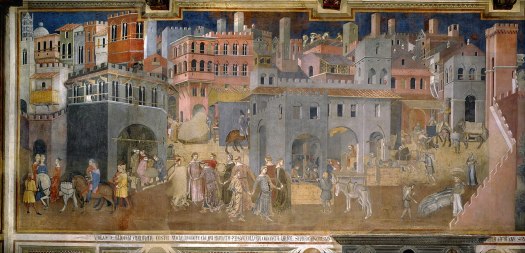
Ambrogio Lorenzetti (1338 – 1339). De effecten van goed bestuur. [Deel uit ‘De allegorie van goed en slecht bestuur’]. Siena, Sala dei Nove.
  1. Deelname, vertegenwoordiging, eerlijk verloop van verkiezingen.
  2. Responsiviteit.
  3. Efficiëntie en effectiviteit.
  4. Openheid en transparantie.
  5. Rechtsstaat.
  6. Ethisch handelen.
  7. Competentie en capaciteit.
  8. Innovatie en openheid voor verandering.
  9. Duurzaamheid en langetermijnvisie.
  10. Deugdelijk financieel beheer.
  11. Mensenrechten, culturele diversiteit en sociale cohesie.
  12. Verantwoordingsplicht.

De overlevering leert ons dat hiervoor een hoog organiserend vermogen nodig is van de bestuurders en managers die de principes geacht worden te hanteren. Siena werd in de veertiende eeuw – toen een staat, geen stad – erg goed geleid. Persoonlijke kwaliteiten dus. Anders gezegd: Siena kwam tot bloei omdat er goede bestuurders zaten. Het is spannend om te weten waar mechanismen van bijsturing zitten en hoe deze werken, indien niet voldaan wordt aan één of meer van de principes.

Wat was hun geheim, wat hun competenties? Een addendum bij deze principes inzake de noodzakelijke competenties is eigenlijk gewenst. Wij weten: zonder goede mensen, geen succes.

A Research Agenda for Governance

Guy Peters, Jon Pierre, Eva Sørensen, Jacob Torfing* | 2022

This incisive Research Agenda for Governance, published by Edward Elgar Publishing**, draws together unique contributions from leading scholars to examine the two distinct models of governance: the traditional model, based on the state and exercise of control through law and bureaucracy, and an alternative model centred on the collaboration of public and private sector actors.

Introducing the essential principles and rationale of these alternative models of governance, both of which can be seen operating at all levels of government in democratic as well as non-democratic regimes, the chapters evaluate the strengths and weaknesses of the two systems. Drawing conclusions from critical areas of inquiry, including multi-level governance, the nature of governance in democratic and authoritarian regimes, and digital innovations in governance, the book offers a richly detailed insight into the respective workings of the models of governing by control and by collaboration.

Lees verder

Future Global Shocks

Improving Risk Governance

European Parliament | 2022

This report addresses risks and building capabilities for Europe in a contested world. The coronavirus crisis has demonstrated that the European Union faces various risks, that those disparate risks are interlinked, and that the response to such challenges to the Union is stronger with the Union and its Member States acting together.

Russia’s war on Ukraine, launched while this study was being drafted, shows us more than just the added value of the Union’s concerted action and the ability of EU institutions and Member States to find new and effective solutions to deal with major shocks.

Risks and policy responses linked

This paper, the first in an annual series, seeks to assess the risks to, and capabilities and resilience of, the EU system. Building on a review of global risks, it considers specific risks with the potential to harm Europe and its people in detail.

It then sets out options for policy responses to ensure Europe can address the dangers of such risks and minimise the potential damage. Among the options set out are those previously included in European Parliament resolutions, in positions from other EU institutions, and in policy papers from think tanks and stakeholders.

Lees verder

COSO

Committee of Sponsoring Organizations (COSO) | 1985

This Internal Control—Integrated Framework was developed by the Committee of Sponsoring Organizations (COSO) of the Treadway Commission.

The American Accounting Organization (AAA), American Institute of Certified Public Accountants (AICPA), Financial Executives International (FEI), Institute of Internal Auditors (IIA), and Institute of Management Accountants (IMA) Organizations seeking to scale find that this framework offered an approach to enterprise risk management (ERM) sensitive to variability from one organization to the next.

Lees verder

(Global) Resilient Cities Network

Global Resilient Cities Network | 2019

The 100 Resilient Cities network continues its goals under the provisional name Global Resilient Cities Network (GRCN). The year 2019 has been a year of significant change.

At the Urban Resilience Summit in Rotterdam, 100 cities worldwide came together under the name 100 Resilient Cities (100RC). Rotterdam, as one of the 100 Resilient Cities, acted as the host city because of its exemplary role as a resilient city.

From medio 2019, the 100RC network will continue under the provisional name (Global) Resilient Cities Network (GRCN). GRCN is leading the global conversation on building resilient cities, or in other words, making cities resilient and future-proof, to accelerate climate action and social and economic resilience, among other things.

Lees verder