Op basis van een serie interviews met bestuurders en managers in het publieke domein, hebben wij de volgende ‘eenvoudige’ formule ontwikkeld om ex ante de kans op Resultaat van besturing te kunnen bepalen. De formule is ontwikkeld binnen het publieke domein van de gemeente, vanuit de unieke positie die wij mochten hebben als gemeentesecretaris. De formule:
SK x OK x IV = R
Er is bij toepassing ervan, bij de start, te allen tijde een voorliggende kwestie nodig die concreet op tafel ligt en die opgelost dient te worden. Immers, anders valt er niets te besturen. De formule komt dáár tot zijn recht, omdat er dan de meeste winst te behalen valt in de kwaliteit van de besturing of het management. De koppen in het dagelijkse nieuws, de verkiezingsprogramma’s en collegeakkoorden maken duidelijk dat het arsenaal van kwesties rijkelijk aanwezig is. Genoeg keuze dus.
Er zijn in de formule, die met uiterste zorg is ontwikkeld, drie determinanten die zich in de vorm van een vermenigvuldiging voordoen en die bepalend zijn voor het uiteindelijke resultaat.
We entered our news and reports into our database, combined them with our surveys related to the FORTE® Framework, a scan of our LinkedIn network posts and asked our AI companion to summarize the headlines as of 23 March 2026.
The results are highly recognisable and comparable with recent surveys by the United Nations, the European Commission, and the World Economic Forum. The results are, in our view, the starting point for action; however, the question arises, by whom exactly?. The fact is that the government and its political leaders are the main players involved in public values and play a dominant role in causing public risks, as mentioned. It seems that leadership itself is under the microscope, and the main factor behind the subtitle of this reporting: ‘the Risk of Leadership’.
Definitions
We used the following definitions.
“Public value refers to the value created by the government through laws, regulations, services, and any other action. In a democratic society, this value is defined by the public itself. Value is determined by citizens’ preferences expressed in a variety of ways, and thus it provides a rough yardstick against which to gauge the public institutions and government policies.” Moore (1995).
Public Risk is defined as ‘possible harm to a chosen public value’, as derived from Kates & Kasperson (1983) and Renn & Klinke (2002).
Public Values
Based on recent Eurobarometer surveys and European public debates (2024-2025), the public values most mentioned as being at stake for European citizens are fundamentally linked to democracy, security, and social cohesion. These values are seen as vital to maintaining stability in a turbulent geopolitical environment. The most frequently mentioned public values at stake include:
[Quote]: “The need to cope with future challenges posed by major transformations such as digitalization and sustainable development has led to several approaches to establish new concepts and methods of science and research.
Scientific studies are supposed to provide background knowledge, to facilitate the desired transformations towards a sustainable future and to help resolving complex problems that accompany societies in transition. Concepts such as transformative, transdisciplinary or co-creative approaches elucidate the direction in which scientific research strives for its new role(s).
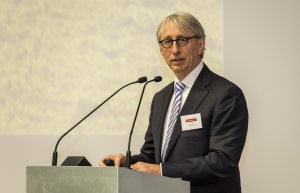
During the Local Government Risk Conference on 17 January 2018 at the Provincial Government Building in Utrecht, a group of experts discussed the key aspects of governance and control as they relate to municipal organisations.
Jack P. Kruf during his keynote speech at the Provincial Government Building in Utrecht. (2018), Risk & Compliance Platform Europe
In his keynote, Jack Kruf advocated for a much stronger link between policy content and policy direction. Given the multitude of interests and stakeholders, the segmentation of expertise and levels of government, as well as the fragmentation of knowledge surrounding issues, he believes that local authorities would be wise to take more time for an ex ante governance clause.
What council would not want its programme to be implemented optimally and effectively? According to him, this does, however, require genuine dialogue and engagement with all stakeholders at the outset. So not just more programme adoptions that focus purely on content, but also explicitly highlight their governance.
Governance in itself – in programmes and agreements by councils and executive bodies – therefore demands our full attention. The quality of public governance has become part of the quality of the public sphere and, consequently, of the public debate. We can no longer avoid explicitly addressing and embedding governanceex ante.
According to Kruf, this governance section is much more than the current ‘risk management and resilience’ section. The latter merely lifts a corner of the veil, and even then only in financial terms. Not unimportant, but resilience is no longer exclusive; it is often purely financially focused, written from a defensive and safeguarding perspective, and does not really address other relevant governance variables, relationships, and connections that play a role in the genuine administration and management of the city, its innovation, and development.
Resilience is good, but not inspiring enough and, moreover, technically wholly inadequate to enable us to discover and dare to explore new paths and set out on them. He quotes a councillor and a mayor from the network:
“Resilience is a theoretical exercise that paints a false picture of reality. I’ve never understood it. More than once, it has served as a smokescreen under which a project was sold.” – Councillor.
“Resilience serves to enable the council to account for its actions in broad terms, rather than to steer them. In practice, other forces – including political ones – determine whether a project is or should be feasible.” – Mayor.
According to Kruf, the new, much broader governance section should describe and (administratively) set out how the council’s programme itself can be steered and managed, and what specific roles the council, the executive committee, and the civil service organisation play in this, alongside social actors and institutions. The section should highlight all elements of governance necessary for performance, results and success. According to him, there are five elements that must be present simultaneously for this to be effective. These are:
Sound financial design and compliance, going hand in hand and, above all, realistic.
A focus by the administration and senior management on the target group (the citizen, the neighbourhood, the young person), on the objective and on the actual delivery of products and services.
Public leadership and stewardship that connects and stands up for its cause.
Tools and organisational capacity to bring plans to fruition.
Focus on the environment: horizontally towards fellow local authorities, market parties and relevant interest groups; vertically towards higher-level authorities, towards sections of society and towards the natural environment and its carrying capacity.
When launching a new programme, a municipal executive could ask its municipal secretary and group controller to draw up a proposal for this governance section. As leading experts in command and control, they are ideally placed to advise the executive on this matter. Indeed, they may be better suited to do so, as they understand the entire landscape. In this section, the five points mentioned above are linked to the executive’s programme.
It goes without saying that governance itself also requires investment. The world is changing, as are the players, and so too must governance. Sometimes this involves the appropriate structuring of a project, process or programme, but it may also concern the development of new roles, thinking in terms of new scenarios, the reorganisation of organisational units, entering into different forms of collaboration or contractual arrangements, or communicating differently with citizens and businesses. Governance itself must then also be budgeted for, regarded as a critical success factor, and embedded. Quality governance costs money, but it also delivers greater returns and can no longer be regarded as merely an afterthought to the substance.
The governance section is, in anticipation of the council’s own in-control statement to be issued in the near future, actually a logical concept. Governance itself thus becomes a fully-fledged factor within the political and administrative sphere. Something that was sorely needed, however contradictory this may sound. Governance too often appears to be a stepchild, resulting in significant public risks.
Kruf cites several examples in his argument. He also quotes from the World Economic Forum’s Global Risks Report 2018, published on the same day. The governance section could broaden the basis for lawful action, both administratively and within the civil service. After all, every euro of taxpayers’ money must be handled with care. And good governance helps with that, he is convinced.
In Kruf’s view, a council programme with a sound and widely supported governance section serves as an inspiration for the success not only of the municipality as an organisation, its executive or council, but also of the municipality as a community of citizens, businesses and institutions, as well as the municipality as a geographical area. In his view, ‘control’ will take on a much more proactive role than it currently does. The reactive role is ‘out’, the proactive role is ‘in’. Control should be able and allowed to play that role. In the coming years, the field of control could evolve into that of governance architecture.
This calls for a new mindset among managers, namely the willingness to bring this knowledge to the forefront of the process. That is not the case at present. Utilising the knowledge, insights, expertise, and skills of (group) controllers and managing directors may well be essential for developing the necessary management capacity. The link between substance and integrated business management, in other words. More, therefore, than just finance and compliance. This is not only challenging but, in fact, calls for a broad reassessment of the expertise of both command and control.
The world has entered a new dynamic. And we know – as Herman Gorter opened his 1889 book ‘Mei’: “A new spring and a new sound…”. In this new spring, substance and governance must be much better linked. The integrated governance section can help with this.
Kruf, J. (2018). PRIMO bepleit Besturingsparagraaf: Van weerstandsparagraaf naar corporate sturing. In J.P. Kruf & E.J. Frank. Publiek Risico: Essays, Stichting Civitas Naturalis, 2020,pp. 708–713.
Sea levels are rising, and the rate of rise is accelerating. All over the world, many of today’s dikes, sea walls and flood barriers won’t be enough to hold back the water in the future. This will be particularly a problem in countries that lack the resources to maintain or fund extensive engineering projects to protect their citizens. But we can all learn from alternative, more affordable and flexible approaches that adapt to the rising water currently emerging all around the world.
Rather than only battling to keep ever-rising seas out, these natural solutions aim to help rebuild land above sea level. Researchers from Utrecht University are testing which of these strategies will work for specific regions to help tame the tide. And they’re also thinking ahead: how can we minimise the damage and ensure people have somewhere safe to go when the water does come?
Kaleidoscope is an internationally developed educational program that provides a holistic, dialogue-oriented approach to public risk. Discussing relevant themes such as cybersecurity, social cohesion, city management, adaptation to climate change, proper water management, and added-value through partnership, and getting familiar with the best concepts, methods, and techniques to manage risk, and learning from authoritative scientists and practitioners.
The program provides insight into how public values and risks intersect, as well as how to design effective governance mechanisms. The education program consists of three main perspectives and is offered in a modular format with capita selecta:
Craftsmanship of risk management (general overview of risks, drivers, frameworks, techniques).
Establishment and governance of specific values (i.e., topic-related approach of risk, resilience, scenarios, from the organisation and client perspective).
Personal skills (how to act, interact, communicate, learn, and develop yourself).
De PRIMO Risk Management Award is in 2007 in het leven geroepen door het bestuur van PRIMO Europe om de inspanningen en normen te erkennen die in onze steden en regio’s worden bereikt bij het creëren en implementeren van risicobeheermechanismen voor een veiligere en efficiëntere omgeving.
PRIMO Risk Management Award
De prijs is bedoeld voor innovatieve benaderingen van risicomanagement die aantoonbare voordelen opleveren in termen van verbeterde processen, kostenverlaging en inbedding van risicomanagement in een organisatie. De prijs wordt toegekend ongeacht de omvang van de organisatie, het niveau van de financiële investering of de hoeveelheid middelen die aan het project of initiatief zijn besteed.
Met deze prijs, bestaande uit een beeld en een laudatio, wil PRIMO bestuurders en managers in het publieke domein aanmoedigen om mee te doen aan deze prijs om onze vereniging te steunen bij het promoten en onder de aandacht brengen van risicomanagement in heel Europa, en om het aanzienlijke werk en de inspanningen die dagelijks op dit gebied worden verricht te laten zien.


 PRIMO Res Publica