Mercy Mercy Me (The Ecology)

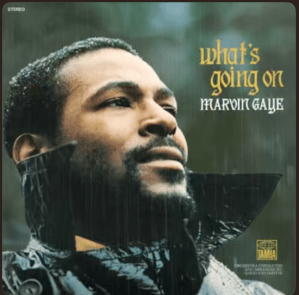
Marvin Gaye | 1971

Woah, ah, mercy, mercy me
Ah, things ain’t what they used to be (ain’t what they used to be)
Where did all the blue skies go?
Poison is the wind that blows
From the north and south and east

(Listen to song on Apple Music or Spotify)

Woah, ah, mercy, mercy me
Ah, things ain’t what they used to be (ain’t what they used to be)
Where did all the blue skies go?
Poison is the wind that blows
From the north and south and east

Woah, mercy, mercy me, yeah
Ah, things ain’t what they used to be (ain’t what they used to be)
Oil wasted on the ocean and upon our seas
Fish full of mercury

Oh Jesus, yeah, mercy, mercy me, ah
Ah, things ain’t what they used to be (ain’t what they used to be)
Radiation underground and in the sky
Animals and birds who live nearby are dying

Hey, mercy, mercy me, oh
Hey, things ain’t what they used to be
What about this overcrowded land?
How much more abuse from man can she stand?

Oh, na, na, na
Oh, oh, oh, oh, oh
Hey, ooh, woo

Bibliography

Gaye, M. (1971) Mercy Mercy Me (The Ecology). Album: What’s Goin on. Detroit: Motown.

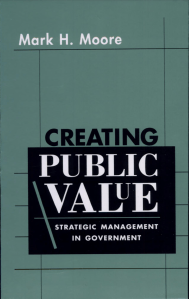
Creating Public Value

Strategic management in government

Mark H. Moore | 1995

Public Value is a theory for public management advanced by Professor Mark Moore of the Harvard Kennedy School. Over the previous two decades, staff and students at Harvard’s Kennedy School of Government, where Moore taught, engaged in conversations about producing excellence in public management.

“Public value refers to the value created by the government through laws, regulations, services and any other action. In a democratic society, this value is defined by the public themselves. Value is determined by citizens preferences expressed in a variety of ways and thus it provides a rough yard stick against which to gauge the public institutions and government policies.”

A seminal figure in the field of public management, Mark Moore presents his summation of 15 years of research, observation, and teaching on what public-sector executives should do to improve the performance of public enterprises.

Lees verder

Uncertain safety

WRR Scientific Council for Government Policy | 2008

In view of the vulnerability of humans, society and the natural environment, a proactive approach to uncertainties is required. A precautionary approach will create new responsibilities for the government, the private sector and consumers, as well as new activities. In its report Uncertain safety (Report no. 82, 2008), the WRR recommends inserting the new precautionary principle in the Constitution.

Not so much risks as uncertainties

The classical risk approach has limitations as a result of social developments (food safety, new technologies and climate change, for example) and progressive scientific insights. Society is not so much confronted with risks as with uncertainties. These uncertainties have to be addressed in an organised manner.

Lees verder

Risk Governance: towards and integrative approach

A framework by International Risk Governance Council

Ortwin Renn, with annexes by Peter Graham | 2005

In this comprehensive white paper Risk Governance: Towards an integrative approach – coordinated and edited by Professor Ortwin Renn – the International Risk Governance Council (IRGC) brought together: “an integrated analytic framework for risk governance which provides guidance for the development of comprehensive assessment and management strategies to cope with risks, in particular at the global level. The framework integrates scientific, economic, social and cultural aspects and includes the effective engagement of stakeholders.” 

In this article the headlines are summarized. In the light of history this framework is noteworthy and marks the next phase in thinking of the risk concepts. It focuses on “the improvement of risk governance strategies for risks with international implications and which have the potential to harm human health and safety, the economy, the environment, and/or the fabric of society at large.”

Lees verder

Is the end of risk management near?

A collective reconsideration

Marinus de Pooter | 2015

For those who listen in various sectors, the picture quickly emerges that risk management is not successful in practice. And that despite all the investments made and the energy that has been put into it in recent years. If risk management does indeed bring so much good (as is usually claimed), how is it possible that line managers do not flock to training and conferences? Why don’t they queue up to learn more about all those wonderful concepts and tools (including the many impressive software applications)? As a management system, has it sold so badly or can it simply not deliver what is promised? Perhaps it is a combination of both. It’s time for something better. As far as I am concerned, the end of conventional risk management is near. I refer to the instrumental approach from a separate staff function. The limited enthusiasm for this usual setup is due to several factors. I will mention a number of observations from the consultancy practice.

Marinus de Pooter

Usually, risk management is invested in a separate function or in different specialised functions such as Security, Quality and Safety, et cetera. This easily leads to responses from line managers along the lines of: “We hired you to take care of those (information security) risks!” Regulators have devised the creation of a separate Risk Management department (or even a separate CRO function) as a counterbalance to the overthrown ambitions of line managers. However, just because of the differences in personalities, its effectiveness can only be limited. If you do something about risk management, because your supervisor requires it or because the head office requires it from you, it will not easily be embedded in your day-to-day operations. If you use it as an accountability tool, it will at most help to give supervisors a sense of (false) security.

Lees verder

Prospect Theory

An analysis of decision under risk

Daniel Kahneman and Amos Tversky | 1979

This paper presents a critique of expected utility theory as a descriptive model of decision making under risk, and develops an alternative model, called prospect theory.

Choices among risky prospects exhibit several pervasive effects that are inconsistent with the basic tenets of utility theory. In particular, people underweight outcomes that are merely probable in comparison with outcomes that are obtained with certainty. This tendency, called the certainty effect, contributes to risk aversion in choices involving sure gains and to risk seeking in choices involving sure losses.

In addition, people generally discard components that are shared by all prospects under consideration. This tendency, called the isolation effect, leads to inconsistent preferences when the same choice is presented in different forms.

An alternative theory of choice is developed, in which value is assigned to gains and losses rather than to final assets and in which probabilities are replaced by decision weights.

The value function is normally concave for gains, commonly convex for losses, and is generally steeper for losses than for gains.

Decision weights are generally lower than the corresponding probabilities, except in the range of low probabilities. Overweighting of low probabilities may contribute to the attractiveness of both insurance and gambling.

Bibliography

Kahneman, D. and Tversky, A. (1979) ‘Prospect Theory: An Analysis of Decision Under Risk’. Econometrica, 47, 263-291.

Download essay.

AR6 Synthesis Report Climate Change 2023

IPCC | 2023

Interlaken, Switzerland, March 20, 2023 —

This IPCC report focuses sharply on the losses and damages we are already experiencing and will continue to experience, especially those hitting the most vulnerable people and ecosystems. Taking the right action now could result in the transformational change essential for a sustainable, equitable world.

There are multiple, feasible and effective options to reduce greenhouse gas emissions and adapt to human-caused climate change, and they are available now, said scientists in the latest Intergovernmental Panel on Climate Change (IPCC) report released today.

“Mainstreaming effective and equitable climate action will not only reduce losses and damages for nature and people, it will also provide wider benefits,” said IPCC Chair Hoesung Lee. “This Synthesis Report underscores the urgency of taking more ambitious action and shows that, if we act now, we can still secure a liveable sustainable future for all.”

In 2018, IPCC highlighted the unprecedented scale of the challenge required to keep warming to 1.5°C. Five years later, that challenge has become even greater due to a continued increase in greenhouse gas emissions. The pace and scale of what has been done so far, and current plans, are insufficient to tackle climate change.

Lees verder