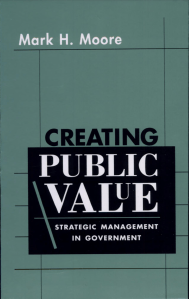
Creating Public Value

Strategic management in government

Mark H. Moore | 1995

Public Value is a theory for public management advanced by Professor Mark Moore of the Harvard Kennedy School. Over the previous two decades, staff and students at Harvard’s Kennedy School of Government, where Moore taught, engaged in conversations about producing excellence in public management.

“Public value refers to the value created by the government through laws, regulations, services and any other action. In a democratic society, this value is defined by the public themselves. Value is determined by citizens preferences expressed in a variety of ways and thus it provides a rough yard stick against which to gauge the public institutions and government policies.”

A seminal figure in the field of public management, Mark Moore presents his summation of 15 years of research, observation, and teaching on what public-sector executives should do to improve the performance of public enterprises.

Lees verder

Staat van het Bestuur 2022

Ministerie van Binnenlandse Zaken en Koninkrijksrelaties (BZK) | 2022

De Staat van het Bestuur biedt elke twee jaar een beeld van hoe het decentrale openbaar bestuur in Nederland ervoor staat. Het bundelt actualiteiten, trends en ontwikkelingen en combineert de functie van langjarige monitoring en signalering voor de kortere termijn.

Naast de constanten die het openbaar bestuur in Nederland kenmerken, toont de Staat van het Bestuur 2022 een beeld van een openbaar bestuur dat vanuit verschillende kanten onder druk staat. Internationale, economische, ecologische en maatschappelijke ontwikkelingen en crisissituaties stellen het bestuur voor uitdagingen in een omgeving waarin het vertrouwen in de politiek onder druk staat en er beperkte middelen beschikbaar zijn. In het decentraal bestuur zelf neemt de versnippering toe en is ook het verloop onder bestuurders en volksvertegenwoordigers groot.

In deze context werpen het themahoofdstuk in de Staat, van de hand van Albert Jan Kruiter, en de essaybundel Realiserend bestuur: daadkrachtig en responsief hun licht op een bestuur dat een bijdrage levert aan de oplossing van maatschappelijke problemen: het realiserende bestuur. De perceptie en waardering van een bestuur dat realiseert en ‘presteert’ zijn dynamisch. Het is tijd- en plaatsgebonden en ook in hoge mate politiek bepaald. In deze essaybundel wordt hier vanuit verschillende invalshoeken naar gekeken.

Bibliografie

Ministerie van Binnenlandse Zaken en Koninkrijksrelaties (2022). Staat van het Bestuur 2022. BZK.

Ministerie van Binnenlandse Zaken en Koninkrijksrelaties (2023). Realiserend bestuur: daadkrachtig en responsief. BZK.

Download De Staat van het Bestuur.

Download Realiserend bestuur: daadkrachtig en responsief.

Maatschappelijke bestuurskunde

Hoe verbindende bestuurskundigen (kunnen) inspelen op maatschappelijke vraagstukken

Tom Overmans, Marlies Honingh & Mirko Noordegraaf  (red.) | Boombestuurskunde.

Het vakgebied bestuurskunde heeft zich de afgelopen jaren bewezen. Via opleidings- en onderzoeksprogramma’s, academische netwerken, internationale verbanden, publicaties, symposia en prijzen wordt gewerkt aan de versterking van het openbaar bestuur. Door de jaren heen is het bereik van bestuurskundigen gegroeid. De bestuurskunde draait niet enkel om de overheid, maar richt zich tevens op maatschappelijke dienstverlening, publiek-private samenwerking, coproductie van beleid en diensten en publieke waardecreatie. De laatste tijd werken bestuurskundigen bovendien aan maatschappelijke impact.

Deze bundel gaat een stap verder. De auteurs laten zien dat het tijd is voor een meer ‘maatschappelijke’ bestuurskunde, die zich nadrukkelijker en zichtbaarder richt op de analyse en aanpak van maatschappelijke vraagstukken. Dat is meer dan ‘maatschappelijke impact maken’. Dat is je verbinden aan andere academische disciplines en maatschappelijke velden, waarin de aanpak van concrete issues centraal staat. Denk aan klimaatadaptatie, duurzame landbouw, energietransitie, migratie, wonen, kansengelijkheid, georganiseerde misdaad, houdbare zorg en digitalisering.

Lees verder

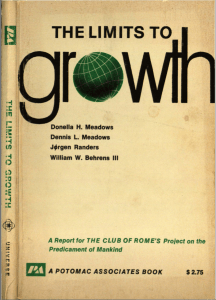
The Limits to Growth

Club of Rome | 1972

In March 1972, a report by a group of young scientists at the Massachusetts Institute of Technology (MIT) commissioned by Aurelio Peccei, founder of The Club of Rome, shook the world. The report excels in system thinking and modelling and in that it is more actual than ever.

Today, 50 years after its publication, “The Limits to Growth” is considered one of the most important and controversial environmental books of all time and it continues to influence conversations around sustainability and our continued existence on this finite planet. Below is the story behind this ground-breaking publication.

Published 1972 – The message of this book still holds today: The earth’s interlocking resources – the global system of nature in which we all live – probably cannot support present economic and population growth rates much beyond the year 2100, if that long, even with advanced technology. In the summer of 1970, an international team of researchers at the Massachusetts Institute of Technology began a study of the implications of continued worldwide growth.

They examined the five basic factors that determine and, in their interactions, ultimately limit growth on this planet-population increase, agricultural production, nonrenewable resource depletion, industrial output, and pollution generation. The MIT team fed data on these five factors into a global computer model. Then it tested the model’s behaviour under several sets of assumptions to determine alternative patterns for mankind’s future. The Limits to Growth is the nontechnical report of their findings.

The book also contains a message of hope: Man can create a society in which he can live indefinitely on earth if he imposes limits on himself and his production of material goods to achieve a state of global equilibrium with population and production in carefully selected balance.


The Limits to Growth, 1972 – key messages:

    • With existing policies, the physical limits to growth would likely be exceeded within one generation.
    • The most likely outcome of reaching these limits would be overshooting them, followed by systems decline.
    • The findings, however, also suggested a viable alternative to these outcomes – one in which population growth and material production could be brought into balance with planetary limits.
    • The fourth conclusion was that it would realistically take 50 to 100 years, or even more, to make this alternative outcome a reality.
    • Finally, the team found that every year action is delayed toward reaching the alternative outcome, decreasing the number of options available to avoid overshoot and collapse.

Bibliography

Meadows, D. H., Meadows, D. L., Randers, J. & Behrens, W. W. (1972). The limits to growth: A report for the Club of Rome’s project on the predicament of mankind. New York: Universe Books.

Limits to Growth (digital scan version, source: https://donellameadows.org)

Short History