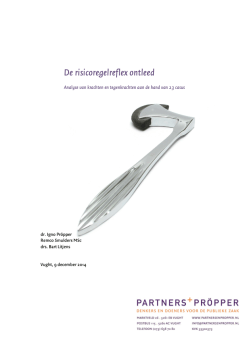
Analyse van krachten en tegenkrachten aan de hand van 23 casus
Igno Pröpper, Remco Smulders en Bart Litjens | december 2014
Dit onderzoek is uitgevoerd in opdracht van het ministerie van Binnenlandse Zaken en Koninkrijksrelaties in het kader van het programma Risico’s en Verantwoordelijkheden.
Reageren overheidsinstanties ondoordacht en te krachtig op incidenten of risico’s? Deze vraag leeft bij Kamerleden, bestuurders en ambtenaren. Het gaat hierbij om het goed inschatten van risico’s en voldoende tijd nemen en krijgen om interventies af te wegen. Minstens zo interessant is de vraag of een risico de verantwoordelijkheid van de overheid is. Schieten we meteen in de reflex dat de overheid het moet oplossen of kan de samenleving dat ook gewoon zelf?
Jack Kruf, Eric Frank and Ronny Frederickx | april 2014
Idea
Gérard Combe and Jack Kruf, board members of the international association PRIMO Europe, proposed during their meeting in Brussels in May 2013 that global developments be brought to the attention of local authorities through a think tank model.
The Union des Dirigeants Territoriaux de l’Europe (UDITE), the leading professional network for directors and senior managers in the public sector in Europe, and the Public Risk Management Organisation (PRIMO), the leading international network for the development of products and the dissemination of knowledge and strategic information for the public sector in Europe, have joined forces to establish the ‘From Global to Local’ think tank. This is regarded as a formal joint project of both organisations. It was developed and implemented at the first think tank held in Amsterdam.
Report of UDITE/ PRIMO Europe Round Table, 25th April 2013, Office EY, Brussels, Belgium.
Ed Mallens and Karl Vanderplaetse | July 2013
PRIMO Europe thanks EY for their hospitality and a special word for Mr. Tristan Dhondt and Mr. Rob Ellermeijer. The round table was supported by Belfius, BNG, and our platinum partner, Risk Management Partners (RMP). We very much appreciate their investment and well-prepared contributions to this round table. The meeting was chaired by ir. Jack Kruf, President of PRIMO Europe. The overview of participants and the PowerPoint presentations used are included in the summary.
Innovation in PPP contracts, modern partnership, and constructive cooperation are topics that can stimulate new developments. It’s the challenge of finding new ways to use PPP contracts in the coming period as part of initiatives to get away from the financial crisis, according to the chairman. He framed the context of this meeting: “Public organizations could give the stimulus for new projects being realized via such contracts”.
Over good governance, leiderschap en risicomanagement
Eric Frank | december 2012
De noodzaak van good governance wordt erkend, maar hoe komt dit ook hoger op de agenda’s? Door duidelijk leiderschap, vertrouwen en openheid. Dit was een van de belangrijkste uitkomsten van de discussiebijeenkomst tussen een aantal gemeenten, de Provincie Noord-Brabant en verbonden partijen, georganiseerd door PRIMO Nederland (Public Risk Management Organisation) in het Provinciehuis van de Provincie Noord-Brabant.
Onder leiding van Mr. Peter Paul Leutscher (partner van Brightrisk en docent aan de Master Risicomanagement UT Twente), presenteerden Rob Ellermeijer RA, voorzitter Government & Public Sector Ernst & Young, Piet Sennema MPM, secretaris-directeur Waterschap Aa en Maas en Drs. Martin Jonker MBA, Concerncontroller gemeente Haarlem, hun inleidingen die ten grondslag lagen aan de dialoog.
Vijf jaar geleden schreef ik een kort artikel met de titel: “Risicomanagement in de publieke en private sector: is er een verschil?” In dat artikel stelde ik dat er weliswaar een sterk argument is dat ‘management management is’ en dat leiderschap in elk type organisatie een beroep doet op gemeenschappelijke kennis, vaardigheden en capaciteiten, maar dat er verschillen zijn en dat deze verschillen het moeilijk maken om te concluderen dat het verbeteren van risicomanagement in de publieke sector simpelweg een kwestie is van het overnemen van praktijken in de private sector. Sinds 2007 is er veel water onder de ‘brug van de publieke sector’ doorgestroomd en ik wil mijn oorspronkelijke stelling enigszins herformuleren.
Peter Young
We moeten voorzichtig zijn met het specificeren van publiek-private verschillen, omdat er een aantal wijdverspreide overtuigingen zijn over verschillen die bij nader inzien niet standhouden. Bijvoorbeeld, het idee dat politiek een exclusief kenmerk is van de publieke sector is gewoon niet waar. Verder worden publieke organisaties, net als privébedrijven, gedreven door zowel korte- als langetermijnoverwegingen. Bovendien zijn sommige private organisaties erg procesgericht en leggen sommige publieke entiteiten de nadruk op output. Ten slotte heeft meer dan dertig jaar experimenteren met uitbesteding, privatisering en publiek-private partnerschappen geleid tot talloze situaties waarin het moeilijk is om te zeggen of we naar een publieke of private onderneming kijken.
Hoe zouden we bijvoorbeeld een regeling noemen waarbij een deelstaatregering een overheidsbedrijf opricht dat vervolgens een joint venture aangaat met openbare en particuliere instellingen – evenals met een groot aantal technische verkopers en consultants uit de particuliere sector – om complex wetenschappelijk onderzoek te ondersteunen, deels namens een nationale overheidsinstantie, maar ook voor particuliere bedrijven? Laten we daarom erkennen dat er veel overeenkomsten zijn tussen management in de publieke en private sector, en veel situaties waarin het echt niet nuttig is om zelfs maar te proberen onderscheid te maken.
Ik zou willen stellen dat het essentiële onderscheid tussen publiek en privaat risicomanagement berust op het idee van ‘publiek risico’. – Peter Young (2012)
Tot zover de overeenkomsten; om het onderscheid te kunnen maken, moeten we ons opnieuw richten op risicomanagement. Er zijn verschillende dingen die kunnen dienen als onderscheidende verschillen, maar ik zou willen betogen dat het essentiële onderscheid tussen publiek en privaat risicobeheer berust op het idee van ‘publiek risico’. Ik moet eerst vaststellen dat publiek risico (in tegenstelling tot privérisico) geen star concept is.
Ongeacht de feitelijke inhoud van een risico, kunnen samenlevingen aan bijna elk risico de status van publiek risico toekennen en inderdaad, als die status eenmaal is toegekend, kan die status in de loop van de tijd blijven bestaan, veranderen of zelfs verdwijnen. Maar voor zover we publieke risico’s kunnen beschrijven, worden ze meestal gekarakteriseerd als risico’s die wijdverspreide (sommigen zouden kunnen zeggen ongedifferentieerde) potentiële gevolgen hebben, of die niet privé kunnen worden afgehandeld, of die een impact hebben op brede politieke/juridische concepten zoals rechten of plichten, en/of die neigen naar hoge niveaus van zowel complexiteit als potentiële impact. Klimaatverandering, bedreigingen voor mondiale economische systemen, terrorisme en natuurrampen zijn allemaal op verschillende manieren beschreven als publieke risico’s.
De kenmerken van deze publieke risico’s brengen een reeks risicobeheerproblemen met zich mee die niet volledig aanwezig zijn in de private sector, waaronder:
Het onvermogen van een overheidsinstantie om zich te onttrekken aan de verantwoordelijkheid voor risico’s die onder haar bevoegdheid vallen.
Frequent onvermogen om markten te gebruiken als instrument voor risicomanagement.
De complexiteit van de reikwijdte en inhoud van risico’s, die het vermogen van afzonderlijke instanties beperken om dergelijke risico’s volledig aan te pakken.
De interactie van risico’s met overheidsdoelen zoals het waarborgen van grondwettelijk gegarandeerde rechten.
De grondwettelijke, wettelijke en juridische bestaansgrond van een overheid, wat leidt tot verschillende risicoblootstellingskwesties (zoals: wie is de ‘eigenaar’ van een overheidsinstantie en dus wettelijk verantwoordelijk voor haar acties?)
Ik zal kort op deze punten ingaan. De betrokkenheid van een overheid bij publieke risico’s ontstaat meestal wanneer individuen (en particuliere markten) niet in staat worden geacht om een goed of dienst efficiënt te leveren, of zelfs helemaal niet, of om de bijbehorende risico’s te beheren. Hoewel we weten dat er gradaties zijn in overheidsinterventie als reactie op publieke risico’s (variërend van het monitoren van een risico tot door de overheid gecontroleerd beheer van dat risico), hebben overheden de neiging om juist in te grijpen vanwege “marktfalen”. Dat wil zeggen dat publieke risico’s bijna per definitie niet privaat beheerd kunnen worden zonder enige betrokkenheid van de overheid. Ook kunnen de effecten van deze risico’s vragen oproepen over rechtvaardigheid en sociale toereikendheid, waardoor het testen van economische efficiëntie politiek en juridisch niet relevant is.
We moeten ook vaststellen dat publieke risico’s niet alleen andere eigenschappen hebben, de aard van de overheid en haar autoriteit en verantwoordelijkheid is ook anders. Als gevolg daarvan kan een overheid vuilnisophaaldiensten privatiseren, of de gezondheidszorg, of gevangenissen, maar de verantwoordelijkheid en autoriteit voor die activiteitengebieden blijft bij de overheid. Iets anders gezegd, als een risico als publiek wordt beschouwd, is het niet mogelijk dat de overheid zich onttrekt aan de verantwoordelijkheid voor dat risico.
Pogingen om publieke activiteiten te privatiseren en uit te besteden hebben uiteenlopende resultaten opgeleverd, maar twee consistente bevindingen zijn: 1) de uitbestedende entiteit versoepelt haar controle op het beheer van risico’s, maar omdat ze nog steeds de verantwoordelijkheid behoudt, 2) de overheid krijgt te maken met onverwachte kosten voor het monitoren van het geprivatiseerde beheer van risico’s (interessant is dat onderzoek aantoont dat haalbaarheidsstudies voor privatisering of uitbesteding consequent geen rekening houden met doorlopende kosten voor het monitoren van risicobeheer).
“We moeten ook vaststellen dat publieke risico’s niet alleen andere eigenschappen hebben, de aard van de overheid en haar autoriteit en verantwoordelijkheid is ook anders.” – Peter Young (2012)
Als we terugkeren van de vorige opmerkingen, kunnen we een bredere bewering doen, namelijk dat overheden bestaan om risico’s te beheren – voornamelijk wat we sociale risico’s zouden kunnen noemen, zoals openbare veiligheid, toegang tot gezondheidszorg, gelijke bescherming onder de wet, onderhoud van veilige infrastructuur en regulering van markten.
Om deze risico’s aan te pakken, zijn overheden gemachtigd om structuren, processen en systemen te creëren die op hun beurt wat we organisatorische of operationele risico’s zouden kunnen noemen genereren; risico’s op brand, ongelukken, letsel bij werknemers, rechtszaken, defecten aan apparatuur, enzovoort.
Deze risico’s zijn vergelijkbaar met private organisatie-/operationele risico’s, maar door de verschillende juridische aard van publieke entiteiten zijn hun gevolgen en implicaties anders. Hoe dan ook, elke beschrijving van risicobeheer binnen publieke entiteiten moet worden georganiseerd rond een breed begrip van de volledige reikwijdte van publieke risico’s waarmee de organisatie te maken krijgt – sommige zijn organisatorisch/operationeel, andere zijn sociaal. Deze meer omvattende benadering van de reikwijdte van de verantwoordelijkheid van de publieke risicomanager past overigens heel goed in het moderne risicomanagementdenken, dat de nadruk legt op holistische, geïntegreerde en benaderingen voor het beoordelen en aanpakken van risico’s.
En hier komen we bij een interessant raadsel dat voortkomt uit het verschil tussen publiek en privaat risicomanagement. Het ‘ding’ (verantwoordelijkheid voor het beheer van publieke risico’s) dat publiek van privaat risicobeheer onderscheidt, is iets dat we eigenlijk niet zo goed doen. Zoals we de afgelopen vijf jaar hebben kunnen zien, is er weinig bewijs dat de publieke sector goed werk heeft geleverd bij het aannemen van een meer consistente en strategische benadering van het beheren van organisatorische en sociale risico’s (kies een voorbeeld: de wereldeconomie, het natuurlijke milieu, multilaterale relaties, volksgezondheid en veiligheid).
Ik ben niet naïef over de institutionele, zelfs filosofische, barrières voor het creëren van een allesomvattende aanpak voor het managen van publieke risico’s. In moderne democratische systemen is efficiëntie soms synoniem met efficiëntie. In moderne democratische systemen is efficiëntie soms zowel een bedreiging als een oplossing – daarom hebben we scheiding der machten in grondwetten opgenomen. En de politiek speelt ook een rol, wat verklaart waarom het reageren op bijvoorbeeld natuurrampen altijd meer steun krijgt na een gebeurtenis dan ervoor. Ik denk dus dat er problemen zijn – sterker nog, er zijn grenzen – aan het vermogen van de publieke sector om risicobeheer volledig te integreren en uit te breiden.
Toch heb ik in een notendop het essentiële probleem/uitdaging/kans voor publieke risicomanagers beschreven en, inderdaad, het essentiële onderscheid tussen publiek en privaat risicomanagement. Het verbeteren van de kwaliteit van publiek risicomanagement vereist een bredere, meer geïntegreerde aanpak van het beoordelen en aanpakken van alle publieke risico’s. Kunnen we onze huidige praktijken op het gebied van risicomanagement veranderen? Kunnen we onze huidige praktijken in die richting laten evolueren? En zo ja, hoe kunnen we ons voorstellen dat dit gebeurt?”
Bibliografie
Young, P. (2012). Reconsidering the Public-Private Risk Sector Management Divide. PRIMO Europe.
Recent werd de aanpak op het gebied van risicomanagement door de gemeente Arnhem in een onderzoek naar 100.000+ gemeenten bestempeld als best practice. De gemeente heeft de afgelopen jaren zijn aanpak van risicomanagement radicaal veranderd. Het is onderdeel geworden van zowel het dagelijks beleid als van de cultuur van de organisatie. Van hoog tot laag zijn mensen van de noodzaak van praktisch risicomanagement doordrongen. Belangrijk is: ‘een proactieve aanpak, goed communiceren met stakeholders, bestaande kennis en menskracht bundelen en verantwoordelijkheid alleen neerleggen waar ze hoort’, vertelt controller Jan-Henk Janssen. Een interview. Lees verder →
Ministry of the Interior and Kingdom Relations, The Netherlands (selection and translation Jack Kruf) | May 2011
One of the most debated and studied terms in the Netherlands is that of the ‘risk-regulation reflex’. This debate began in 2009 and is still ongoing. The reflex in question is “the tendency of the government to constantly reduce risks, whether or not in response to an incident, and to regard this as a self-evident task.” A re-examination provides insight into the quest, particularly in political and administrative circles, to identify the very heart of democracy in the Netherlands.
This is the definition set out in the Risks and Responsibilities Programme adopted by the Ministry of the Interior and Kingdom Relations (2011). The impetus for this arose at the end of 2009, when the Minister of the Interior and Kingdom Relations undertook to provide a general review of the government’s role and responsibility in dealing with (primarily physical) risks and incidents.