Seizing the day

PriceWaterhouseCoopers | 2010

The impact of the global financial crisis on cities and local public services: the ‘Great Recession’ has had a dramatic impact on the financial services sector and other areas of the private sector and highlighted the importance of the role of government at international and national levels in addressing global and systemic risks.

But what has been the global financial crisis’s impact on cities and local governments’ roles and brands? How have their budgets (both costs and revenues) been affected? And how confident are local government leaders in their ability to deal with future threats and, most importantly, effectively and swiftly respond to these challenges?
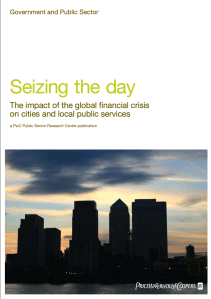
This report addresses these issues based on the findings of an international survey of city and local government leaders, which sought to gauge their reactions and understand their responses to the global financial crisis. It is clear from their reactions that local government leaders have already seen a significant impact on their organisations and brands and a collapse in revenues.

Tough times, hard choices

Tough times are driving innovation, collaboration, and service design and rationalisation. There are winners and losers—local government leaders, particularly in developed countries, who are facing the need to transform in the face of an impending crisis. In contrast, others, particularly in developing countries, have the opportunity to learn the lessons and leapfrog to new models of service delivery, particularly focusing on early intervention and prevention and making more use of commissioning.

Now is a time to get back to basics and focus on those functions where cities and local governments can add the most value and retain the talent critical to these core functions. Greater collaboration between public sector agencies, private and voluntary/not-for-profit organisations, and spatially across geographies is also needed.

Our goals in publishing this report are to outline the challenges and opportunities facing local government leaders following the onset of the global financial crisis and to set out our views on the future for cities and local governments and successful ways for local government leaders to act. The research builds on the insights from PwC’s Global Cities and Local Government Network’s publication ‘Cities of the Future’ and subsequent toolkit, drawing on our experiences working with cities and local governments worldwide.

We appreciate the time the local government leaders took to respond to our survey. This report focuses on the 58 responses we received for the global survey to provide a geographically balanced spread. The results are also split by Developed countries (33 responses) and Developing countries (25 responses), in cities comprising a total population of over 120 million people. We have also commissioned country-specific reports for Brazil, The Netherlands and Sweden, covering an additional 215 cities. The details of our sample and methodology for this global report are in the Appendix.

This report would not have been possible without the active participation of all the contributing cities and local authorities. We would like to thank all respondents for their contributions and whose views form the basis for this report.

Download: Seizing the daytekst
(Global) Resilient Cities Network

Global Resilient Cities Network | 2019

The 100 Resilient Cities network continues its goals under the provisional name Global Resilient Cities Network (GRCN). The year 2019 has been a year of significant change.

At the Urban Resilience Summit in Rotterdam, 100 cities worldwide came together under the name 100 Resilient Cities (100RC). Rotterdam, as one of the 100 Resilient Cities, acted as the host city because of its exemplary role as a resilient city.

From medio 2019, the 100RC network will continue under the provisional name (Global) Resilient Cities Network (GRCN). GRCN is leading the global conversation on building resilient cities, or in other words, making cities resilient and future-proof, to accelerate climate action and social and economic resilience, among other things.

Lees verder

Agenda 21

United Nations | 1992

Agenda 21 is a voluntary action plan developed by the United Nations and national governments at the “Earth Summit” in Rio de Janeiro, Brazil 1992. At the Summit, governmental leaders worldwide agreed on the need to become more sustainable—to meet today’s needs without sacrificing our future.

Agenda 21 presents a vision for how all levels of government—especially in the developing world—can take voluntary action to combat poverty and pollution, conserve natural resources and develop in a sustainable manner. One-hundred-seventy-eight nations, including the United States under the Bush Administration, adopted the agenda.

Preamble

"1.1 Humanity stands at a defining moment in history. We are confronted with a perpetuation of disparities between and within nations, a worsening of poverty, hunger, ill health and illiteracy, and the continuing deterioration of the ecosystems on which we depend for our well-being. However, integration of environment and development concerns and greater attention to them will lead to the fulfilment of basic needs, improved living standards for all, better protected and managed ecosystems and a safer, more prosperous future. No nation can achieve this on its own; but together we can - in a global partnership for sustainable development."

Agenda 21 is not a treaty or legally binding document and does not infringe upon the sovereignty of any nation, state, or local government. Agenda 21 does not advocate for abolishing private property or have any bearing on U.S. local and state land-use decisions. In other words, it isn’t being forced on anybody, anywhere, by any organisation.

A chapter within Agenda 21 introduces the concept of a “Local Agenda 21” and offers a vision for how local governments can develop their own sustainability initiatives.

28.1. Because so many of the problems and solutions being addressed by Agenda 21 have their roots in local activities, the participation and cooperation of local authorities will be a determining factor in fulfilling its objectives. Local authorities construct, operate and maintain economic, social and environmental infrastructure, oversee planning processes, establish local environmental policies and regulations, and assist in implementing national and subnational environmental policies. As the level of governance closest to the people, they play a vital role in educating, mobilizing and responding to the public to promote sustainable development.

A key theme with Agenda 21 was local self-determination and community engagement: “Each local authority should enter into a dialogue with its citizens, local organisations and private enterprises. Through consultation and consensus-building, local authorities would learn from citizens and local, civic, community, business and industrial organisations and acquire the information needed for formulating the best strategies. The process of consultation would increase household awareness of sustainable development issues.”

Download Framework.

INTERFUTURES: Facing the future

The Organisation for Economic Co-operation and Development (OECD) | 1979

Following an initiative by the Government of Japan in May 1975, a major new research project was established within the framework of the OECD on 1st January, 1976, to study “the future development of advanced industrial societies in harmony with that of developing countries”. The project, now referred to as INTERFUTURES ran for a period of three years to 31st December 1978.

Mastering the Probable and Managing the Unpredictable.

The primary purpose of the project, as laid down at the outset by the OECD Council, was: “to provide de OEDC Member Governments an assessment of alternative patterns of longer-term world economic development in order to clarify there implications for the strategic policy choices open to them in the management of their own economies, in relationships among them, and in their relationships with developing countries”.

p. 10: “The publication in 1972 of the Report of the Club of Rome on The Limits of Growth stimulated a decades-old debate, one which is essential for mankind and can be summed up in a single question:

Will the growth in population and in the world economy be helped in the relatively near future by the constraints resulting from the limited availability of the earth’s natural resources or the absorptive capacities of the ecosystem?

If this were to be the case, then efforts would have to be made at once to find ways of achieving another kind of growth which would be more economical in non-renewable resources and less harmful to the physical environment.”

Final chapter p. 423

“A starting point

If the many challenges which the advanced industrial societies will have to meet in the next half-century are to be progressively mastered, nothing is more vital than the establishment in the foremost societies of a solid political leadership capable of taking into account both the long-term issues and the interdependence between the various areas.

Yet the fact has to be faced that in today’s democracies the plans which pay quick dividends have more chance of being carried out than other, more important ones whose benefits are long-term. In election campaigns the long-term issues are often pushed into the background or not mentioned at all, since politicians are convinced, perhaps rightly, that voters look no further than their own private interests and their immediate environment. Things will probably continue this way until the political leaders succeed in producing a vision of long-term objectives that will win the deep conviction of the majority of citizens, but conversely, those same political leaders will need an essential minimum of support from the population in order to embark on this course.

The possible futures described in this report show not only the importance of political dialogue in the democracies of the developed countries, but also the value of informing the public very extensively about trends in the world as a whole.

Scientific circles, the education system and the media should help in this priority task.

    • Where the scientists are concerned, it is not a question of their setting up as specialists in fields other than their own, but of helping as objectively as possible to inform the public of the contribution which the physical, biological or social sciences can make to an understanding of world issues.
    • The education system is a key element of modern democratic societies. In a world of growing interdependence, a knowledge of foreign countries, different cultures and other languages is as crucial for the continental nations like the United States as for the small OECD countries. Furthermore, in societies where the challenges of the future are liable to be political, economic and social, it is probably necessary to think again about how to combine the sound and precise technical training that international competition demands with the outward orientation necessary for a citizen of a democratic country.
    • Finally, the mass media have a responsibility in regard to dissemination of information, critical assessment of policies and introduction of constructive proposals. Often they have simply picked on the sensational aspects of the issues of the future, be it to announce the end of the world or to reassure the uneasy, but they need to do more than disseminate futurological trivia. They must contribute to a realisation by the citizens of developed countries of the tasks that await them and the problems they will have to resolve.

The democratic systems of industrial societies have deep and secure roots. Despite their inadequacies, they should show themselves to be able to face up to the possibilities the future holds. They can ensure that no ageing, sclerosis or withdrawal process threatens those societies in their coexistence with the young societies of the Third World and the socialist world of East Europe.

This report will have achieved its aim if it succeeds in convincing the main active forces in the developed countries to undertake extensive efforts to spread the word about the challenges of the future. Not to develop a resignation to the inevitable but to generate creative responses. Even if many questions remain unanswered or if some of the points of view expressed are debatable, the work of INTERFUTURES should be the starting point for increased allowance for the long term in the policies of governments. For this, which things are necessary:

    • Based on this report, each country looks searchingly into the specific long-term issues with which it will be confronted and then undertakes the necessary additional studies.
    • That the OECD countries then consult one another on the policy conclusions they have drawn from this vast investigation of the long term.”

Report: INTERFUTURES: Facing the future

Emerging Systemic Risks in the 21st Century

The Organisation for Economic Co-operation and Development (OECD) | 2003

What is new about major risks in the 21st century? Recent years have witnessed a host of large-scale disasters of various kinds throughout the world: hugely damaging windstorms and flooding in Europe and ice storms in Canada; new diseases infecting both humans (AIDS, the Ebola virus) and animals (BSE); terrorist attacks such as those of 11 September 2001 in the United States and the Sarin gas attack in Japan; major disruptions to critical infrastructures caused by computer viruses or simply technical failure.

These are just some of the extremely costly disasters that have struck over the past few years. And yet, it is not just the nature of major risks that seems to be changing, but also the context within which they appear and society’s capacity to manage them. The forces shaping these changes are many and varied. For example, weather conditions appear to be becoming increasingly extreme.

Lees verder

The Limits to Growth

Club of Rome | 1972

In March 1972, a report by a group of young scientists at the Massachusetts Institute of Technology (MIT) commissioned by Aurelio Peccei, founder of The Club of Rome, shook the world. The report excels in system thinking and modelling and in that it is more actual than ever.

Today, 50 years after its publication, “The Limits to Growth” is considered one of the most important and controversial environmental books of all time and it continues to influence conversations around sustainability and our continued existence on this finite planet. Below is the story behind this ground-breaking publication.

Published 1972 – The message of this book still holds today: The earth’s interlocking resources – the global system of nature in which we all live – probably cannot support present economic and population growth rates much beyond the year 2100, if that long, even with advanced technology. In the summer of 1970, an international team of researchers at the Massachusetts Institute of Technology began a study of the implications of continued worldwide growth.

They examined the five basic factors that determine and, in their interactions, ultimately limit growth on this planet-population increase, agricultural production, nonrenewable resource depletion, industrial output, and pollution generation. The MIT team fed data on these five factors into a global computer model. Then it tested the model’s behaviour under several sets of assumptions to determine alternative patterns for mankind’s future. The Limits to Growth is the nontechnical report of their findings.

The book also contains a message of hope: Man can create a society in which he can live indefinitely on earth if he imposes limits on himself and his production of material goods to achieve a state of global equilibrium with population and production in carefully selected balance.


The Limits to Growth, 1972 – key messages:

    • With existing policies, the physical limits to growth would likely be exceeded within one generation.
    • The most likely outcome of reaching these limits would be overshooting them, followed by systems decline.
    • The findings, however, also suggested a viable alternative to these outcomes – one in which population growth and material production could be brought into balance with planetary limits.
    • The fourth conclusion was that it would realistically take 50 to 100 years, or even more, to make this alternative outcome a reality.
    • Finally, the team found that every year action is delayed toward reaching the alternative outcome, decreasing the number of options available to avoid overshoot and collapse.

Bibliography

Meadows, D. H., Meadows, D. L., Randers, J. & Behrens, W. W. (1972). The limits to growth: A report for the Club of Rome’s project on the predicament of mankind. New York: Universe Books.

Limits to Growth (digital scan version, source: https://donellameadows.org)

Short History

Brundtland Report

United Nations | April 1987

The first explicit common reference to sustainable development was in the 1987 Brundtland Report Our Common Future of the United Nations Commission on Environment and Development.

In this report, sustainable development was defined as: “development that meets the needs of the present without compromising the ability of future generations to meet their own needs”. In 1987 the need for cooperating on this was high.

Lees verder