Third-Party Risk Policies in The Netherlands

A Historical Sketch 

Ben Ale | April 2023, Cambridge Scholars Publishing

It is not easy to keep the population safe in a country that is one of the most densely populated in the world, a hub of international transport over land and water and through the air, about one-third of which lies below sea level.

.

Third-party risk policies developed gradually in The Netherlands but became acute in the late 20th century as various industries increased their use and production of hazardous materials.

The Dutch government, considering its constitutional responsibility to protect the life, health and well-being of its people, must resolve the ongoing debate between the general population, who are exposed to these risks, and those profiting from the creation of said risks-the resultant policies are a product of this balancing act.

Lees verder →
Cooperation PRIMO Europe and UDITE 2013-2014

Brussels, October 2012

UDITE and PRIMO have signed a partnership agreement for 2013 and 2014. Cooperation on administrative issues is necessary to provide the European network of municipal secretaries with practical solutions. Knowledge exchange and dialogue are crucial.

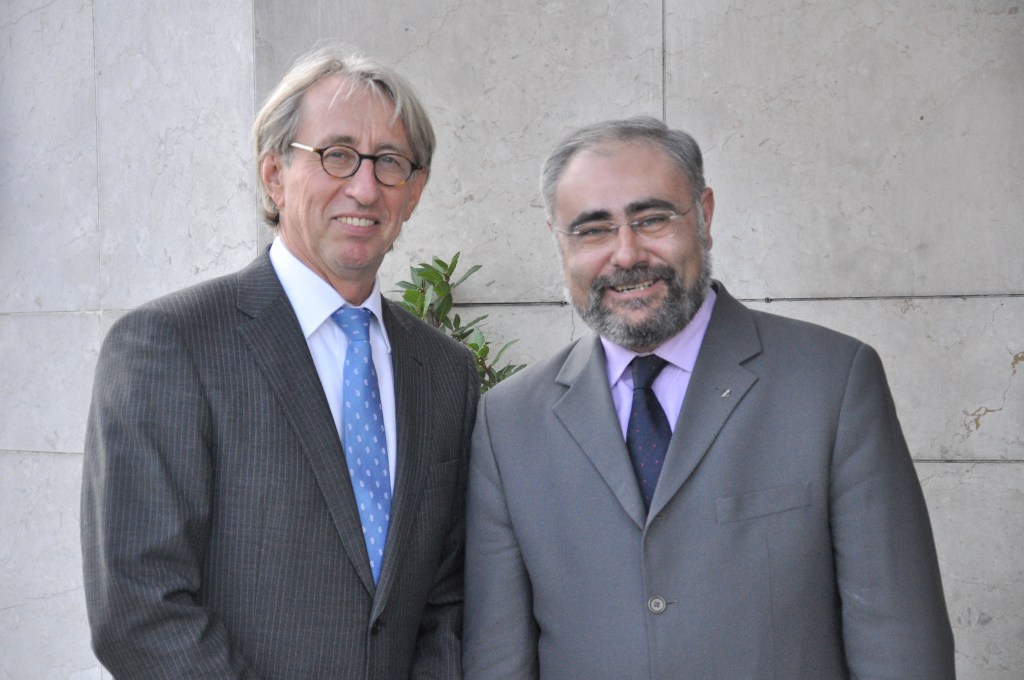
In Brussels, the Union des Dirigeants Territoriaux de l’Europe (UDITE, the European association of municipal secretaries), represented by its president Eulalio Ávila Cano, who is also president of COSITAL (Consejo General de Colegios Oficiales de Secretarios, Interventores y Tesoreros de Administración Local, the Spanish association of municipal secretaries, controllers, and financial managers), and the Public Risk Management Organisation (PRIMO) Europe, represented by John O’Dea (secretary general of PRIMO Europe and president of PRIMO Malta) and Jack Kruf (president of PRIMO Europe).

Jack Kruf (left) and Eulalio Ávila Cano

The collaboration will have a renewed focus: strengthening the administrative capacity of local government (enhanced public governance) in general and public-private partnerships in particular.

Lees verder →

PPP as innovation in the public domain

Report of UDITE/ PRIMO Europe Round Table, 25th April 2013, Office EY, Brussels, Belgium.

Ed Mallens and Karl Vanderplaetse | July 2013

PRIMO Europe thanks EY for their hospitality and a special word for Mr. Tristan Dhondt and Mr. Rob Ellermeijer. The round table was supported by Belfius, BNG, and our platinum partner, Risk Management Partners (RMP). We very much appreciate their investment and well-prepared contributions to this round table. The meeting was chaired by ir. Jack Kruf, President of PRIMO Europe. The overview of participants and the PowerPoint presentations used are included in the summary.

Innovation in PPP contracts, modern partnership, and constructive cooperation are topics that can stimulate new developments. It’s the challenge of finding new ways to use PPP contracts in the coming period as part of initiatives to get away from the financial crisis, according to the chairman. He framed the context of this meeting: “Public organizations could give the stimulus for new projects being realized via such contracts”.

Lees verder →

The Financial Crisis

An opportunity for balancing risks in Infrastructure Projects and Public-Private Partnerships?

Philippe Auzimour and Sabrina Boshuizen | December 2009

Partnership risk is seen as one of the main risks by Public Entities in the Risk Survey Marsh and PRIMO Europe conducted in the third quarter of 2009. The survey shows that 59% of participants rate partnership risk significant, a similar amount as for public liability and business continuity risks.

All over Europe, unsuccessful projects have increased by the downturn. As a result the number of transactions and the total value has gone down. The companies bidding for projects now find it difficult to raise the capital and finance to carry them out, and public entities have their own problems in this regard, as the institutions funding their debt are running into trouble. These issues will all have impact on the time it takes for a project to reach its financial close and will increase partnership risk, whatever the contractual arrangement.

Lees verder →

PPP is a mindset, not a way of building

Harry Sterk* | april 2010

The major differences between traditional and PPP projects, according to Harry Sterk, lie in how costs are defined and how building plans are developed. In a PPP project, total costs are assessed in light of the project’s lifecycle.

Harry Sterk

Traditionally, the focus is on initial construction costs and omits, for instance, maintenance and other ‘post-initial’ costs. The initiator doesn’t make a detailed plan but instead formulates what has to be done within a certain framework: the output specifications.

Lees verder →