The Limits to Growth

Club of Rome | 1972

In March 1972, a report by a group of young scientists at the Massachusetts Institute of Technology (MIT) commissioned by Aurelio Peccei, founder of The Club of Rome, shook the world. The report excels in system thinking and modelling and in that it is more actual than ever.

Today, 50 years after its publication, “The Limits to Growth” is considered one of the most important and controversial environmental books of all time and it continues to influence conversations around sustainability and our continued existence on this finite planet. Below is the story behind this ground-breaking publication.
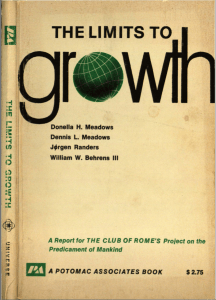
Published 1972 – The message of this book still holds today: The earth’s interlocking resources – the global system of nature in which we all live – probably cannot support present economic and population growth rates much beyond the year 2100, if that long, even with advanced technology. In the summer of 1970, an international team of researchers at the Massachusetts Institute of Technology began a study of the implications of continued worldwide growth.

They examined the five basic factors that determine and, in their interactions, ultimately limit growth on this planet-population increase, agricultural production, nonrenewable resource depletion, industrial output, and pollution generation. The MIT team fed data on these five factors into a global computer model. Then it tested the model’s behaviour under several sets of assumptions to determine alternative patterns for mankind’s future. The Limits to Growth is the nontechnical report of their findings.

The book also contains a message of hope: Man can create a society in which he can live indefinitely on earth if he imposes limits on himself and his production of material goods to achieve a state of global equilibrium with population and production in carefully selected balance.


The Limits to Growth, 1972 – key messages:

    • With existing policies, the physical limits to growth would likely be exceeded within one generation.
    • The most likely outcome of reaching these limits would be overshooting them, followed by systems decline.
    • The findings, however, also suggested a viable alternative to these outcomes – one in which population growth and material production could be brought into balance with planetary limits.
    • The fourth conclusion was that it would realistically take 50 to 100 years, or even more, to make this alternative outcome a reality.
    • Finally, the team found that every year action is delayed toward reaching the alternative outcome, decreasing the number of options available to avoid overshoot and collapse.

Bibliography

Meadows, D. H., Meadows, D. L., Randers, J. & Behrens, W. W. (1972). The limits to growth: A report for the Club of Rome’s project on the predicament of mankind. New York: Universe Books.

Limits to Growth (digital scan version, source: https://donellameadows.org)

Short History

Stern Review on the Economics of Climate Change

HM Treasury UK | 2006

“The scientific evidence is now overwhelming: climate change presents serious global risks and demands an urgent global response. This independent Review was commissioned by the Chancellor of the Exchequer, who reports to both the Chancellor and the Prime Minister, to contribute to assessing the evidence and building an understanding of the economics of climate change.

The Review first examines the evidence on the economic impacts of climate change itself and explores the economics of stabilizing greenhouse gases in the atmosphere. The second half of the Review considers the complex policy challenges involved in managing the transition to a low-carbon economy and in ensuring that societies can adapt to the consequences of climate change that can no longer be avoided.

The Review takes an international perspective. Climate change is global in its causes and consequences, and international collective action will be critical in driving an effective, efficient and equitable response on the scale required. This response will require deeper international cooperation in many areas – most notably in creating price signals and markets for carbon, spurring technology research, development and deployment, and promoting adaptation, particularly for developing countries.

Climate change presents a unique challenge for economics: it is the greatest and widest-ranging market failure ever seen. The economic analysis must therefore be global, deal with long time horizons, have the economics of risk and uncertainty at centre stage, and examine the possibility of major, non-marginal change. To meet these requirements, the Review draws on ideas and techniques from most of the important areas of economics, including many recent advances.

The benefits of strong, early action on climate change outweigh the costs

The effects of our actions now on future changes in the climate have long lead times. What we do now can have only a limited effect on the climate over the next 40 or 50 years. On the other hand what we do in the next 10 or 20 years can have a profound effect on the climate in the second half of this century and in the next.

No-one can predict the consequences of climate change with complete certainty; but we now know enough to understand the risks. Mitigation – taking strong action to reduce emissions – must be viewed as an investment, a cost incurred now and in the coming few decades to avoid the risks of very severe consequences in the future. If these investments are made wisely, the costs will be manageable, and there will be a wide range of opportunities for growth and development along the way. For this to work well, policy must promote sound market signals, overcome market failures and have equity and risk mitigation at its core. That essentially is the conceptual framework of this Review.

The Review considers the economic costs of the impacts of climate change, and the costs and benefits of action to reduce the emissions of greenhouse gases (GHGs) that cause it, in three different ways:

  • Using disaggregated techniques, in other words considering the physical
    impacts of climate change on the economy, on human life and on the environment, and examining the resource costs of different technologies and strategies to reduce greenhouse gas emissions.
  • Using economic models, including integrated assessment models that estimate the economic impacts of climate change, and macro-economic models that represent the costs and effects of the transition to low-carbon energy systems for the economy as a whole.
  • Using comparisons of the current level and future trajectories of the ‘social cost of carbon’ (the cost of impacts associated with an additional unit of greenhouse gas emissions) with the marginal abatement cost (the costs associated with incremental reductions in units of emissions).

From all of these perspectives, the evidence gathered by the Review leads to a
simple conclusion: the benefits of strong, early action considerably outweigh the costs.

The evidence shows that ignoring climate change will eventually damage economic growth. Our actions over the coming few decades could create risks of major disruption to economic and social activity, later in this century and in the next, on a scale similar to those associated with the great wars and the economic depression of the first half of the 20th century. And it will be difficult or impossible to reverse these changes. Tackling climate change is the pro-growth strategy for the longer term, and it can be done in a way that does not cap the aspirations for growth of rich or poor countries. The earlier effective action is taken, the less costly it will be.

At the same time, given that climate change is happening, measures to help people adapt to it are essential. And the less mitigation we do now, the greater the difficulty of continuing to adapt in future.

Download Stern Executive Summary

Visit National UK Archives

Rising above water

Marta Jiménez | Utrecht University

Sea levels are rising, and the rate of rise is accelerating. All over the world, many of today’s dikes, sea walls and flood barriers won’t be enough to hold back the water in the future. This will be particularly a problem in countries that lack the resources to maintain or fund extensive engineering projects to protect their citizens. But we can all learn from alternative, more affordable and flexible approaches that adapt to the rising water currently emerging all around the world.

Rather than only battling to keep ever-rising seas out, these natural solutions aim to help rebuild land above sea level. Researchers from Utrecht University are testing which of these strategies will work for specific regions to help tame the tide. And they’re also thinking ahead: how can we minimise the damage and ensure people have somewhere safe to go when the water does come?

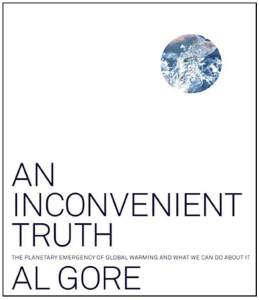
An Inconvenient Truth

The Planetary Emergency of Global Warming and What We Can Do About It

Al Gore | 2006

In his best-selling book, An Inconvenient Truth, former Vice President Al Gore argues against the climate crisis and argues that it is imperative that we solve it.

Our climate crisis may, at times, appear to be happening slowly, but it is happening very quickly and has become a true planetary emergency. The Chinese expression for crisis consists of two characters. The first is a symbol of danger; the second is a symbol of opportunity.

Lees verder

Global reconstruction of historical ocean heat storage and transport

L. Zanna, S. Khatiwala, J.M. Gregory, J. Ison, & P. Heimbach | January 2019, in Proceedings of the National Academy of Sciences 

Zanna et al. (2019): “Since the 19th century, rising greenhouse gas concentrations have caused the ocean to absorb most of the Earth’s excess heat and warm up. Before the 1990s, most ocean temperature measurements were above 700 m and therefore, insufficient for an accurate global estimate of ocean warming. We present a method to reconstruct ocean temperature changes with global, full-depth ocean coverage, revealing warming of 436 x 1021 Joules since 1871.

Our reconstruction, which agrees with other estimates for the well-observed period, demonstrates that the ocean absorbed as much heat during 1921–1946 as during 1990–2015. Since the 1950s, up to one-half of excess heat in the Atlantic Ocean at midlatitudes has come from other regions via circulation-related changes in heat transport.”

Lees verder

Rotterdam Resilience Strategie

Op 16 mei 2016 lanceerde Rotterdam haar Resilience Strategie. De holistische aanvliegroute van nieuwe doelen voor de stad is wat aanspreekt. Het is een nieuw concept van denken, dat geleidelijk aan terrein wint. Rotterdam gaat voor Resilience.

De publieke sturing dient daarmee gelijke tred te houden en afgestemd te zijn, dit om de resilience waar te kunnen maken. Veerkrachtige steden vragen dus ook om meer holistische besturingsconcepten.

Lees verder

Rapport Stern

PRIMO France | novembre 2005

L’originalité du rapport Stern réside dans sa tentative de chiffrer le « coût de l’inaction en matière d’environnement »Ainsi, si l’on agissait aujourd’hui pour stabiliser les émissions de gaz carbonique à 550 ppm (parties par million), niveau requis pour une hausse des températures de « seulement » 3 °C, l’investissement annuel nécessaire serait de l’ordre de 1 % du PIB mondial. Mais, « si nous ne renversons pas la tendance actuelle, le coût pourrait s’élever au minimum à 5 % du futur PIB » dans un futur proche, prévient Sir Stern.

L’économiste britannique estime que si l’on agit au plus vite, les retombées des mesures visant à lutter contre le réchauffement climatique ne devraient pas trop nuire à la compétitivité et à la croissance. Il insiste sur le fait que l’on peut « mener de pair la croissance et la lutte contre le changement climatique ».

Lees verder