The Fukushima Nuclear Accident Independent Investigation Commission | 2012
De evaluatie van de kernramp in Fukushima Daiichi in 2011, die werd veroorzaakt door een aardbeving gevolgd door een tsunami, is een goed voorbeeld van het uitzoomen van een ramp en het leren van de lessen. Het is een echt voorbeeld van zelfreflectie omdat het diep graaft in het publieke ecosysteem waar overheid, bedrijfsleven en maatschappelijk middenveld samenkomen. Het is een vorm van netwerkanalyse. De ramp had een grote impact op het natuurlijke milieu en de ecosystemen. De ramp schokte de hele wereld.
Lezenswaardig omdat dit rapport de wederzijdse afhankelijkheden tussen organisaties in het publieke domein blootlegt, ook daar waar het onafhankelijkheden hadden moeten zijn. Het is actueel voor waar wij nu nog steeds moeite mee hebben: het creëren van checks & balances bij de invulling van het openbaar bestuur. In elk college van gemeenten, provincies en waterschappen blijft het immers een permanent punt van aandacht bij de verdeling en uitoefening van de portefeuilles, de mogelijke koppeling met mogelijke persoonlijke belangen en in de feitelijke werking in besluitvorming en sturing.
Risk and Reason presenteert een verstandig systeem voor het verminderen van risico’s om levens en geld te besparen. Wat moet er gedaan worden aan de veiligheid van vliegtuigen en terrorisme, de opwarming van de aarde, vervuild water, kernenergie en genetisch gemanipuleerd voedsel? Risico’s voor de veiligheid, de gezondheid en het milieu staan wereldwijd sterk in de belangstelling. Maar al te vaak zijn we bang voor de verkeerde dingen.
Soms maken we de situatie zelfs erger. In plaats van de feiten te onderzoeken, reageren we op tijdelijke angsten. Het resultaat is een situatie van hysterie en verwaarlozing – en onnodige ziekte en dood.
Mijn verhaal begint in de nacht van 31 januari op 1 februari 1953. Nog net niet geboren maar op basis van de verhalen van mijn vader, één van de redders in het eerste uur, en van zijn vrienden, heb ik alles tot in detail kunnen reconstrueren. Het overkwam ons, maar toch ook weer niet helemaal. Er werd en wordt niet gewezen. Wel is er een collectief trauma voor mijn dorp Halsteren. Het zaadje ‘publiek risicomanagement’ is deze nacht in mij geplant.
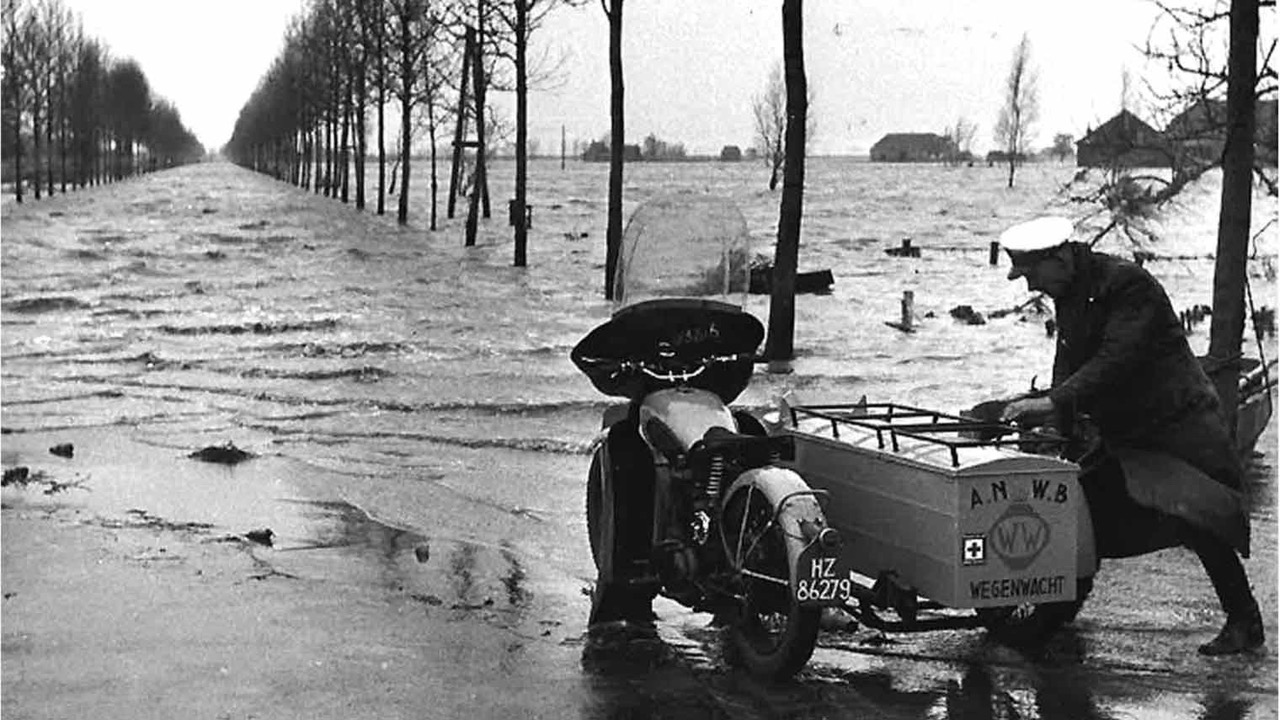
Auvergnepolder, Halsteren, 1 februari 1953. Ad Kruf met zijn ANWB motor met zijspan.
De ochtend van 1 februari was grijs, de storm was gaan ‘liggen’ tot windkracht 8/9, lage gevoelstemperatuur, waterig zonnetje, jagende wolken. Mijn vader stond nu op het land van zijn voorvaderen. Zij hadden hier gewoond en geleefd, in deze polder, de Auvergnepolder in Halsteren.
Het water was die nacht 5 meter hoog over de polder gestroomd en had huizen en levens van mens en dier genomen. Nu staat hij hier op deze ochtend voor een eindeloze zee, met zijn ANWB BSA-motor met zijspan. Het geel van het zijspan is de enige kleur in dit troosteloze landschap. En met een sloep om opnieuw uit te varen op zoek naar overlevenden. In de nacht is hij met anderen druk geweest om te doen wat mogelijk was. Toen hij werd geroepen in de nacht, scheen de maan, en de weerkaatsing op het zeewater zo dicht bij het dorp gaf een haast onwerkelijke schittering. Vanuit zijn slaapkamer zag hij aan de reflectie op de jagende wolken, dat er iets goed mis was.
The evaluation of the Fukushima Daiichi nuclear disaster in 2011, which was caused by an earthquake followed by a tsunami, is a good example of zooming out from a disaster and learning the lessons. It is a true example of self-reflection because it digs deep into the public ecosystem where government, business, and civic society meet. It is a form of network analysis. The disaster had a major impact on the natural environment and ecosystems. The disaster shocked the entire world.
The conclusions of the Fukushima Nuclear Accident Independent Investigation Commission were thorough and blistering. They shed light on how attitudes, stakes, and rules and their interdependencies, and the lack of cooperation in peacetime (read: before the earthquake and the tsunami) between organisations related to the public domain, had increased the disaster.
The major conclusions [quote]:
In order to prevent future disasters, fundamental reforms must take place. These reforms must cover both the structure of the electric power industry and the structure of the related government and regulatory agencies as well as the operation processes. They must cover both normal and emergency situations.
The TEPCO Fukushima Nuclear Power Plant accident was the result of collusion between the government, the regulators and TEPCO, and the lack of governance by said parties. They effectively betrayed the nation’s right to be safe from nuclear accidents. Therefore, we conclude that the accident was clearly “manmade”. We believe that the root causes were the organisational and regulatory systems that supported faulty rationales for decisions and actions, rather than issues relating to the competency of any specific individual.
We conclude that TEPCO was too quick to cite the tsunami as the cause of the nuclear accident and deny that the earthquake caused any damage.
The Commission concludes that there were organisational problems within TEPCO. Had there been a higher level of knowledge, training, and equipment inspection related to severe accidents, and had there been specific instructions given to the on-site workers concerning the state of emergency within the necessary time frame, a more effective accident response would have been possible.
The Commission concludes that the situation continued to deteriorate because the crisis management system of the Kantei, the regulators and other responsible agencies did not function correctly. The boundaries defining the roles and responsibilities of the parties involved were problematic, due to their ambiguity.
The Commission concludes that the residents’ confusion over the evacuation stemmed from the regulators’ negligence and failure over the years to implement adequate measures against a nuclear disaster, as well as a lack of action by previous governments and regulators focused on crisis management. The crisis management system that existed for the Kantei and the regulators should protect the health and safety of the public, but it failed in this function.
The Commission recognizes that the residents in the affected area are still struggling from the effects of the accident. They continue to face grave concerns, including the health effects of radiation exposure, displacement, the dissolution of families, disruption of their lives and lifestyles and the contamination of vast areas of the environment. There is no foreseeable end to the decontamination and restoration activities that are essential for rebuilding communities.
The Commission concludes that the government and the regulators are not fully committed to protecting public health and safety; that they have not acted to protect the health of the residents and to restore their welfare.
The Commission has concluded that the safety of nuclear energy in Japan and the public cannot be assured unless the regulators go through an essential transformation process. The entire organisation needs to be transformed, not as a formality but in a substantial way. Japan’s regulators need to shed the insular attitude of ignoring international safety standards and transform themselves into a globally trusted entity.
TEPCO did not fulfil its responsibilities as a private corporation, instead obeying and relying upon the government bureaucracy of METI, the government agency driving nuclear policy. At the same time, through the auspices of the FEPC, it manipulated the cozy relationship with the regulators to take the teeth out of regulations.
The Commission concludes that it is necessary to realign existing laws and regulations concerning nuclear energy. Mechanisms must be established to ensure that the latest technological findings from international sources are reflected in all existing laws and regulations.
Replacing people or changing the names of institutions will not solve the problems. Unless these root causes are resolved, preventive measures against future similar accidents will never be complete.” [unquote]
The chairman of the research commission of the National Diet report Kiyoshi Kurokawa summarised the conclusions [quote]:
The disaster cannot be regarded as a natural disaster. It was a profoundly manmade disaster – that could and should have been foreseen and prevented. And its effects could have been mitigated by a more effective human response.
Our report catalogues a multitude of errors and wilful negligence that left the Fukushima plant unprepared for the events of March 11. And it examines serious deficiencies in the response to the accident by TEPCO, regulators and the government.
What must be admitted – very painfully – is that this was a disaster “Made in Japan.” Its fundamental causes are to be found in the ingrained conventions of Japanese culture: our reflexive obedience; our reluctance to question authority; our devotion to ‘sticking with the program’; our groupism; and our insularity. Had other Japanese been in the shoes of those who bear responsibility for this accident, the result may well have been the same.
Following the 1970s “oil shocks,” Japan accelerated the development of nuclear power in an effort to achieve national energy security. As such, it was embraced as a policy goal by government and business alike, and pursued with the same single-minded determination that drove Japan’s postwar economic miracle.
With such a powerful mandate, nuclear power became an unstoppable force, immune to scrutiny by civil society. Its regulation was entrusted to the same government bureaucracy responsible for its promotion. At a time when Japan’s self-confidence was soaring, a tightly knit elite with enormous financial resources had diminishing regard for anything ‘not invented here.’
This conceit was reinforced by the collective mindset of Japanese bureaucracy, by which the first duty of any individual bureaucrat is to defend the interests of his organisation. Carried to an extreme, this led bureaucrats to put organisational interests ahead of their paramount duty to protect public safety.
Only by grasping this mindset can one understand how Japan’s nuclear industry managed to avoid absorbing the critical lessons learned from Three Mile Island and Chernobyl; and how it became accepted practice to resist regulatory pressure and cover up small-scale accidents. It was this mindset that led to the disaster at the Fukushima Daiichi Nuclear Plant.
This report singles out numerous individuals and organisations for harsh criticism, but the goal is not—and should not be—to lay blame. The goal must be to learn from this disaster, and reflect deeply on its fundamental causes, in order to ensure that it is never repeated.
Many of the lessons relate to policies and procedures, but the most important is one upon which each and every Japanese citizen should reflect very deeply.
The consequences of negligence at Fukushima stand out as catastrophic, but the mindset that supported it can be found across Japan. In recognizing that fact, each of us should reflect on our responsibility as individuals in a democratic society.
As the first investigative commission to be empowered by the legislature and independent of the bureaucracy, we hope this initiative can contribute to the development of Japan’s civil society. Above all, we have endeavoured to produce a report that meets the highest standard of transparency. The people of Fukushima, the people of Japan and the global community deserve nothing less. [unquote]
Cadbury committee | 1992, London Stock Exchange, en • nl
This report is a milestone in corporate governance. It is 1992. The Cadbury Report about “Financial Aspects of Corporate Governance” has been published. This groundbreaking report – chaired by Sir Adrian Cadbury – led to improvements in governance standards. It was a reaction to the Bank of Credit and Commerce International scandal in 1991.
• Dit rapport is een mijlpaal in het corporate besturing. Het is 1992. Het Cadbury Report over “Financial Aspects of Corporate Governance” wordt gepubliceerd. Baanbrekend – voorgezeten door Sir Adrian Cadbury – en het leidde tot verbeteringen in de normen voor deugdelijk bestuur. Het was een reactie op het schandaal in 1991 bij de Bank of Credit and Commerce International.
The report made specific recommendations on good corporate governance, which it described as ”best practice” or ”code of conduct.”It was highly influential in developing organisational codes regarding external shareholders’ accountability. It is the start of a new line of thinking about good governance, also in the public context. • Het rapport deed specifieke aanbevelingen voor goed ondernemingsbestuur, die het omschreef als “best practice” of “gedragscode”. Het rapport was zeer invloedrijk bij het ontwikkelen van organisatiecodes met betrekking tot de verantwoordingsplicht van externe aandeelhouders. Het is het begin van een nieuwe manier van denken over goed bestuur, ook in de publieke context.
This interview with Sir Adrian Cadbury gives the precise focus and the intention to look further into the essence of corporate governance. • Dit interview met Sir Adrian Cadbury geeft de precieze focus en de intentie om verder te kijken naar de essentie van corporate governance.
The report stipulated “the continuing concern about standards of financial reporting and accountability, … which has kept corporate governance in the public eye.” Some findings and recommendations (a personal selection) tell the story of the search for codes, checks and balances [quote]:
By adhering to the Code, listed companies will strengthen their control over their businesses and public accountability. In so doing, they will be striking the right balance between meeting the standards of corporate governance now expected of them and retaining the essential spirit of enterprise.
Every public company should be headed by an effective board that can lead and control the business.
However, the framework in which auditors operate is not well designed in certain respects to provide the objectivity that shareholders and the public expect of auditors in carrying out their function.
The new system has only recently been established, and its full impact has yet to be felt. In the following paragraphs, we endorse the steps being taken and recommend additional action to strengthen public confidence in the audit approach.
We believe that there should be an extension of the audit, which will add to users of accounts and bring it closer into line with public expectations.
So far as reporting fraud is concerned, the present legal position is that confidentiality is an implied term of an auditor’s contract, and there is a public interest in maintaining confidential client relationships. Normally, therefore, it is the auditor’s duty to report fraud to senior management. However, there is also a public interest in fraud being dealt with expeditiously and this may entail disclosing matters to a proper authority. [unquote]
• Het rapport vermeldde “de voortdurende bezorgdheid over normen voor financiële verslaggeving en verantwoording, … die corporate governance in de publieke belangstelling heeft gehouden.” Enkele bevindingen en aanbevelingen (een persoonlijke selectie) vertellen het verhaal van de zoektocht naar codes, checks and balances [citaat]:
Door de Code na te leven zullen beursgenoteerde ondernemingen hun controle over hun bedrijf en hun publieke verantwoording versterken. Op die manier vinden ze het juiste evenwicht tussen het voldoen aan de normen van corporate governance die nu van hen worden verwacht en het behouden van de essentiële ondernemingsgeest.
Elke beursgenoteerde onderneming moet worden geleid door een effectieve raad van bestuur die de onderneming kan leiden en controleren.
Het kader waarbinnen auditors werken is in bepaalde opzichten echter niet goed ontworpen om de objectiviteit te bieden die aandeelhouders en het publiek verwachten van auditors bij het uitvoeren van hun functie.
Het nieuwe systeem is pas onlangs ingevoerd en de volledige impact ervan moet nog merkbaar worden. In de volgende paragrafen onderschrijven we de stappen die worden genomen en bevelen we aanvullende maatregelen aan om het vertrouwen van het publiek in de controleaanpak te versterken.
Wij zijn van mening dat de controle moet worden uitgebreid, wat de gebruikers van de rekeningen ten goede zal komen en de controle meer in overeenstemming zal brengen met de verwachtingen van het publiek.
Wat het melden van fraude betreft, is de huidige rechtspositie dat vertrouwelijkheid een impliciete voorwaarde is van het contract van een auditor en dat er een algemeen belang is bij het onderhouden van vertrouwelijke relaties met cliënten. Normaal gesproken is het daarom de plicht van de auditor om fraude te melden aan het senior management. Het is echter ook in het algemeen belang dat fraude snel wordt aangepakt en dit kan betekenen dat zaken moeten worden gemeld aan een bevoegde autoriteit. [unquote]
Le Plan Communal de Sauvegarde, communément appelé PCS, est un outil fondamental pour organiser la sécurité civile et la sauvegarde des populations à l’échelle communale. Toutefois, la mise en place de ce dispositif indispensable peut constituer une véritable contrainte pour certaines communes.
Ces dernières années, la France a connu une longue suite d’événements marquants en matière de catastrophes naturelles et technologiques : marées noires, tempêtes, canicules et explosions ont été autant de jalons entraînant une prise de conscience de la part des pouvoirs publics sur le manque de préparation du territoire face à ces incidents.


 PRIMO Res Publica