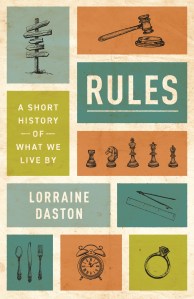
Rules • Regels

A short history of what we live by. A panoramic history of rules in the Western world Een korte geschiedenis van wat ons leven bepaalt. Een overzicht van de geschiedenis van regels in de westerse wereld

Lorraine Daston | 2022, Princeton University Press

Rules order almost every aspect of our lives. They set our work hours, dictate how we drive and set the table, tell us whether to offer an extended hand or cheek in greeting, and organise life’s rites, from birth through death. We may chafe under the rules we have and yearn for ones we don’t, yet no culture could do without them. Regels bepalen bijna elk aspect van ons leven. Ze bepalen onze werktijden, dicteren hoe we rijden en de tafel dekken, vertellen ons of we een uitgestoken hand of wang moeten geven ter begroeting en organiseren de rituelen van het leven, van geboorte tot dood. We kunnen ons ergeren aan de regels die we hebben en verlangen naar de regels die we niet hebben, maar toch zou geen enkele cultuur zonder deze regels kunnen.

In Rules, historian Lorraine Daston traces rules’ development in the Western tradition and shows how they have evolved from ancient to modern times. Drawing on a rich trove of examples, including legal treatises, cookbooks, military manuals, traffic regulations, and game handbooks, Daston demonstrates that while rules’ content is dazzlingly diverse, their forms are surprisingly few and long-lived. In ‘Regels’ traceert historica Lorraine Daston de ontwikkeling van regels in de westerse traditie en laat ze zien hoe ze van de oudheid tot de moderne tijd zijn geëvolueerd. Aan de hand van een rijke schat aan voorbeelden, waaronder juridische verhandelingen, kookboeken, militaire handleidingen, verkeersregels en spelhandboeken, laat Daston zien dat terwijl de inhoud van regels duizelingwekkend divers is, hun vormen een verrassend beperkt scala hebben en langlevend zijn.

Lees verder

Rethinking Public Governance

Jacob Torfing* | 2023, Edward Elgar Publishing

In this innovative book, Jacob Torfing, a leading scholar, critically evaluates emerging ideas, practices and institutions, transforming how public governance is perceived, theorised and conducted in practice.

A novel rethinking of how current societies are governed, this book will inspire students, scholars and practitioners of political science, public policy, regulation and governance, and public administration management to reconsider how public governance and administration may be organised in the future to present innovative solutions to societal problems.

Identifying cutting-edge developments in public governance, this incisive book analyses new forms of political leadership, public management, public organisation, administrative steering, cross-boundary collaboration, public regulation and societal problem-solving. Examining some of the most significant instances of public governance transformation, chapters explore the effects of transformations from sovereign to interactive political leadership, from national to multi-level governance, and from hard to soft power.

Lees verder

Third-Party Risk Policies in The Netherlands

A Historical Sketch 

Ben Ale | April 2023, Cambridge Scholars Publishing

It is not easy to keep the population safe in a country that is one of the most densely populated in the world, a hub of international transport over land and water and through the air, about one-third of which lies below sea level.

.

Third-party risk policies developed gradually in The Netherlands but became acute in the late 20th century as various industries increased their use and production of hazardous materials.

The Dutch government, considering its constitutional responsibility to protect the life, health and well-being of its people, must resolve the ongoing debate between the general population, who are exposed to these risks, and those profiting from the creation of said risks-the resultant policies are a product of this balancing act.

Lees verder

Silent Spring

Rachel Carson | 1962

This sensational book, Silent Spring (1962) by Rachel Carson, warned of the dangers to all natural systems from the misuse of chemical pesticides such as DDT, and questioned the scope and direction of modern science, initiating the contemporary environmental movement.

Silent Spring began with a “fable for tomorrow” – a true story using a composite of examples drawn from many real communities where the use of DDT had caused damage to wildlife, birds, bees, agricultural animals, domestic pets, and even humans. Carson used it as an introduction to a very scientifically complicated and already controversial subject. This “fable” made an indelible impression on readers and was used by critics to accuse Carson of being a fiction writer rather than a scientist.

Lees verder

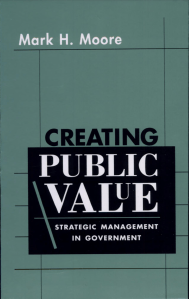
Creating Public Value

Strategic management in government

Mark H. Moore | 1995

Public Value is a theory for public management advanced by Professor Mark Moore of the Harvard Kennedy School. Over the previous two decades, staff and students at Harvard’s Kennedy School of Government, where Moore taught, engaged in conversations about producing excellence in public management.

“Public value refers to the value created by the government through laws, regulations, services and any other action. In a democratic society, this value is defined by the public themselves. Value is determined by citizens preferences expressed in a variety of ways and thus it provides a rough yard stick against which to gauge the public institutions and government policies.”

A seminal figure in the field of public management, Mark Moore presents his summation of 15 years of research, observation, and teaching on what public-sector executives should do to improve the performance of public enterprises.

Lees verder

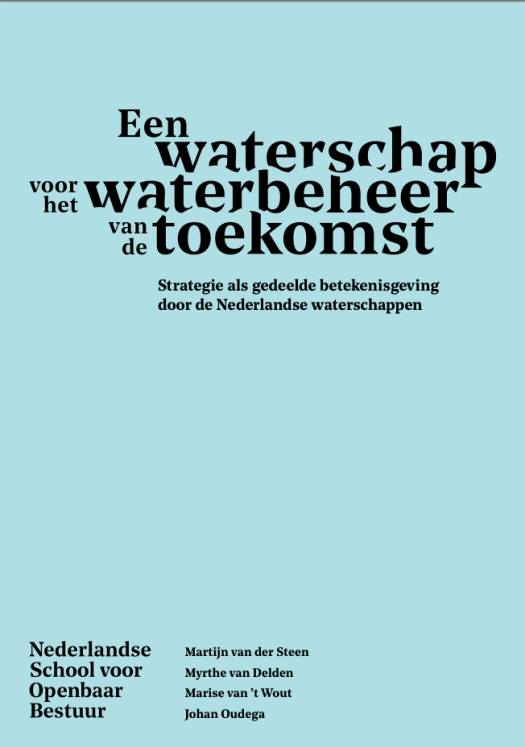
Een waterschap voor het waterbeheer van de toekomst

Strategie als gedeelde betekenisgeving door de Nederlandse waterschappen

Myrthe van Delden, Johan Oudega, Martijn van der Steen en Marise van ’t Wout | 2023

In 2023 zijn er opnieuw waterschapsverkiezingen in Nederland. In de aanloop naar die verkiezingen voerden de waterschappen met elkaar een strategisch gesprek over de uitdagingen die er op waterschappen afkomen, over de kansen die er liggen en over de onzekerheden die er zijn. Ze zijn in gesprek gegaan over hoe waterschappen, vanuit hun sleutelrol in het veilig, leefbaar en veerkrachtig houden van Nederland, zich het beste zouden kunnen organiseren en profileren. Om met dit gesprek de publieke waarde waar ze voor staan ook in een sterk veranderende tijd te blijven realiseren.

Het verkennen van de toekomst en het ontwikkelen van strategie om daar mee om te gaan, betekent het omgaan met inherente onzekerheid. De toekomst ‘is’ nog niet. Er kunnen geen metingen over verricht worden en het is ook nooit met zekerheid te zeggen hoe de toekomst zal zijn. Dat betekent dat het nodig is om de onzekerheid in alle mogelijke vormen te onderkennen.

Lees verder

Maatschappelijke bestuurskunde

Hoe verbindende bestuurskundigen (kunnen) inspelen op maatschappelijke vraagstukken

Tom Overmans, Marlies Honingh & Mirko Noordegraaf  (red.) | Boombestuurskunde.

Het vakgebied bestuurskunde heeft zich de afgelopen jaren bewezen. Via opleidings- en onderzoeksprogramma’s, academische netwerken, internationale verbanden, publicaties, symposia en prijzen wordt gewerkt aan de versterking van het openbaar bestuur. Door de jaren heen is het bereik van bestuurskundigen gegroeid. De bestuurskunde draait niet enkel om de overheid, maar richt zich tevens op maatschappelijke dienstverlening, publiek-private samenwerking, coproductie van beleid en diensten en publieke waardecreatie. De laatste tijd werken bestuurskundigen bovendien aan maatschappelijke impact.

Deze bundel gaat een stap verder. De auteurs laten zien dat het tijd is voor een meer ‘maatschappelijke’ bestuurskunde, die zich nadrukkelijker en zichtbaarder richt op de analyse en aanpak van maatschappelijke vraagstukken. Dat is meer dan ‘maatschappelijke impact maken’. Dat is je verbinden aan andere academische disciplines en maatschappelijke velden, waarin de aanpak van concrete issues centraal staat. Denk aan klimaatadaptatie, duurzame landbouw, energietransitie, migratie, wonen, kansengelijkheid, georganiseerde misdaad, houdbare zorg en digitalisering.

Lees verder