State of the Global Climate 2025

World Meteorological Organization | March 2026

Geneva, Switzerland – Press Release “The Earth’s climate is more out of balance than at any time in observed history, as greenhouse gas concentrations drive continued warming of the atmosphere and ocean and melting of ice, according to the World Meteorological Organization (WMO). These rapid and large-scale changes have occurred within a few decades but will have harmful repercussions for hundreds – and potentially thousands – of years.  
World Meteorological Organization

Key messages:

  • WMO State of Climate report confirms 2015-2025 hottest 11 years on record
  • Earth’s energy imbalance is highest in sixty five-year record
  • The ocean has been absorbing about eighteen times the annual human energy use each year for the past two decades
  • Extreme weather impacts millions and costs billions
  • World Meteorological Day: observing today to protect tomorrow

WMO’s State of the Global Climate report 2025 confirms that 2015-2025 are the hottest 11-years on record, and that 2025 was the second or third hottest year on record, at about 1.43 °C above the 1850-1900 average. Extreme events around the world, including intense heat, heavy rainfall, and tropical cyclones, caused disruption and devastation, highlighting the vulnerability of our interconnected economies and societies.

Lees verder
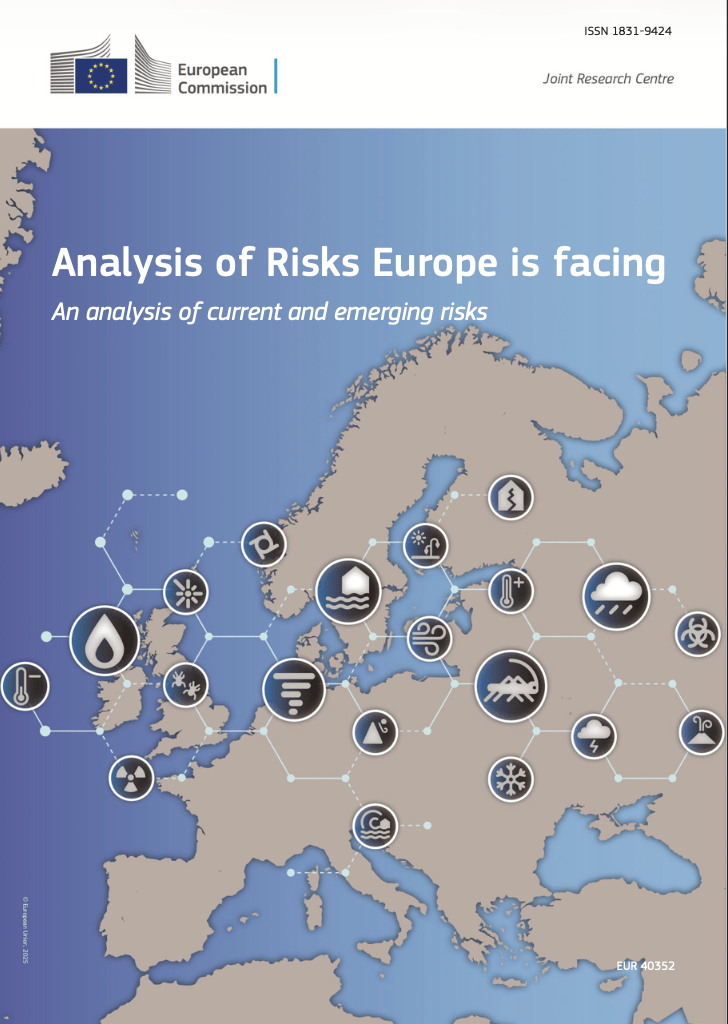
Analysis of Risks Europe is facing

An analysis of current and emerging risks

European Commission Joint Research Centre (JRC) | 2025

“As Europe stands at the nexus of intensifying global uncertainties, this flagship report on Current and Emerging Risks in Europe marks a critical step in shaping a more prepared and resilient Union. It offers an integrated scientific analysis of 47 diverse risks-from climate-driven disasters and pandemics to cyber threats and geopolitical instability-highlighting the urgent need for cross-sectoral, whole-of-society action.

Our Member States rightly expect the European Union to anticipate risks and threats and protect them from cascading crises through a coordinated and proactive approach to addressing the evolving risk landscape.

Lees verder

Nederland vraagt om daadkracht en realistische oplossingen

Acht maatschappelijke opgaven in aanloop naar de Tweede Kamerverkiezingen 2025

Sociaal Cultureel Planbureau | juli 2025

[Citaat] “In deze notitie voor de Tweede Kamerverkiezingen op 29 oktober 2025, gaat het Sociaal Cultureel Planbureau (SCP) vanuit sociaal-maatschappelijke kennis en expertise in op acht urgente maatschappelijke opgaven1 die vragen om politiek handelen. Het SCP roept politieke partijen op om deze opgaven te adresseren in hun verkiezingsprogramma’s, tijdens de komende verkiezingen en de regeerperiode die daarop volgt. Om vanuit een heldere visie keuzes te maken en deze duidelijk aan burgers te communiceren.

In vergelijking met veel andere landen is de kwaliteit van leven van veel Nederlanders hoog (Vermeij et al. 2024). Tegelijkertijd staat de samenleving voor grote uitdagingen, onder andere vanwege vergrijzing, arbeidsmarktkrapte, klimaatverandering, de energietransitie, migratie en kunstmatige intelligentie. Nederlanders zijn negatief gestemd over de politiek en de richting die het met de samenleving op gaat.

Mensen maken zich zorgen over uiteenlopende thema’s als samenleven, immigratie, betaalbare en beschikbare woonruimte, stijgende prijzen en de werking van de politiek zelf (Miltenburg et al. 2025). Vanwege geopolitieke spanningen wordt er extra geïnvesteerd in veiligheid en defensie, wat de begrotingsruimte voor de aanpak van andere maatschappelijke vraagstukken verder beperkt.

Lees verder

Te heet onder onze voeten 

Gezond samenleven kan alleen op een gezonde planeet

Raad voor Volksgezondheid & Samenleving | 21 juli 2025

Onze planeet wordt steeds ongezonder, dat is niet alleen een ecologisch probleem, maar ook een gezondheids- én een rechtvaardigheidsprobleem, zo stelt de Raad in dit advies. Als we onze gezondheid belangrijk vinden, dan moeten we de planetaire grenzen, zoals klimaatverandering en vervuiling serieus nemen en centraal stellen binnen beleid.

Dat betekent niet alleen nieuwe gewoonten opbouwen, maar ook schadelijke systemen afbouwen. Daar hoort ook het maken van lastige keuzes bij, bijvoorbeeld over voeding, mobiliteit en industrie, maar ook binnen zorg en welzijn. Alleen zo komen we tot een gezonde en eerlijke samenleving die ook in de toekomst houdbaar is.

Een ongezonde planeet is niet alleen een ecologisch probleem, maar ook een gezondheids- én een rechtvaardigheidsprobleem. Daarom pleit de Raad voor Volksgezondheid & Samenleving (RVS) in zijn nieuwste advies Te heet onder onze voeten ervoor om gezond samenleven binnen planetaire grenzen het uitgangspunt van beleid te maken. Planetaire gezondheid wordt nu nog vaak los gezien van onze eigen gezondheid, waardoor oplossingen buiten bereik blijven.

Lees verder

UN Global Risk Report

United Nations | July 2025

The first-ever United Nations Global Risk Report 2024 has been released, offering insights from over 1,100 experts and stakeholders on the most pressing global risks and the world’s preparedness to address them. The report, based on a global survey conducted in 2024, assesses the perceptions of these risks across societal, technological, economic, environmental, and political categories. It highlights the interconnectedness of these risks and emphasizes the need for a more united and multilateral approach to strengthen the world’s capacity to anticipate, adapt, and respond to future challenges, according to the report. 


António Guterres: “We are at a defining moment for humanity. In a year marked by converging global crises, the international community faces mounting pressure to strengthen our collective capacity to anticipate and respond to shared risks.

This report, drawing on data collected in 2024, offers a valuable snapshot of how stakeholders around the world—governments, the private sector, academia, and civil society—perceive global risks and assess the multilateral system’s readiness to address them.

Lees verder

Chronic Risks Analysis

Cabinet Office and Government Office for Science, United Kingdom | | 8 July 2025

The Chronic Risks Analysis (CRA) is the UK Government’s first bespoke risk assessment for medium to long term risks. It complements the National Risk Register (NRR), which focuses on the UK’s most serious acute risks. The 26 chronic risks identified by the UK Government cover seven themes, spanning across Security, Technology and Cybersecurity, Geopolitical, Environmental, Societal, Biosecurity and Economic issues.

The Rt Hon Pat McFadden MP, Chancellor of the Duchy of Lancaster: “The world order is shifting at breakneck speed. A once-in-a-generation pandemic, war on the continent of Europe, a cost of living crisis, fluctuations in global energy and financial markets – all within the past decade. But in this period of upheaval, the first duty of any Government remains the same: keeping the public safe.

Lees verder

De Fyra

De ambities, de strijd en de gevolgen

Parlementaire enquêtecommissie Fyra | 28 oktober 2015

De parlementaire enquêtecommissie Fyra is in mei/juni 2015 de openbare verhoren gestart inzake de vraag waarom het beoogde vervoer over de Hogesnelheidslijn-Zuid niet tot stand is gekomen. Zij werkte sindsdien aan een eindrapport dat op 28 oktober 2015 aan de pers is gepresenteerd. 

Aanleiding

Op dinsdag 15 januari 2013 valt een afdekrooster van de onderkant van een Fyra, de hogesnelheidstrein van de Italiaanse bouwer AnsaldoBreda. De trein rijdt op dat moment via het hogesnelheidsspoor (HSL-Zuid) van Brussel naar Amsterdam. Twee dagen later blijkt ook een andere Fyra flink beschadigd. NS haalt daarop de treinen van het spoor. Op de dure Thalys na is er op dat moment geen treinvervoer tussen Amsterdam en Brussel. De reiziger staat letterlijk en figuurlijk in de kou.

Lees verder