Ransomware: An insurance market perspective

Source: Geneva Association

  • New Geneva Association report highlights the important role of private re/insurers, alongside governments, in boosting society’s resilience to ransomware and ensuring the full benefits of digitalisation can be realised.
  • The report explores the significant value add of cyber insurance beyond risk transfer, amid ongoing debate on whether to ban ransom payments or associated insurance coverage.
  • Governments should do more to counter ransomware attacks: disrupt cybercriminal business models, fight illicit use of cryptocurrencies and promote cyber hygiene throughout business and society.

ZURICH, 20 July 2022 – The frequency of ransomware attacks, a form of cyber extortion, is increasing, along with the size and nature of ransom demands. Cybercriminals are deploying more sophisticated approaches to target governments, businesses and individuals, with serious and costly effects. The growth of the ransomware-as-a-service (RaaS) business model has also enabled threat actors with limited technical skills to launch highly disruptive attacks.

Cyber insurance provides vital financial protection and operational support in the event of an attack, but ransomware has contributed to the recent deterioration in cyber insurers’ underwriting performance. Ransomware accounted for 75% of all cyber insurance claims in 2020 (AM Best) and is also likely to have been the costliest loss event category in 2021 (WTW).

Lees verder


Public-Private Sector Risk Management: is there a difference?

Peter Young | February 2007

Are there differences between risk management in the public and private sectors? As a professor who has spent time in both public administration and business administration programs, I have had several opportunities to think about both sides of the debate. 

Professor Peter Young

On one side, we have those who argue that management is management and that differences in the public and private sectors are modest (“if only government were run like a business”). Opponents of the “management is management” point of view argue that the public sector is so different from the private sector that it is a distinctly separate thing and, thus, requires different knowledge and management skills.

Lees verder

The Risk of Leadership

A plea for a new search for ‘responsible-in-the-end’ leadership: stewardship

Jack Kruf | 10 March 2017

Of course, we have our democratic system, a great set of principles and values that serve as equipment for good public governance. Public leadership, concerning both public organisations and the public domain of society, is embedded in this system, at least it should be. You may expect excellent results because the democratic system traces back to the Greek δημοκρατία in 508 BC and has been tested and challenged over and over again. Over the millennia, it has developed to this point.

Jack Kruf

Considering the present state of society and of natural ecosystems, you may be surprised by the results of this period of 2525 years of development. The Global Risks Reports, published by the World Economic Forum since 2005, tell the story of how critical the state of the Earth is. Reading these reports, I had a flashback to 1972, when the Club of Rome presented facts, findings, and figures in its report, The Limits to Growth. For at least five decades (i.e., half a century!), we know what is going on and where many generations of leadership have brought us.

Lees verder

Handreiking Risicobeheersing voor Raadsleden

VNG | 30 juni 2022

Raadsleden moeten lastige afwegingen maken over grote projecten. Wat is het risico voor de gemeente? Welke maatschappelijke meerwaarde levert het op? Om raadsleden op weg te helpen in risicobeheer, is er nu de Handreiking Risicobeheersing voor Raadsleden. De handreiking is een gezamenlijk product van VNG Risicobeheer, de Nederlandse Vereniging voor Raadsleden en het ministerie van BZK. Het idee is dat risicobeheer reële verwachtingen oplevert en erkende (on)zekerheden. Met als doel een gedeeld besef van hoe er kan worden (bij)gestuurd, ook als zaken anders lopen dan verwacht.

Grip op projecten

De handreiking kan raadsleden helpen om op praktisch niveau beeld te brengen waar je op moet letten en of de gemaakte keuzes bijdragen aan maatschappelijke oplossingen. In projecten gaat het erom het financiële resultaat in beeld te krijgen, maar ook of de afweging van voor- en nadelen bijdraagt aan een betere samenleving,’ zegt directeur Henk Bouwmans van de Nederlandse Vereniging voor Raadsleden. 45% van alle raadsleden in de nieuwe periode is nieuw. ‘Ze moeten zich verdiepen in allerlei onderwerpen en worden overspoeld met informatie. Raadsleden steken gemiddeld 16 uur per week in het raadswerk. We zijn blij met deze handreiking omdat die helpt grip te krijgen op de risico’s van projecten en activiteiten.

Brede blik

Concerncontroller Tom Noordermeer van de gemeente Zevenaar werkte mee aan de handreiking namens het Risico Platform Overheden (RPO). Hij vindt het belangrijk dat de handreiking een brede kijk geeft op risicobeheersing. ‘Het gaat in de gemeenteraad vaak om het ratiogetal in de weerstandsparagraaf. Maar de vraag is: draagt die ratio bij aan een goed besluit of belemmert die dat juist?’ De weerstandsparagraaf is op zichzelf een goed instrument, maar het is aan actualisering toe, vindt Noordermeer. ‘De focus moet niet eenzijdig financieel zijn, in gemeenten is het aspect van publieke waarde net zo belangrijk. Het ratiogetal suggereert een exactheid die er in feite niet is.’ De handreiking is een bijdrage aan een bredere kijk op risicobeheersing.

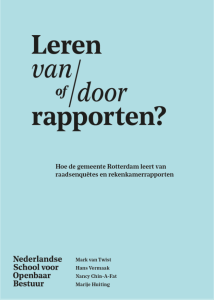
Leren van of door rapporten

Hoe de gemeente Rotterdam leert van raadsenquêtes en rekenkamerrapporten

Mark van Twist, Hans Vermaak, Nancy Chin-A-Fat en Marije Huiting | 2021, NSOB

Herkent u dat? Er verschijnt over uw organisatie een rapport met aanbevelingen hoe van alles beter moet. De bedoeling is dat dat doorwerkt en effect sorteert. Maar toch werkt dat niet altijd zo uit…

Betrokkenen kunnen ervaren dat het rapport er (een beetje) naast zit of te negatief uitpakt. Of ze vinden het rapport goed, maar het (b)lijkt lastig om al die aanbevelingen op te volgen. Of als je ze opvolgt, krijg je er dan wel een sterkere organisatie of beter werk van?
Lees verder

Towards a fully circular economy

Where do the risks lie?

Jack Kruf | November 2021, B&G Magazine

In early 2021, the Netherlands Environmental Assessment Agency published the first Integrated Circular Economy Report (ICER 2021). The report outlines the progress of the transition to a circular economy in the Netherlands. I have summarised this comprehensive, highly informative report, with a focus on the major risks articulated by the authors.

The Dutch government aims to have achieved a fully circular economy by 2050. Monitoring the progress of this transition is essential. The ICER 2021 report is a significant milestone in this process. It highlights the interventions undertaken by the Dutch government to initiate and accelerate the transition to a circular economy, as well as the actions taken by civil society organisations.

Lees verder

COVID-19: A Failure in Risk Management

David Zaruk as Risk-Monger | March 2020

The longer the Risk-Monger gets in the tooth, the more global mass panic events he has witnessed. Every crisis is a learning opportunity and as I had written in mid February, 2020. COVID-19, the Wuhan-originated coronavirus, has created a rich pedagogic environment.

When a train crashes, authorities are on the scene to determine the cause. The COVID-19 coronavirus is fast becoming a global train wreck and unless we quickly assess the mistakes leading up to this tragedy, more trains will pile into the station.

David Zaruk

Lessons are, unsurprisingly, being learnt the hard way with more mistakes sending the public health situation deeper into disaster. Worse, as our communications methods move from an expert-based model to a bottom-up citizen-based community model, our friends on social media become our main source of information.

Lees verder