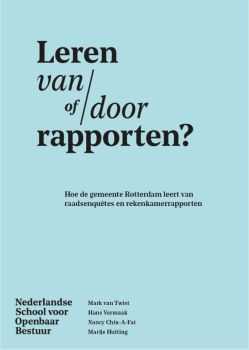
Hoe de gemeente Rotterdam leert van raadsenquêtes en rekenkamerrapporten
Mark van Twist, Hans Vermaak, Nancy Chin-A-Fat en Marije Huiting | 2021, NSOB
Herkent u dat? Er verschijnt over uw organisatie een rapport met aanbevelingen hoe van alles beter moet. De bedoeling is dat dat doorwerkt en effect sorteert. Maar toch werkt dat niet altijd zo uit…
Betrokkenen kunnen ervaren dat het rapport er (een beetje) naast zit of te negatief uitpakt. Of ze vinden het rapport goed, maar het (b)lijkt lastig om al die aanbevelingen op te volgen. Of als je ze opvolgt, krijg je er dan wel een sterkere organisatie of beter werk van? Lees verder “Leren van of door rapporten”
Cadbury committee | 1992, London Stock Exchange, en • nl
This report is a milestone in corporate governance. It is 1992. The Cadbury Report about “Financial Aspects of Corporate Governance” has been published. This groundbreaking report – chaired by Sir Adrian Cadbury – led to improvements in governance standards. It was a reaction to the Bank of Credit and Commerce International scandal in 1991.
• Dit rapport is een mijlpaal in het corporate besturing. Het is 1992. Het Cadbury Report over “Financial Aspects of Corporate Governance” wordt gepubliceerd. Baanbrekend – voorgezeten door Sir Adrian Cadbury – en het leidde tot verbeteringen in de normen voor deugdelijk bestuur. Het was een reactie op het schandaal in 1991 bij de Bank of Credit and Commerce International.
The report made specific recommendations on good corporate governance, which it described as ”best practice” or ”code of conduct.”It was highly influential in developing organisational codes regarding external shareholders’ accountability. It is the start of a new line of thinking about good governance, also in the public context. • Het rapport deed specifieke aanbevelingen voor goed ondernemingsbestuur, die het omschreef als “best practice” of “gedragscode”. Het rapport was zeer invloedrijk bij het ontwikkelen van organisatiecodes met betrekking tot de verantwoordingsplicht van externe aandeelhouders. Het is het begin van een nieuwe manier van denken over goed bestuur, ook in de publieke context.
This interview with Sir Adrian Cadbury gives the precise focus and the intention to look further into the essence of corporate governance. • Dit interview met Sir Adrian Cadbury geeft de precieze focus en de intentie om verder te kijken naar de essentie van corporate governance.
The report stipulated “the continuing concern about standards of financial reporting and accountability, … which has kept corporate governance in the public eye.” Some findings and recommendations (a personal selection) tell the story of the search for codes, checks and balances [quote]:
By adhering to the Code, listed companies will strengthen their control over their businesses and public accountability. In so doing, they will be striking the right balance between meeting the standards of corporate governance now expected of them and retaining the essential spirit of enterprise.
Every public company should be headed by an effective board that can lead and control the business.
However, the framework in which auditors operate is not well designed in certain respects to provide the objectivity that shareholders and the public expect of auditors in carrying out their function.
The new system has only recently been established, and its full impact has yet to be felt. In the following paragraphs, we endorse the steps being taken and recommend additional action to strengthen public confidence in the audit approach.
We believe that there should be an extension of the audit, which will add to users of accounts and bring it closer into line with public expectations.
So far as reporting fraud is concerned, the present legal position is that confidentiality is an implied term of an auditor’s contract, and there is a public interest in maintaining confidential client relationships. Normally, therefore, it is the auditor’s duty to report fraud to senior management. However, there is also a public interest in fraud being dealt with expeditiously and this may entail disclosing matters to a proper authority. [unquote]
• Het rapport vermeldde “de voortdurende bezorgdheid over normen voor financiële verslaggeving en verantwoording, … die corporate governance in de publieke belangstelling heeft gehouden.” Enkele bevindingen en aanbevelingen (een persoonlijke selectie) vertellen het verhaal van de zoektocht naar codes, checks and balances [citaat]:
Door de Code na te leven zullen beursgenoteerde ondernemingen hun controle over hun bedrijf en hun publieke verantwoording versterken. Op die manier vinden ze het juiste evenwicht tussen het voldoen aan de normen van corporate governance die nu van hen worden verwacht en het behouden van de essentiële ondernemingsgeest.
Elke beursgenoteerde onderneming moet worden geleid door een effectieve raad van bestuur die de onderneming kan leiden en controleren.
Het kader waarbinnen auditors werken is in bepaalde opzichten echter niet goed ontworpen om de objectiviteit te bieden die aandeelhouders en het publiek verwachten van auditors bij het uitvoeren van hun functie.
Het nieuwe systeem is pas onlangs ingevoerd en de volledige impact ervan moet nog merkbaar worden. In de volgende paragrafen onderschrijven we de stappen die worden genomen en bevelen we aanvullende maatregelen aan om het vertrouwen van het publiek in de controleaanpak te versterken.
Wij zijn van mening dat de controle moet worden uitgebreid, wat de gebruikers van de rekeningen ten goede zal komen en de controle meer in overeenstemming zal brengen met de verwachtingen van het publiek.
Wat het melden van fraude betreft, is de huidige rechtspositie dat vertrouwelijkheid een impliciete voorwaarde is van het contract van een auditor en dat er een algemeen belang is bij het onderhouden van vertrouwelijke relaties met cliënten. Normaal gesproken is het daarom de plicht van de auditor om fraude te melden aan het senior management. Het is echter ook in het algemeen belang dat fraude snel wordt aangepakt en dit kan betekenen dat zaken moeten worden gemeld aan een bevoegde autoriteit. [unquote]
Organizations are human undertakings, operating in an increasingly uncertain, complex, interconnected, and volatile world. They often have multiple stakeholders with diverse, changeable, and sometimes competing interests. Stakeholders entrust organizational oversight to a governing body, which in turn delegates resources and authority to management to take appropriate actions, including managing risk.
For these reasons and more, organizations need effective structures and processes to enable the achievement of objectives, while supporting strong governance and risk management. As the governing body receives reports from management on activities, outcomes, and forecasts, both the governing body and management rely on internal audit to provide independent, objective assurance and advice on all matters and to promote and facilitate innovation and improvement. The governing body is ultimately accountable for governance, which is achieved through the actions and behaviors of the governing body as well as management and internal audit.
The IIA’s Three Lines Model
The Three Lines Model helps organizations identify structures and processes that best assist the achievement of objectives and facilitate strong governance and risk management. The model applies to all organizations and is optimized by:
Adopting a principles-based approach and adapting the model to suit organizational objectives and circumstances.
Focusing on the contribution risk management makes to achieving objectives and creating value, as well as to matters of “defense” and protecting value.
Clearly understanding the roles and responsibilities represented in the model and the relationships among them.
Implementing measures to ensure activities and objectives are aligned with the prioritized interests of stakeholders.
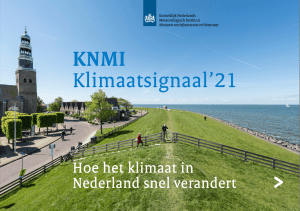
Een stijgende zeespiegel, een toename van droge lentes en zomers en meer extreme zomerse buien vormen de klimaatrisico’s voor Nederland. Met dit rapport wordt de urgentie van de zich snel voltrekkende klimaatverandering duidelijk.
Het KNMI rapporteert hoe het klimaat in Nederland steeds sneller verandert. De nieuwste inzichten over het veranderende Nederlandse klimaat zijn gepubliceerd in het KNMI Klimaatsignaal’21. Het is gebaseerd op het laatste IPCC-rapport – dat in augustus 2021 is verschenen – en eigen onderzoek van het KNMI.
In onze zoektocht naar onderzoeksmethoden of wijzen van denken die verbindend kunnen zijn om vraagstukken integraal en holistisch te benaderen, lijkt de inheemse benadering handvatten te bevatten. Tenminste gaan inheemse onderzoekers uit van de diepere kennis van de complexiteit, de fysieke samenhang der dingen en de interacties van het land, waar zij ook van zijn. Een fascinerend boek door Swan Wilson, Opaskwayak Cree van Noord Manitoba.
“Twintig deelnemers aan een leiderschapsprogramma van het ministerie van Infrastructuur en Waterstaat voerden in 2020 verdiepende gesprekken met acht betrokkenen bij het laatste Ruimte voor de Rivier project Veessen-Wapenveld.
“De ervaringen van Albert, Robbert, Annet, Jean, Agnes, Jos, Josan en Thijs brengen nieuwe inzichten over wat er allemaal speelt in een groot programma als Ruimte voor de Rivier.” (p.48)
In dit persoonlijk leiderschapsprogramma, de Community of Practice voor leidinggevenden, bekwamen leidinggevenden zich in aandachtig luisteren, het stellen van de goede vragen en het doorgronden van persoonlijke verhalen aan de hand van een methodiek uit de praktische filosofie: het kralenspel.
“De acht verhalen roepen een programmawerkelijkheid op waar de schrijvers van het officiële evaluatierapport geen oog voor hadden. Begrijpelijk, omdat zij het programma langs een andere, objectieve maatlat legden die speciaal daarvoor in de wet is vastgelegd.” (p.49)
Wat zouden ze horen en zien als ze deze kwaliteiten inzetten om het verhaal rondom de noordtak van de IJssel, als onderdeel van Ruimte voor de Rivier, op een andere manier boven water te halen? Wat zouden mensen dan anders vertellen dan er staat geschreven in de gebruikelijke projectevaluaties of de tientallen journalistieke reportages die over dit ingrijpende programma de afgelopen decennia zijn verschenen?
En zo ging men in gesprek met bewoners en professionals die bij de aanleg van de hoogwatergeul waren betrokken. De leidinggevenden hebben de persoonlijke verhalen en de gegroeide inzichten in woorden én in beelden vertaald, waar ze professioneel bij werden begeleid. Dit is het resultaat: Pijn en pracht, ruimte voor de rivier van verhalen.”
Civitas Naturalis: “Een open en zelfreflectieve aanpak van de overheid die perspectief biedt om systeemwereld en leefwereld dichter bij elkaar te brengen.”
Delft, 20 januari 2022. De tweede Professor dr.ir. Roelof A.A. Oldeman Lezing* door Mr. J. (Hans) Krul, gemeentesecretaris en algemeen directeur van de Gemeente Delft.
Hij belicht vanuit zijn functie en rol in het knooppunt van het gemeentelijk verkeer, hoe vanuit lokaal perspectief voorliggende complexe opgaven kunnen worden benaderd. Thorbecke en Oldeman zijn daarbij behulpzaam in denken en handelen.
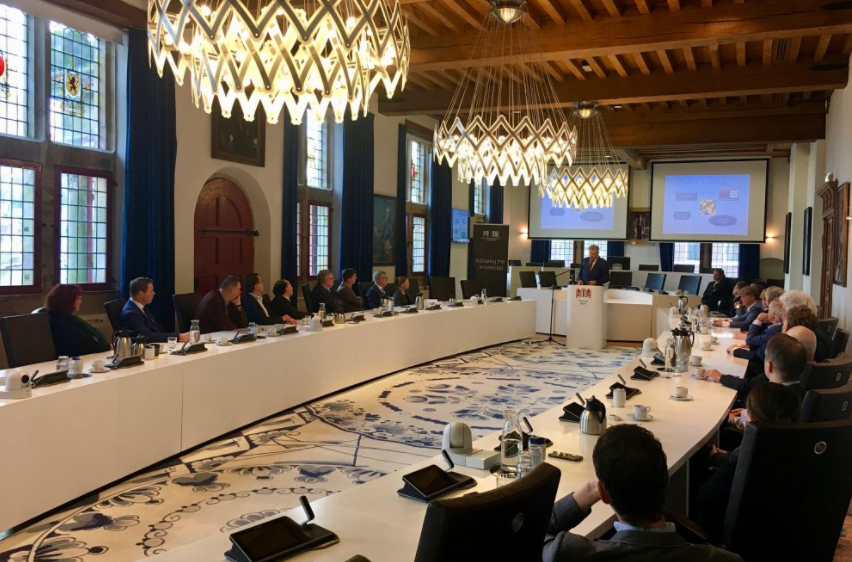
Hans Krul spreekt de 2e Professor Oldemanlezing uit in de raadszaal van de gemeente Delft.
De lezing
“Hartelijk welkom in de raadszaal van dit mooie historische stadhuis van Delft, een van de jongste leden van het PRIMO netwerk. Het is een eer dat ik vandaag in deze voor mij zo vertrouwde omgeving van de Delftse raadszaal de Oldeman Lezing uit mag spreken.
Ik ga dan ook mijn uiterste best doen u niet teleur te stellen waarbij ik in de eerste plaats terugval op mijn ruim 40-jarige werkervaring bij de overheid. Mijn lezing zal zich via de volgende stations voltrekken:





 PRIMO Res Publica