Delft, 20 januari 2022. De tweede Professor dr.ir. Roelof A.A. Oldeman Lezing* door Mr. J. (Hans) Krul, gemeentesecretaris en algemeen directeur van de Gemeente Delft.
Hij belicht vanuit zijn functie en rol in het knooppunt van het gemeentelijk verkeer, hoe vanuit lokaal perspectief voorliggende complexe opgaven kunnen worden benaderd. Thorbecke en Oldeman zijn daarbij behulpzaam in denken en handelen.
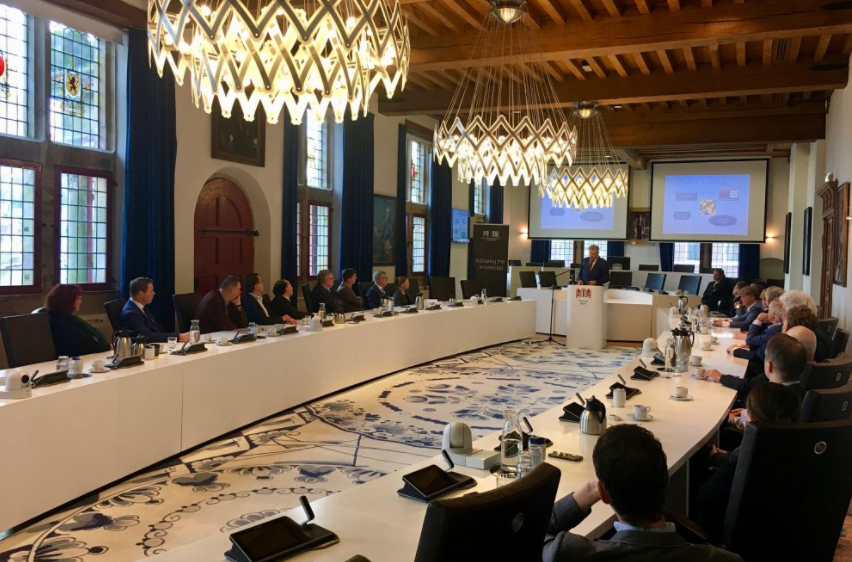
Hans Krul spreekt de 2e Professor Oldemanlezing uit in de raadszaal van de gemeente Delft.
De lezing
“Hartelijk welkom in de raadszaal van dit mooie historische stadhuis van Delft, een van de jongste leden van het PRIMO netwerk. Het is een eer dat ik vandaag in deze voor mij zo vertrouwde omgeving van de Delftse raadszaal de Oldeman Lezing uit mag spreken.
Ik ga dan ook mijn uiterste best doen u niet teleur te stellen waarbij ik in de eerste plaats terugval op mijn ruim 40-jarige werkervaring bij de overheid. Mijn lezing zal zich via de volgende stations voltrekken:
Abstract (quote): “The need to cope with future challenges posed by major transformations such as digitalization and sustainable development has led to several approaches to establish new concepts and methods of science and research. Scientific studies are supposed to provide background knowledge, to facilitate the desired transformations towards a sustainable future and to help resolving complex problems that accompany societies in transition. Concepts such as transformative, transdisciplinary or co-creative approaches elucidate the direction in which scientific research strives for its new role(s).
Based on the discussion of these concepts and their different roots, the article proposes a modular concept for a transdisciplinary scientific approach combining and integrating curiosity driven research with goal oriented (advocacy) knowledge generation and catalytic, process-oriented expertise. This integration promises to address some of the deficits of the existing concepts and is particularly suitable for future studies comprising orientation, strategies and reflection for designing policies for transformations.”
Highlights (quote)
A thorough review of concepts and approaches for interdisciplinary research with an emphasis on European traditions.
An analysis of the merits, problems and shortcomings of these approaches.
A new approach based on the combination of curiosity-driven, goal-oriented and catalytic research concepts.
A brief case study illustrating the new approach.
Summary (quote)
“Policymaking for dealing with wicked and complex problems requires a robust knowledge base for the assessment of the likely consequences of each policy option and is based on balancing conflicting goals considering the diversity of interests, preferences and values of society. This requires a better integration of scientific expertise for informing policymaking, so that the relevant knowledge base can be used in the preparation of evidence-informed, socially acceptable and morally substantiated decisions.
The best way to inform policymaking is by implementing transdisciplinary research methods. Transdisciplinarity becomes manifest in the systematic integration of classic curiosity-driven research (disciplinary and interdisciplinary), goal-oriented strategic research (impact assessment of different options); and process-related catalytic research (deliberative integration of knowledge, values, interests, and preferences). The defining characteristics of transdisciplinarity, namely, the systematic perspective, the orientation on complex real-world problems and the inclusion of non-scientific knowledge, are inherent to this kind of research process (Despres et al., 2004: 472; Jahn et al., 2012: 8; Pohl, 2011: 619; Thompson Klein, 2013: 190; Zscheischler & Rogga, 2015: 29).
To meet these characteristics requires an organic synthesis of the three research concepts described in this article. The curiosity-driven concept brings in the systematic insights to make policy options effective, the goal-oriented concept develops strategies to achieve the desired objectives or to constructively address problems that need public attention, and the catalytic concept delivers the institutional architecture and communicative design necessary to successfully conduct a deliberative discourse between and among the various knowledge carriers and users of knowledge.
The synthesis of these three concepts into an integrative approach of building bridges between knowledge and collective action corresponds to the transdisciplinary mission of science. Transdisciplinary approaches integrate process-related, factual, and strategy-related knowledge and ideally lead to a problem resolution that is factually convincing, argumentatively consistent, morally substantiated, and, in principle, acceptable to all.”
One of the crucial skills of public leaders and managers is to be able to get the bigger picture of society, and from there to connect things and to act accordingly. Mayors and city managers among others need to keep the main focus on the bigger picture, while aldermen and directors have their specific discipline, craftsmanship and portfolio.
Overview and content go hand in hand, both complementary pieces of the puzzle of public governance. Zooming out is a form of art, necessary to understand the city as an ecosystem. For this art, Alexander von Humboldt and Roelof A.A. Oldeman have been of great inspiration. The ability of zooming out is the essential skill for true knowledge, they say. Two quotes.
Naturalist, explorer and geographer Alexander von Humboldt (1856) concluded that zooming out leads to more overview and offers the possibility to interconnect things (and even sciences). Von Humboldt gave guidance on the relation between ecosystems and abiotic factors. At the beginning of the 19th century, he came to this fascinating conclusion, actually revolutionary for that time.
“Physical geography…, elevated to a higher point of view, … embraces the sphere of organic life…”. – Humboldt (1856).
He saw the connection between the life in the ecosystems and the constraints of soil, water, energy and climate. Nobody before him had done this. Also in cities these connections between in fact habitats and communities are all over the place. So we can learn here from the discoveries of Von Humboldt.
“The principle impulse by which I was directed was the earnest endeavour to comprehend the phenomena of physical objects in their general connection, and to represent nature as one great whole, moved and animated by internal forces. Without an earnest striving to attain to a knowledge of special branches of study, all attempts to give a grand and general view of the universe would be nothing more than vain illusion.” – Von Humboldt (1856)
Connection between sciences seems to be necessary to find the real answers. It is about the ability of sharpening one’s view from different angles and principles. Oldeman et al. (1990) underlined, in cross-border studies of forests, the need for such an holistic approach in diagnosis. He always encouraged, within the fragmented landscape of sciences, the necessity to cross the by individual universities so heavily guarded boundaries. For most of the city challenges, the process of policy making and service delivery needs to be based on a cross-border view, to come to well-founded decisions.
“The group that was responsible for the forest components theme decided to accelerate the process by starting an ambitious project, the writing of a common book. There is no way in which cooperation can be stimulated better, but this way has to be learned and practised too. The result is now before you. The book is not yet ideal in our opinion because it still contains too many traces of the old University tradition of researchers working, each apart, on such narrow subjects as they know best.
This way of executing the research of course is necessary to reach sufficient depth. But it carries the risk of loss of vision of the whole system, parts of which are studied. Still a little bit unbalanced, but on its way to improve along lines that are more clear now, this presentation in a pluridisciplinary way is a first step, however, to overcome both the limits of individual researchers and the shallowness of groups. We trust, however, that it is exactly this wrestling with integration of broad views versus the deepening of restricted views that may be as interesting to the reader as the facts, figures, conclusions and hypotheses on forests and their components which are presented in the following pages.” – Oldeman et al. (1990)
Von Humboldt and Oldeman are inspiring in this cross-scientific and pluridisciplinary discovery. Zooming out is crucial to get the picture.
Bibliography
Humboldt, Alexander von (1856). Kosmos: A Sketch of a Physical Description of the Universe, Volume 1. New York: Harper & Brothers Publishers. 406 pp.
Oldeman, R.A.A., P. Schmidt and E.J.M. Arnolds (1990). Forest components. Wageningen: Aricultural University, 111 pp.

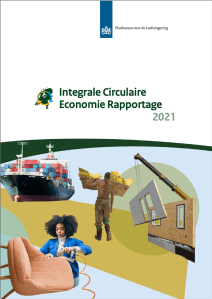
BNG Bank: “Begin 2021 heeft het Planbureau voor de Leefomgeving de eerste Integrale Circulaire Economie Rapportage (ICER 2021) gepubliceerd. Het rapport schetst de voortgang van de transitie naar een circulaire economie in Nederland. Erevoorzitter van PRIMO Europe – Jack Kruf – heeft deze omvangrijke maar zeer informatieve rapportage samengevat op majeure risico’s, zoals zij door de auteurs zijn verwoord.”
De Nederlandse regering wil in 2050 een volledig circulaire economie hebben bereikt. Monitoring van de voortgang van deze transitie is gewenst. Deze rapportage is een belangrijke mijlpaal in dit proces. Welke interventies heeft de overheid in Nederland gedaan om de transitie naar een circulaire economie op gang te brengen en te versnellen? Wat zijn de acties van maatschappelijke partijen?
In onze veranderende wereld kunnen complexe problemen enkel aangepakt worden als organisaties samenwerken. Individuele organisaties zijn niet in staat om deze complexiteit het hoofd te bieden. Ze moeten hun expertise noodgedwongen verbinden aan die van andere en maken hierdoor steeds vaker deel uit van organisatienetwerken. In dit boek verkennen we de fascinerende wereld van organisatienetwerken. Hoe en waarom moeten we steeds vaker streven naar iets dat onze eigen organisatie overstijgt?
Op basis van de meest recente wetenschappelijke inzichten, die de auteurs vaak zelf verzameld hebben, komen alle belangrijke bouwstenen van organisatienetwerken aan bod. Wanneer moet je een organisatienetwerk oprichten en wanneer niet? Hoe doe je dat dan? Wat zijn de valkuilen en hoe kan je hiermee omgaan? Hoe evalueer je op een eenvoudige manier de werking van je organisatienetwerk?
Het vraagt kennis en kunde om organisatienetwerken te doen slagen. Dit boek biedt je via talrijke voorbeelden en begrijpelijke inzichten de mogelijkheid om ook jouw organisatienetwerk te bouwen en evalueren.
Bibliografie
Kenis, P. en Cambré, B. (2019) Organisatienetwerken: De organisatievorm van de toekomst. Kalmthout, België: Pelckmans.
BREDA – Bij zijn afscheidslezing als directeur PRIMO Nederland heeft burgemeester Paul Depla van Breda vrijdag 19 maart 2021 een Koninklijke Onderscheiding uitgereikt aan Jack Kruf. Kruf is benoemd tot Officier in de Orde van Oranje-Nassau. Jack Kruf heeft zich meer dan twintig jaar ingezet voor het op de kaart zetten van risicomanagement binnen de publieke sector. Dat deed hij zowel in Europa als in Nederland.
Aan het eind van de lezing roemde burgemeester Depla de inzet van Kruf als een verbindende factor binnen de stad: “Breda is een stad waar verbindingen tot stand worden gebracht, Jack is hier een voorbeeld van. Hij brengt wetenschap en praktijk bij elkaar.” Kruf reageerde verrast en ontroerd op zijn benoeming.
Centraal thema in zijn afscheidslezing van PRIMO Nederland was ‘Wat hebben wij geleerd van 2020? Over de herwaardering van publieke waarden’ De lezing was voor de leden van PRIMO te volgen via een livestream.
Jack Kruf is ‘de founding father’ en Honorary President van PRIMO Europe en is medeoprichter en oud-directeur van PRIMO Nederland. PRIMO ondersteunt zowel Europees als in Nederland haar leden op het gebied van publiek risicomanagement. Dat doet ze door kennisdeling en een breed opgezet onderwijs programma.
At his farewell lecture as director of PRIMO Netherlands, Mayor Paul Depla of Breda presented Jack Kruf with a Royal Decoration on Friday, March 19. Kruf has been appointed Officer in the Order of Orange-Nassau. Jack Kruf has spent more than twenty years putting risk management on the map within the public sector in Europe and the Netherlands.
fr • Lors de sa conférence d’adieu en tant que directeur de PRIMO Pays-Bas, le maire Paul Depla de Breda a remis une décoration royale à Jack Kruf le vendredi 19 mars. Kruf a été nommé Officier dans l’Ordre d’Orange-Nassau. Jack Kruf a passé plus de vingt ans à mettre la gestion des risques sur la carte au sein du secteur public. Il l’a fait à la fois en Europe et aux Pays-Bas.
nl • Bij zijn afscheidslezing als directeur PRIMO Nederland heeft burgemeester Paul Depla van Breda vrijdag 19 maart een Koninklijke Onderscheiding uitgereikt aan Jack Kruf. Kruf is benoemd tot Officier in de Orde van Oranje-Nassau. Jack Kruf heeft zich meer dan twintig jaar ingezet voor het op de kaart zetten van risicomanagement binnen de publieke sector. Dat deed hij zowel in Europa als in Nederland.
Paul Depla, Mayor of the City of Breda, in his speech to Jack Kruf, with his wife Marij Zegers at his side.
Connecting factor
At the end of the lecture, Mayor Depla praised Kruf’s efforts as a connecting factor within the city: “Breda is a city where connections are made; Jack is an example of this. He brings science and practice together.” Kruf reacted in surprise and moved to his appointment.
fr • À la fin de la conférence, le maire Depla a salué les efforts de Kruf en tant que facteur de connexion au sein de la ville: « Breda est une ville où des connexions sont établies, Jack en est un exemple. Il réunit la science et la pratique. » Kruf a réagi surpris et s’est déplacé à sa nomination.
nl • Aan het eind van de lezing roemde burgemeester Depla de inzet van Kruf als een verbindende factor binnen de stad: “Breda is een stad waar verbindingen tot stand worden gebracht, Jack is hier een voorbeeld van. Hij brengt wetenschap en praktijk bij elkaar.” Kruf reageerde verrast en ontroerd op zijn benoeming.
Theme
The central theme in his farewell lecture to PRIMO Netherlands was ‘What have we learned from 2020? On the revaluation of public values.’ The lecture was live-streamed for PRIMO members/
fr • Le thème central de sa conférence d’adieu de PRIMO Pays-Bas était « Qu’avons-nous appris de 2020 ? Sur la réévaluation des valeurs publiques’ La conférence était destinée aux membres de PRIMO à suivre via un livestream.
nl • Centraal thema in zijn afscheidslezing van PRIMO Nederland was ‘Wat hebben wij geleerd van 2020? Over de herwaardering van publieke waarden’ De lezing was voor de leden van PRIMO te volgen via een livestream.
PRIMO
Jack Kruf is PRIMO Europe’s founding father, co-founder, and former director of PRIMO Netherlands. PRIMO supports its members in risk management at the European level and in the Netherlands through knowledge sharing and a broad-based education program.
fr •Jack Kruf est « le père fondateur » de PRIMO Europe et est co-fondateur et ancien directeur de PRIMO Pays-Bas. PRIMO soutient ses membres dans le domaine de la gestion des risques, tant au niveau européen qu’aux Pays-Bas. Elle le fait grâce au partage des connaissances et à un vaste programme d’éducation.
nl • Jack Kruf is ‘de founding father’ van PRIMO Europe en is medeoprichter en oud-directeur van PRIMO Nederland. PRIMO ondersteunt zowel Europees als in Nederland haar leden op het gebied van risicomanagement. Dat doet ze door kennisdeling en een breed opgezet onderwijs programma.
Final word
Jack Kruf: “A moment that makes me quiet and humble, partly because of the special words of Mayor Paul Depla. Grateful and honoured. Special thanks to chairman Jan Paul Woudstra, event manager Esther van Zijp, director Frank Havik, colleagues Ed Mallens and Tom Wustenberghs and last but not least, my co-referent Professor Leen Paape with whom I was allowed to give the lecture, all those present at the webinar and of course my dear family. The fact that they were allowed to be there during lockdown was extraordinary.”
fr • Jack Kruf: « Un moment qui me rend calme et humble, en partie à cause des paroles spéciales du maire Paul Depla. Reconnaissant et honoré. Un merci spécial au président Jan Paul Woudstra, à la responsable de l’événement Esther van Zijp, au directeur Frank Havik, à son collègue Ed Mallens et à Tom Wustenberghs et enfin et surtout mon co-référent le professeur Leen Paape avec qui j’ai été autorisé à donner la conférence, toutes les personnes présentes au webinaire et bien sûr ma chère famille. Le fait qu’ils aient été autorisés à être là en période de confinement était très spécial. »
nl • Jack Kruf: “Een moment dat mij stil en nederig maakt, mede door de bijzondere woorden van Burgemeester Paul Depla. Dankbaar en vereerd. In het bijzonder dank aan voorzitter Jan Paul Woudstra, event-managener Esther van Zijp, directeur Frank Havik, collega Ed Mallens en Tom Wustenberghs en last but not least mijn co-referent professor Leen Paape met wie ik de lezing mocht verzorgen, alle aanwezigen bij het webinar en natuurlijk mijn lieve familie. Dat zij erbij mochten zijn in tijden van lockdown, was wel heel bijzonder.”
_____
Original language: Dutch. Translation in English and French by Deepl.