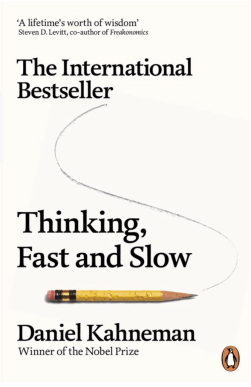
Thinking, Fast and Slow

Daniel Kahneman | 2013

In this fascinating treatise by a giant in the field of decision research, the mind is a hilariously muddled compromise between incompatible modes of thought.

Psychologist Kahneman positions a brain governed by two clashing decision-making processes. The largely unconscious System 1, he contends, makes intuitive snap judgments based on emotion, memory, and hard-wired rules of thumb and the painfully conscious System 2 laboriously checks the facts and does the math but is so “lazy” and distractible that it usually defers to System 1.

Kahneman uses this scheme to frame a scintillating discussion of his findings in cognitive psychology and behavioural economics and of the ingenious experiments that tease out the irrational, self-contradictory logics that underlie our choices.

All the factors described play a direct and indirect role in public governance. All public leaders and managers should be aware of the thoroughly described systems of our brains and behaviour. They make things clear and understandable. The book is an epiphany.

Bibliography

Kahneman, D. (2013) Thinking, Fast and Slow. New York: Farrar, Straus and Giroux

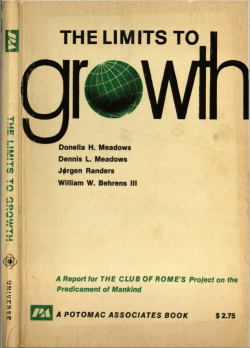
The Limits to Growth

Club of Rome | 1972

In March 1972, a report by a group of young scientists at the Massachusetts Institute of Technology (MIT) commissioned by Aurelio Peccei, founder of The Club of Rome, shook the world. The report excels in system thinking and modelling and in that it is more actual than ever.

Today, 50 years after its publication, “The Limits to Growth” is considered one of the most important and controversial environmental books of all time and it continues to influence conversations around sustainability and our continued existence on this finite planet. Below is the story behind this ground-breaking publication.

Published 1972 – The message of this book still holds today: The earth’s interlocking resources – the global system of nature in which we all live – probably cannot support present economic and population growth rates much beyond the year 2100, if that long, even with advanced technology. In the summer of 1970, an international team of researchers at the Massachusetts Institute of Technology began a study of the implications of continued worldwide growth.

They examined the five basic factors that determine and, in their interactions, ultimately limit growth on this planet-population increase, agricultural production, nonrenewable resource depletion, industrial output, and pollution generation. The MIT team fed data on these five factors into a global computer model. Then it tested the model’s behaviour under several sets of assumptions to determine alternative patterns for mankind’s future. The Limits to Growth is the nontechnical report of their findings.

The book also contains a message of hope: Man can create a society in which he can live indefinitely on earth if he imposes limits on himself and his production of material goods to achieve a state of global equilibrium with population and production in carefully selected balance.


The Limits to Growth, 1972 – key messages:

    • With existing policies, the physical limits to growth would likely be exceeded within one generation.
    • The most likely outcome of reaching these limits would be overshooting them, followed by systems decline.
    • The findings, however, also suggested a viable alternative to these outcomes – one in which population growth and material production could be brought into balance with planetary limits.
    • The fourth conclusion was that it would realistically take 50 to 100 years, or even more, to make this alternative outcome a reality.
    • Finally, the team found that every year action is delayed toward reaching the alternative outcome, decreasing the number of options available to avoid overshoot and collapse.

Bibliography

Meadows, D. H., Meadows, D. L., Randers, J. & Behrens, W. W. (1972). The limits to growth: A report for the Club of Rome’s project on the predicament of mankind. New York: Universe Books.

Limits to Growth (digital scan version, source: https://donellameadows.org)

Short History

Brundtland Report

United Nations | April 1987

The first explicit common reference to sustainable development was in the 1987 Brundtland Report Our Common Future of the United Nations Commission on Environment and Development.

In this report, sustainable development was defined as: “development that meets the needs of the present without compromising the ability of future generations to meet their own needs”. In 1987 the need for cooperating on this was high.

Lees verder “Brundtland Report”

Millennium Development Goals

United Nations | 2000

One way to improve global governance of society and nature’s public domain is to work on governance codes. Another is to pursue goals on global public policy issues. The United Nations set the Millennium Development Goals (MDGs) in 2000.

In September 2000, building upon a decade of major United Nations conferences and summits, world leaders came together at United Nations Headquarters in New York to adopt the United Nations Millennium Declaration.

They committed their nations to a new global partnership to reduce extreme poverty and set out a series of time-bound targets – with a deadline of 2015. They were the first attempt to formulate global targets and are the predecessors of the Sustainable Development Goals SDGs. 

Download Millennium Declaration.

Fukushima report

The National Diet of Japan | 2012

The evaluation of the Fukushima Daiichi nuclear disaster in 2011, which was caused by an earthquake followed by a tsunami, is a good example of zooming out from a disaster and learning the lessons. It is a true example of self-reflection because it digs deep into the public ecosystem where government, business, and civic society meet. It is a form of network analysis. The disaster had a major impact on the natural environment and ecosystems. The disaster shocked the entire world.

The National Diet of Japan

The conclusions of the Fukushima Nuclear Accident Independent Investigation Commission were thorough and blistering. They shed light on how attitudes, stakes, and rules and their interdependencies, and the lack of cooperation in peacetime (read: before the earthquake and the tsunami) between organisations related to the public domain, had increased the disaster.

The major conclusions [quote]:

    • In order to prevent future disasters, fundamental reforms must take place. These reforms must cover both the structure of the electric power industry and the structure of the related government and regulatory agencies as well as the operation processes. They must cover both normal and emergency situations. 
    • The TEPCO Fukushima Nuclear Power Plant accident was the result of collusion between the government, the regulators and TEPCO, and the lack of governance by said parties. They effectively betrayed the nation’s right to be safe from nuclear accidents. Therefore, we conclude that the accident was clearly “manmade”. We believe that the root causes were the organisational and regulatory systems that supported faulty rationales for decisions and actions, rather than issues relating to the competency of any specific individual. 
    • We conclude that TEPCO was too quick to cite the tsunami as the cause of the nuclear accident and deny that the earthquake caused any damage.
    • The Commission concludes that there were organisational problems within TEPCO. Had there been a higher level of knowledge, training, and equipment inspection related to severe accidents, and had there been specific instructions given to the on-site workers concerning the state of emergency within the necessary time frame, a more effective accident response would have been possible. 
    • The Commission concludes that the situation continued to deteriorate because the crisis management system of the Kantei, the regulators and other responsible agencies did not function correctly. The boundaries defining the roles and responsibilities of the parties involved were problematic, due to their ambiguity. 
    • The Commission concludes that the residents’ confusion over the evacuation stemmed from the regulators’ negligence and failure over the years to implement adequate measures against a nuclear disaster, as well as a lack of action by previous governments and regulators focused on crisis management. The crisis management system that existed for the Kantei and the regulators should protect the health and safety of the public, but it failed in this function. 
    • The Commission recognizes that the residents in the affected area are still struggling from the effects of the accident. They continue to face grave concerns, including the health effects of radiation exposure, displacement, the dissolution of families, disruption of their lives and lifestyles and the contamination of vast areas of the environment. There is no foreseeable end to the decontamination and restoration activities that are essential for rebuilding communities. 
    • The Commission concludes that the government and the regulators are not fully committed to protecting public health and safety; that they have not acted to protect the health of the residents and to restore their welfare. 
    • The Commission has concluded that the safety of nuclear energy in Japan and the public cannot be assured unless the regulators go through an essential transformation process. The entire organisation needs to be transformed, not as a formality but in a substantial way. Japan’s regulators need to shed the insular attitude of ignoring international safety standards and transform themselves into a globally trusted entity. 
    • TEPCO did not fulfil its responsibilities as a private corporation, instead obeying and relying upon the government bureaucracy of METI, the government agency driving nuclear policy. At the same time, through the auspices of the FEPC, it manipulated the cozy relationship with the regulators to take the teeth out of regulations. 
    • The Commission concludes that it is necessary to realign existing laws and regulations concerning nuclear energy. Mechanisms must be established to ensure that the latest technological findings from international sources are reflected in all existing laws and regulations.
    • Replacing people or changing the names of institutions will not solve the problems. Unless these root causes are resolved, preventive measures against future similar accidents will never be complete.” [unquote] 

The chairman of the research commission of the National Diet report Kiyoshi Kurokawa summarised the conclusions [quote]:

    • The disaster cannot be regarded as a natural disaster. It was a profoundly manmade disaster – that could and should have been foreseen and prevented. And its effects could have been mitigated by a more effective human response.
    • Our report catalogues a multitude of errors and wilful negligence that left the Fukushima plant unprepared for the events of March 11. And it examines serious deficiencies in the response to the accident by TEPCO, regulators and the government. 
    • What must be admitted – very painfully – is that this was a disaster “Made in Japan.” Its fundamental causes are to be found in the ingrained conventions of Japanese culture: our reflexive obedience; our reluctance to question authority; our devotion to ‘sticking with the program’; our groupism; and our insularity.  Had other Japanese been in the shoes of those who bear responsibility for this accident, the result may well have been the same. 
    • Following the 1970s “oil shocks,” Japan accelerated the development of nuclear power in an effort to achieve national energy security. As such, it was embraced as a policy goal by government and business alike, and pursued with the same single-minded determination that drove Japan’s postwar economic miracle. 
    • With such a powerful mandate, nuclear power became an unstoppable force, immune to scrutiny by civil society. Its regulation was entrusted to the same government bureaucracy responsible for its promotion. At a time when Japan’s self-confidence was soaring, a tightly knit elite with enormous financial resources had diminishing regard for anything ‘not invented here.’ 
    • This conceit was reinforced by the collective mindset of Japanese bureaucracy, by which the first duty of any individual bureaucrat is to defend the interests of his organisation. Carried to an extreme, this led bureaucrats to put organisational interests ahead of their paramount duty to protect public safety. 
    • Only by grasping this mindset can one understand how Japan’s nuclear industry managed to avoid absorbing the critical lessons learned from Three Mile Island and Chernobyl; and how it became accepted practice to resist regulatory pressure and cover up small-scale accidents. It was this mindset that led to the disaster at the Fukushima Daiichi Nuclear Plant. 
    • This report singles out numerous individuals and organisations for harsh criticism, but the goal is not—and should not be—to lay blame. The goal must be to learn from this disaster, and reflect deeply on its fundamental causes, in order to ensure that it is never repeated. 
    • Many of the lessons relate to policies and procedures, but the most important is one upon which each and every Japanese citizen should reflect very deeply. 
    • The consequences of negligence at Fukushima stand out as catastrophic, but the mindset that supported it can be found across Japan. In recognizing that fact, each of us should reflect on our responsibility as individuals in a democratic society. 
    • As the first investigative commission to be empowered by the legislature and independent of the bureaucracy, we hope this initiative can contribute to the development of Japan’s civil society. Above all, we have endeavoured to produce a report that meets the highest standard of transparency. The people of Fukushima, the people of Japan and the global community deserve nothing less. [unquote]

Bibliography

The National Diet of Japan (2012) The Fukushima Nuclear Accident Independent Investigation Commission. The National Diet of Japan https://warp.da.ndl.go.jp/info:ndljp/pid/3856371/naiic.go.jp/en/report/


Comparative risk analysis of technological hazards (a review)

Robert W. Kates and Jeanne X. Kasperson | 1983

Hazards are threats to people, and what they value, and risks are measures of hazards. Comparative analyses of the risks and hazards of technology can be dated to Starr (1969) but are rooted in recent trends in the evolution of technology, the identification of hazards, the perception of risk, and the activities of society.

These trends have spawned an interdisciplinary quasi-profession with new terminology, methodology, and literature. A review of 54 English-language monographs and book-length collections published between 1970 and 1983 identified seven recurring themes:

i. Overviews of the field of risk assessment.

ii. Efforts to estimate and quantify risk.

iii. Discussions of risk acceptability.

iv. Perception.

v. Analyses of regulation.

vi. Case studies of specific technological hazards.

vii. Agenda for research.

Within this field, science occupies a unique niche, for many technological hazards transcend the realm of ordinary experience and require expert study. Scientists can make unique contributions to each area of hazard management, but their primary contribution is in the practice of basic science.

Hazards are threats to people, and what they value, and risks are measures of hazards.

Beyond that, science needs to further risk assessment by understanding the more subtle processes of hazard creation, establishing conventions for estimating risk and presenting and handling uncertainty.

Scientists can enlighten the discussion of tolerable risk by setting risks into comparative contexts, studying the evaluation process, and participating as knowledgeable individuals, but they cannot decide the issue. Science can inform the hazard management process by broadening the range of alternative control actions and modes of implementation and devising methods to evaluate their effectiveness.

Bibliography

Kates, R. W., & Kasperson, J. X. (1983). Comparative risk analysis of technological hazards (a review). Proceedings of the National Academy of Sciences, 80(22), 7027-7038.https://doi.org/10.1073/pnas.80.22.7027

Starr, C. (1969). Social benefit versus technological risk: what is our society willing to pay for safety?. Science, 165(3899), 1232-1238.

ISO 31000

The International Organization for Standardization | November 2009

The International Organization for Standardization (ISO) in Genève started in 2005 the development of a guidance standard on risk management. An ISO working group was established to develop a Committee Draft called ISO CD31000. The standard “gives generic guidelines for the principles and the adequate implementation of risk management. It is not intended to be used for the purposes of certification.”

ISO 31000 seeks to provide a universally recognised paradigm for practitioners and companies employing risk management processes, replacing the myriad of existing standards, methodologies, and paradigms that differ between industries, subject matters, and regions. For this purpose, the recommendations provided in ISO 31000 can be customized to any organisation and its context.

In some respects, ISO 31000 is similar to ISO 9000 and other broad-based international standards. Though it is not certifiable, it is a concise and comprehensive statement which can, in a practical sense, contribute to the awareness and implementation of risk management.