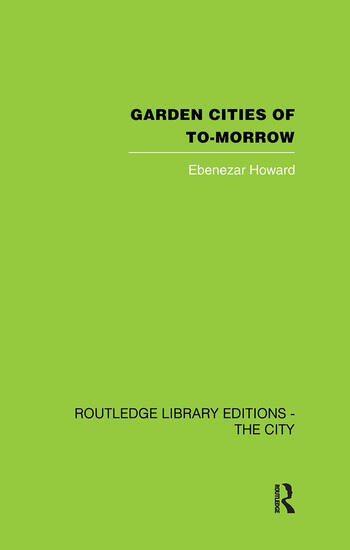
Originally published in 1898 as To-Morrow: A Peaceful Path to Reform by Ebener Howard “the book”, writes F.J. Osborn “holds a unique place in town planning literature, is cited in all planning bibliographies, stands on the shelves of the more important libraries, and is alluded to in most books on planning; yet most of the popular writers on planning do not seem to have read it – or if they have read it, to remember what it says.”
The book gave rise to the garden city movement and is very important in the field of urban design. It aimed to propose an alternative to industrialised cities in the late 19th century. In what he calls town-country, it is a type of urban development somewhere between the city and the countryside. It would be the best of both worlds.
‘The forests have taught us that diversity is key and that abundance comes with the growth of different ways to interact with the environment and not limit or eliminate it.’ (Lombardi, 2021).
All organisms play a part in the functioning of the forest in the processes of building up and breaking down organic matter and recycling nutrients. Biodiversity is key.
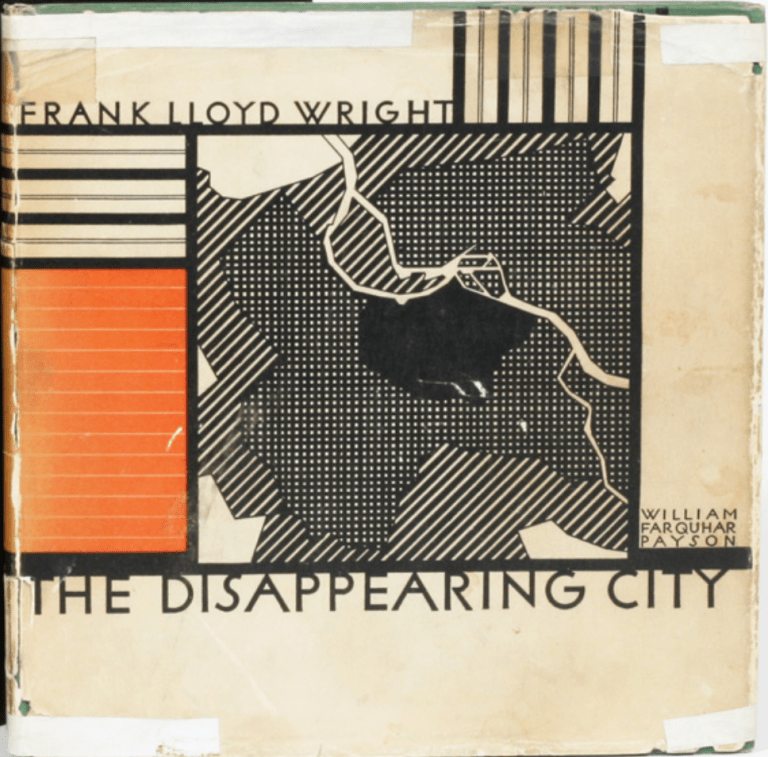
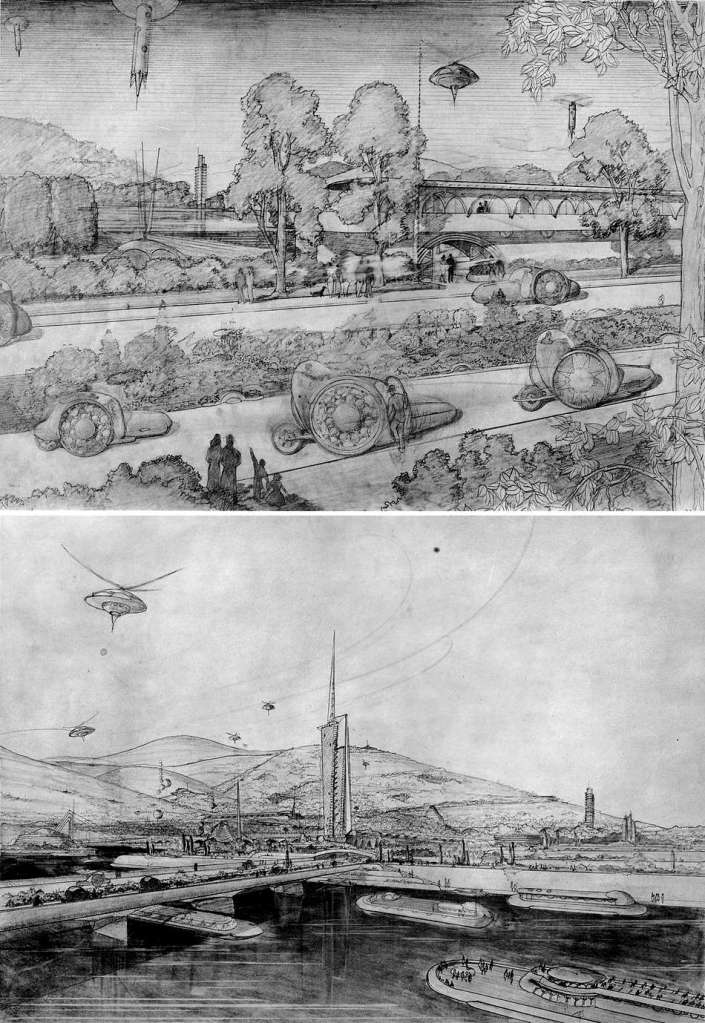
“The principles set forth in The Disappearing City Frank Lloyd Wright’s advocacy of creating cities built to human scale, of planning the open spaces, making possible both community places and truly private places, of decentralizing the structure of our civilization – found their most thoughtful expression in his Broadacre City, an idea that grew from the 1932 book into a highly influential theory of city planning – and a radical critique, not only of the unhealthy, unwieldy American city but of his European contemporaries’ coldly rational urban warehouses for humans” (Fowler, Frank Lloyd Wright: Graphic Artist).
On Earth
“The value of this earth, as man’s heritage, is pretty far gone from him now in the cities centralization has built. And centralization has over-built them all. Such urban happiness as the properly citified citizen knows consists in the warmth and pressure or the approbation of the crowd. Grown Argus-eyed and enamoured of “whirl” as a dervish, the surge and mechanical roar of the big city turns his head, fills his ears as the song of birds, the wind in the trees, animal cries and the voices and songs of his loved ones once filled his heart.
But as he stands, out of machines he can create nothing but machinery.
The properly citified citizen has become a broker dealing, chiefly, in human frailties or the ideas and inventions of others: a puller of levers, a presser of the buttons of a vicarious power, his by way of machine craft.
A parasite of the spirit is here, a whirling dervish in a whirling vortex. Perpetual to and from excites and robs the urban individual of the meditation, imaginative reflection and projection once his as he lived and walked under clean sky among the growing greenery to which he was born companion. The invigoration of the Book of Creation he has traded for the emasculation of a treatise on abstraction. Native pastimes with the native streams, woods and fields, this recreation he has traded for the taint of carbon-monoxide, a rented aggregate of rented cells up-ended on hard pavements, “Paramounts”, “Roxies” and nightclubs, speakeasies. And for this he lives in a cubicle among cubicles under a landlord who lives above him, the apotheosis of rent, in some form, in some penthouse.
The citizen, properly citified, is a slave to herd instinct and vicarious power as the medieval laborer, not so long before him, was a slave to his pot of “heavy wet.” A cultural weed of another kind.
The weed goes to seed. Children grow up, herded by thousands in schools built like factories, run like factories, systematically turning out herd-struck morons as machinery turns out shoes.
Men of genius, productive when unsuccessful, “succeed,” become vicarious, and except those whose metier is the crowd, these men, who should be human salvage, sink in the city to produce, but create no more. Impotent.
Life itself is become the restless “tenant” in the big city. The citizen himself has lost sight of the true aim of human existence and accepts substitute aims as his life, unnaturally gregarious, tends more and more toward the promiscuous blind adventure of a crafty animal, some form of graft, a febrile pursuit of sex as “relief” from factual routine in the mechanical uproar of mechanical conflicts. Meantime, he is struggling to maintain, artificially, teeth, hair, muscles and sap; sight growing dim by work in artificial light, hearing now chiefly by telephone; going against or across the tide of traffic at the risk of damage or death. His time is regularly wasted by others because he, as regularly, wastes theirs as all go in different directions on scaffolding, or concrete or underground to get into another cubicle under some other landlord. The citizen’s entire life is exaggerated but sterilized by machinery–and medicine: were motor oil and castor oil to dry up, the city would cease to function and promptly perish.
The city itself is become a form of anxious rent, the citizen’s own life rented, he and his family evicted if he is in “arrears” or “the system” goes to smash. Renting, rented and finally the man himself rent should his nervous pace slacken. Should this anxious lock-step of his fall out with the landlord, the moneylord, the machinelord, he is a total loss.
And over him, beside him and beneath him, even in his heart as he sleeps is the taximeter of rent, in some form, to goad this anxious consumer’s unceasing struggle for or against more or less merciful or merciless money increment. To stay in lockstep. To pay up. He hopes for not much more now. He is paying his own life into bondage or he is managing to get the lives of others there, in order to keep up the three sacrosanct increments to which he has subscribed as the present great and beneficent lottery of private capital. Humanity preying upon humanity seems to be the only “economic system” he knows anything about…”
The Broadacre City
We are concerned here in the consideration of the future city as a future for individuality in this organic sense: individuality being a fine integrity of the human race. Without such integrity there can be no real culture whatever what we call civilization may be. We are going to call this city for the individual the Broadacre City because it is based upon a minimum of an acre to the family.
And, we are concerned for fear systems, schemes, and “styles” have already become so expedient as civilization that they may try to go on in Usonia as imitation culture and so will indefinitely postpone all hope of any great life for a growing people in any such city the United States may yet have.
To date our capitalism as individualism, our eclecticism as personality has, by way of taste, got in the way of integrity as individuality in the popular understanding, and on account of that fundamental misunderstanding we, the prey of our culture-monger, stand in danger of losing out chance at this free life our charter of liberty originally held out to us.
I see that free life in the Broadacre City.
As for freedom, we have-prohibition because a few fools can’t carry their liquor; Russia has communism because a few fools couldn’t carry their power; we have a swollen privatism because a few fools can’t carry their “success” and money must go on making money.
If instead of an organic architecture we have a style formula in architecture in America, it will be because too many fools have neither imagination nor the integrity called individuality. And we have our present overgrown cities because the many capitalistic fools are contented to be dangerous fools.
A fool ordinarily lacks significance except as a cipher has it. The fool is neither positive nor negative. But by way of adventitious wealth and mechanical leverage he and his satellites – the neuters – are the overgrown city and the dam across the stream flowing toward freedom.
It is only the individual developing in his own right (consciously or unconsciously) who will go, first, to the Broadacre City because it is the proper sense of the dignity and worth of the individual, as an individual, that is building that city. But after those with this sense the others will come trailing along into the communal-individuality that alone we can call Democracy.
But before anything of significance or consequence can happen in the culture of such a civilization as ours, no matter how that civilization came to be, individuality as a significance and integrity must be a healthy growth or at least growing healthy. And it must be a recognized quality of greatness.
In an organic modern architecture, all will gladly contribute this quality, as they may, in the spirit that built the majestic cathedrals of the middle-ages. That medieval spirit was nearest the communal, democratic spirit of anything we know. The common-spirit of a people disciplined by means and methods and materials, in common, will have – and withno recognized formula – great unity.”
Wat je kunt leren van high reliability organizations
Karl Weick en Kathleen Sutcliffe | 2001
Dit boek gaat over organisaties, verwachtingen en opmerkzaamheid. De basale boodschap van de auteurs, is dat verwachtingen organisaties in moeilijkheden kunnen brengen, tenzij deze een opmerkzame cultuur én infrastructuur schept die voortdurend in staat is om te schakelen. Zij baseren hun bevindingen op een studie naar wat de organisatorische en bestuurskundige ingrediënten waren voor succesvolle organisaties.
De auteurs tonen de lezers hoe zij flexibel kunnen reageren op onverwachte uitdagingen en hoe zij de ontregelende effecten van verandering kunnen minimaliseren door het gebruiken van zingeving, stressreductie, migratiebeslissingen en labeling. Lees verder “Management van het Onverwachte”
Al jaren worstelen organisaties met de onderwerpen inclusie, diversiteit, gelijkwaardigheid en discriminatie. Op alle niveaus. Want natuurlijk wil niemand onderscheid maken en iedereen gelijk behandelen.
Doorgaans zonder succes want er wordt vaak teruggegrepen op trainingen die nauwelijks werken, adviseurs die nooit echt eindverantwoordelijkheid hebben en een obligaat verhaal in de jaarplannen. Met als gevolg dat medewerkers en managers alleen maar moe worden van deze onderwerpen.
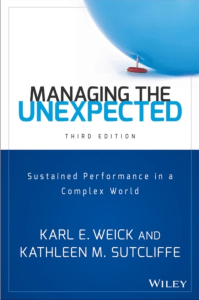
Assuring High Performance in an Age of Complexity.
Karl E. Weick and Kathleen M. Sutcliffe | August 2015 (original 2001)
Improve your company’s ability to avoid or manage crises! ‘Managing the Unexpected’, Third Edition, is a thoroughly revised text that offers an updated look at the groundbreaking ideas explored in the first and second editions.
Revised to reflect events emblematic of the unique challenges that organisations have faced in recent years, including bank failures, intelligence failures, quality failures, and other organisational misfortunes, often sparked by organisational actions, this critical book focuses on why some organisations are better able to sustain high performance in the face of unanticipated change.
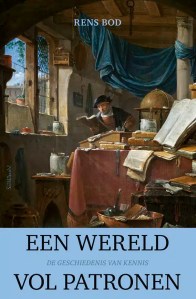
Het idee dat de wereld kan worden begrepen aan de hand van patronen en onderliggende principes is een van de belangrijkste inzichten van de mens.
Dit boek gaat over deze uniek menselijke zoektocht die meer dan 40.000 jaar geleden begon met het krassen van streepjespatronen op mammoetbotten en die heeft geleid tot de wetenschappen van vandaag. Welke routes heeft menselijke kennis doorlopen om van dit bescheiden begin uit te groeien tot onze moderne inzichten over natuur en cultuur?


 PRIMO Res Publica