Een korte geschiedenis van publiek risicomanagement

Naar een holistische benadering

Finn Kjaer Jensen | februari 2007

Het is zeker waar dat overheden al duizenden jaren aan risicomanagement doen, tenminste in de algemene zin van het woord. Steden in de oudheid die muren bouwden om indringers buiten te houden, deden aan een elementaire (maar degelijke) vorm van risicomanagement. Risicomanagement is zelfs een fundamenteel doel van de overheid. Sterker, de overheid is in grote mate zelf een vorm van risicomanagement. Er zijn tal van activiteiten in de huidige publieke sector die specifiek kunnen worden gekarakteriseerd als risicomanagement (immunisatieprogramma’s, defensiebeleid), maar die verweven zijn met andere functies van de overheid. 
De categorieën van risicobeheer in de publieke sector

Om het historische proces dat heeft geleid tot het huidige risicomanagement beter te begrijpen, is het nuttig om eerst het algemene kader van risicomanagement in de publieke sector te begrijpen. Lees verder “Een korte geschiedenis van publiek risicomanagement”

Risk Governance: towards and integrative approach

A framework by the International Risk Governance Council

Ortwin Renn | 2006

In dit uitgebreide witboek – gecoördineerd en geredigeerd door Renn (2006) – brengt de International Risk Governance Council een geïntegreerd analytisch kader voor risicomanagement. Het biedt een leidraad voor de ontwikkeling van alomvattende beoordelings- en beheerstrategieën om met risico’s om te gaan, met name op mondiaal niveau. Het kader integreert wetenschappelijke, economische, sociale en culturele aspecten en omvat de effectieve betrokkenheid van belanghebbenden.

In het licht van de geschiedenis is deze leidraad opmerkelijk en markeert het de volgende fase in het denken over risicoconcepten. Het richt zich op “de verbetering van besturingsstrategieën voor risico’s met internationale implicaties die “de menselijke gezondheid, veiligheid, economie, milieu en/of het weefsel van de samenleving als geheel kunnen schaden”. Lees verder “Risk Governance: towards and integrative approach”

Flying start PRIMO Vlaanderen

PRIMO Vlaanderen (2009) is preparing for a promotional campaign right after the summer period. We recently had a first presentation of PRIMO Vlaanderen during an AXA-hosted seminar on adequate prevention policy in our local administrations, compared to what already exists in several companies.

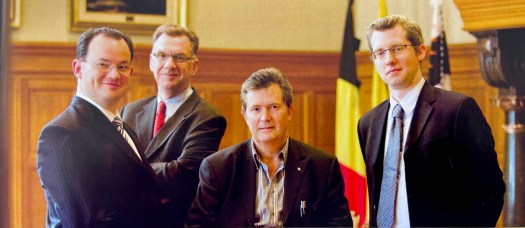
From left to right: Tom Wustenberghs, Ronny Frederickx, Luc Verhulst en Karl Vanderplaetse.

Although it doesn’t seem obvious to imply that political decision makers should think about preventive risk management (often referred to as a waste of time), this aspect might be valuable for developing the association in Flanders as a key information network on risk management.

The new association wants to highlight the importance of preventive risk management over existing crisis planning. Such a policy can only help improve the organisation’s quality (quality management) and reduce costs by diminishing risks.

Lees verder “Flying start PRIMO Vlaanderen”

International Standards for Drinking Water

World Health Organization | 1958

The World Health Organization has long appreciated the need for some form of international agreement and cooperation on the requirements for safe and potable water supplies.

The status of water treatment and quality in the Member States of the World Health Organization was the subject of a questionnaire circulated in 1953. The replies clearly indicated the magnitude of the problem and the need for attention by the World Health Organization.

Lees verder “International Standards for Drinking Water”

Managing the Unexpected (2015)

Assuring High Performance in an Age of Complexity.

Karl E. Weick and Kathleen M. Sutcliffe | August 2015 (original 2001)

Improve your company’s ability to avoid or manage crises! ‘Managing the Unexpected’, Third Edition, is a thoroughly revised text that offers an updated look at the groundbreaking ideas explored in the first and second editions.

Revised to reflect events emblematic of the unique challenges that organisations have faced in recent years, including bank failures, intelligence failures, quality failures, and other organisational misfortunes, often sparked by organisational actions, this critical book focuses on why some organisations are better able to sustain high performance in the face of unanticipated change.

Lees verder “Managing the Unexpected (2015)”

Leiderschap als tragische vergissing

Op zoek naar andere woorden voor heersen en hiërarchie

Mark van Twist en Paul Frissen | 2024

Als we over leiderschap spreken – wat wij bijna nooit doen en eigenlijk ook liever niet willen – dan is dat niet in een taal met uitroeptekens, maar met vraagtekens.

Ook termen als vooruitgang, rationalisering en modernisering, stippen op de horizon en neuzen dezelfde kant op, koers en richting, opgave en opdracht, en transities en ‘paradigma- shifts’ willen we bij voorkeur vermijden.

Lees verder “Leiderschap als tragische vergissing”

Public values and risks in Strasbourg

The birth of Public Risk Management Organisation (PRIMO)

Jack Kruf* | May 2005

Last month, on April 1, 2005, the Executive Committee of UDITE, the network of local government Chief Executives across Europe, met in Strasbourg to discuss ‘public risk management’ as a new idea. City managers from across Europe looked forward to a newly

proposed approach, which Alan Vendelbo, president of UDITE, put at the top of the agenda.

It was clear from the start that they believed it could strengthen their role and function in supporting politics, society, and their organisations. Current events, social attacks, and out-of-control budgets or projects have raised the importance of proactive thinking about public values, targets, and their risks. Here is a short personal impression. I was there on this day.

Lees verder “Public values and risks in Strasbourg”