Comparative risk analysis of technological hazards (a review)

Robert W. Kates and Jeanne X. Kasperson | 1983

Hazards are threats to people, and what they value, and risks are measures of hazards. Comparative analyses of the risks and hazards of technology can be dated to Starr (1969) but are rooted in recent trends in the evolution of technology, the identification of hazards, the perception of risk, and the activities of society.

These trends have spawned an interdisciplinary quasi-profession with new terminology, methodology, and literature. A review of 54 English-language monographs and book-length collections published between 1970 and 1983 identified seven recurring themes:

i. Overviews of the field of risk assessment.

ii. Efforts to estimate and quantify risk.

iii. Discussions of risk acceptability.

iv. Perception.

v. Analyses of regulation.

vi. Case studies of specific technological hazards.

vii. Agenda for research.

Within this field, science occupies a unique niche, for many technological hazards transcend the realm of ordinary experience and require expert study. Scientists can make unique contributions to each area of hazard management, but their primary contribution is in the practice of basic science.

Hazards are threats to people, and what they value, and risks are measures of hazards.

Beyond that, science needs to further risk assessment by understanding the more subtle processes of hazard creation, establishing conventions for estimating risk and presenting and handling uncertainty.

Scientists can enlighten the discussion of tolerable risk by setting risks into comparative contexts, studying the evaluation process, and participating as knowledgeable individuals, but they cannot decide the issue. Science can inform the hazard management process by broadening the range of alternative control actions and modes of implementation and devising methods to evaluate their effectiveness.

Bibliography

Kates, R. W., & Kasperson, J. X. (1983). Comparative risk analysis of technological hazards (a review). Proceedings of the National Academy of Sciences, 80(22), 7027-7038.https://doi.org/10.1073/pnas.80.22.7027

Starr, C. (1969). Social benefit versus technological risk: what is our society willing to pay for safety?. Science, 165(3899), 1232-1238.

Surroundings: A History of Environments and Environmentalisms

Etienne S. Benson

Given the ubiquity of environmental rhetoric in the modern world, it’s easy to think that the meaning of the terms environment and environmentalism are and always have been self-evident.  But in Surroundings, we learn that the environmental past is much more complex than it seems at first glance. In this wide-ranging history of the concept, Etienne S. Benson uncovers the diversity of forms that environmentalism has taken over the last two centuries and opens our eyes to the promising new varieties of environmentalism that are emerging today.

Through a series of richly contextualized case studies, Benson shows us how and why particular groups of people—from naturalists in Napoleonic France in the 1790s to global climate change activists today—adopted the concept of environment and adapted it to their specific needs and challenges. Bold and deeply researched, Surroundings challenges much of what we think we know about what an environment is, why we should care about it, and how we can protect it.

Visit website of Etienne Benson.

The Sea Around Us

Rachel Carson | July 1951

Here is the strange story of the seas – how they were born, how life emerged from them, and the marine world within them. Rachel Carson’s writing teems with images – the newly-formed Earth cooling beneath an endlessly overcast sky; volcanic action throwing up huge masses on the ocean floor to create immense mountains and desolate canyons; giant squid battling sperm whales hundreds of fathoms below the surface.
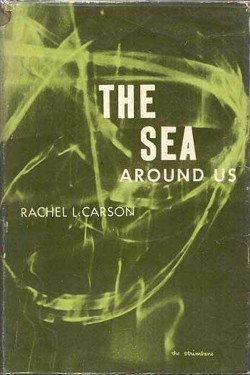
A new chapter by Jeffrey Levinton brings the science of “The Sea Around Us” up to date. Levinton incorporates the most recent thinking on continental drift, coral reefs, the spread of the ocean floor, the deterioration of the oceans, the mass extinction of sea life, and many other topics. First published in 1951, this work won the 1952 National Book Award.

“Published in 1951, The Sea Around Us is one of the most remarkably successful books ever written about the natural world. Rachel Carson’s rare ability to combine scientific insight with moving, poetic prose catapulted her book… It inspired an Academy Award-winning documentary and won the 1952 National Book Award and the John Burroughs Medal. This classic work remains as fresh today as when it first appeared.”

Today, with the oceans endangered by the dumping of medical waste and ecological disasters such as the Exxon oil spill in Alaska, this illuminating volume provides a timely reminder of both the fragility and the importance of the ocean and the life that abounds within it. Anyone who loves the sea, or who is concerned about our natural environment, will want to read this classic work.

Bibliography

Carlson, R. (1951) The Sea Around Us. Oxford: Oxford University Press