The environment and bilateral development aid

Brian Johnson and Robert O. Blake | 1979

Since January 1977, the International Institute for Environment and Development (IIED) has been conducting a research program on the environmental policies and programs of major development aid organizations. The first of IIED’s studies in this field, a report on environmental procedures and practices in nine multilateral development agencies, was completed in 1978 and published in book form as “Banking on the Biosphere?” (Lexington Books, New York, 1979).

This study aroused considerable interest and IIED, as a result, decided to conduct a parallel policy review in relation to six bilateral aid agencies. This “assessment project” began in May 1978 with the agreement and support of the aid agencies of Canada, the Federal Republic of Germany, the Netherlands, Sweden and the United States.

The study’s aim was:

    • To assess the extent to which policies, procedures and programs of the six bilateral agencies promote sustainable, environ­mentally sound development.
    • To examine the constraints to improved environmental performance in these agencies, that might be necessary to remove or substantially reduce these constraints.

At the end of a decade (The Seventies, ed.) in which international concern has arisen sharply at the depletion, misuse and overuse of world resources, there is a high level of public and official interest in the impact of aid programs on developing countries’ environmental resources. This new interest caused the development aid agencies of Canada, the Federal Republic of Germany, the Netherlands, Sweden, the United Kingdom and the United States to sponsor the present study.

The IIED and the six national research teams that carried out this study found that there is general consensus in the aid agencies studied as to the meaning of “environment” in the context of development problems. This represents a major change from the confused position of only three or four years ago.


In the minds of most (but not all) of the officials of these agencies, it is clear that a broad, “holistic” interpretation of the concept is not only acceptable but necessary.1 This recognition by officers of the holistic nature of the concept “environment” is an important step ahead.2

We also found growing recognition of the importance of emphasizing the interconnectedness of all facets of development and of rejecting any notion that the “environmental concerns” can merely be considered one more “add-on” to be planned for in the economic development process.

The term environment as used in this report is synonymous with human environment: the biological and physical components which exist and processes which operate on the earth’s surface and in its atmosphere, and which have direct or indirect influence on humans. The phrase environmental effect: a change in the environment resulting from human action. Environmental impact: the net change
in human well-being resulting from an environmental effect; the environmental impact of a development scheme is the difference in well-being between implementation and non-implementation of the scheme.

2 Almost all “environmental” problems can be defined under other headings, especially resource use, public health and amenity. What gives the word “environment” relevance is its meaning of total surroundings implying inter-connectedness. Thus, the word “environment” means, a dam or a housing project.


The most important feature of this consensus is that environment is now beginning to be seen not as an additional subject, the examination of which has to be added woodenly on to traditional development considerations. Rather this is increasingly seen as a whole new approach to development which gives greater weight to the sustainability of results and to the costs of destructive side effects of projects.

However, one major finding of this study is that this new view, however widely accepted theoretically, has still made too little impact on the orientation and design of the projects or practical development policies of the agencies studied.

Recognizing that each nation’s aid program is bound to have particular priorities which reflect that country’s broad political, economic and socio-cultural relations with recipients of its aid, the comparative report finds that:

    1. There is a need to define more thoroughly environmental and natural resource objectives and concerns in the context of aid programs as a whole.
    2. The most urgent attention should be given to helping developing countries build up their own capacity to study and manage their own environmental problems. This effort should be closely related to donor efforts aimed at fostering greater environmental concern in these countries.
    3. There is a need to encourage and fund a much higher level of consideration and rehabilitation projects commensurate with the rapidly increasing needs of recipient countries.
    4. Policy documents which are produced in each agency project design and execution frequently lack adequate attention to environmental implications.
    5. In only three of the agencies studied was there a clearly focal point for environmental responsibility. A framework for systematically checking on environmental implications is essential.
    6. Procedures to ensure that projects are systematically for environmental impact and where necessary subjected to environmental examination are also needed.
    7. There is a strong case for greater multilateral cooperation in the utilization of donor country resources in these areas.

This report belongs to the selected and used sources of the Brundtland Report.

Common Assessment Framework (CAF)

European Union | 2000

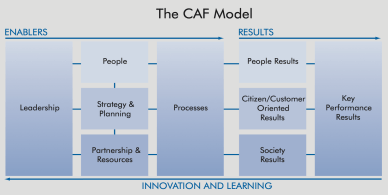
The Common Assessment Framework (CAF) is a total quality management tool inspired by the Excellence Model of the European Foundation for Quality Management (EFQM) and the model of the German University of Administrative Sciences in Speyer.

It is based on the premise that excellent results in organisational performance, citizens/customers, people, and society are achieved through leadership driving strategy and planning, people, partnerships, resources, and processes. It simultaneously looks at the organisation from different angles, taking a holistic approach to organisational performance analysis.

Lees verder “Common Assessment Framework (CAF)”

Shorten the odds

Accounts Commission, Glasgow Caledonian University and ALARM (Scotland) | 1999

Risk management is a key task for managers in every organisation. In local government, identifying and evaluating the consequences of policies or actions is not always referred to as risk management. However, failure to pay proper attention to the likelihood and consequences of risks can cause the council serious problems. The financial cost, service disruption, bad publicity, threats to public health or compensation claims are among the most obvious. The effective management of risk is, therefore a critical part of councils’ approaches to delivering the sound governance element of Best Value.

This paper is aimed at managers and elected members rather than risk management experts. The paper promotes the concept of risk management and highlights good practices in managing risk effectively. It also outlines the key roles and responsibilities of managers and members in developing and implementing an all-encompassing corporate approach to managing risk. Finally, it introduces a range of tools, techniques and checklists to help managers to manage risk systematically.

Download report

Bibliography

Accounts Commission, Glasgow Caledonian University and ALARM (Scotland) (1999) Shorten the Odds – A guide to Understanding and Managing Risk. Edinburgh: Accounts Commission for Scotland.

Global Risks Report 2012

World Economic Forum

Quote: “Economic imbalances and social inequality risk reversing the gains of globalization, warns the World Economic Forum in its report Global Risks 2012.

These are the findings of a survey of 469 experts and industry leaders, indicating a shift of concern from environmental risks to socioeconomic risks compared to a year ago. Respondents worry that further economic shocks and social upheaval could roll back the progress globalization has brought, and feel that the world’s institutions are ill-equipped to cope with today’s interconnected, rapidly evolving risks.

The findings of the survey fed into an analysis of three major risk cases: Seeds of Dystopia; Unsafe Safeguards and the Dark Side of Connectivity. The report analyses the top 10 risks in five categories – economic, environmental, geopolitical, societal and technological – and also highlights “X Factor” risks, the wild card threats which warrant more research, including a volcanic winter, cyber neotribalism and epigenetics, the risk that the way we live could have harmful, inheritable effects on our genes. Key crisis management lessons from Japan’s earthquake, tsunami and nuclear disasters are highlighted in a special chapter.”

WEF Global Risks Report 2012

Regeren is Vooruitzien

Anno 2022 spreken wij in Nederland nu bijna 2 jaar over Corona. Als crisis wel te verstaan. Alle discussies en rapporten steken in op de  Corona-aanpak in de vorm van crisismanagement. Zowel de politiek, het bestuur, de media, de wetenschappelijke adviesraden en de zorgsector zelve zijn opgenomen in deze dans van reactie en reductie.

Covid-19 is gezien haar schaal een nieuw fenomeen, een grote pandemie, iets dat ons overkomt. Of lijkt te overkomen. Dat is natuurlijk niet het geval. Er waren immers veel meer zekerheden dat er iets zou gaan gebeuren dan de veelal gesuggereerde en gebruikte onzekerheden.

Onze eigen mensengeschiedenis verschaft ons veel informatie of eerdere pandemieën, en vooral de dierenwereld én de plantenwereld staan erom bekend, dat door uitgebreide monocultures de feedback-mechanismes in systemen worden stilgelegd, of liever omzeild door bacteriën, schimmels, parasieten en virussen. Het leidt permanent tot vele vormen van pandemische uitbraken. Wellicht zijn wij eraan gewend geraakt dat periodiek vele dieren het veld moeten ruimen om in de beteugeling van de pandemie te voorzien. En wij weten dat onze landbouw vele vormen van intensieve bestrijding toepassen om het voedsel op onze borden te krijgen.

Wij hebben het eerste Global Risks Report van 2005, gepubliceerd door het World Economic Forum in de vorm van Global Risks to the Business Environment, er nog eens op nagelezen. En natuurlijk aansluitend de rapporten die jaarlijks volgden. Wat weten wij nu bijna sinds 2 decennia? Althans op basis van deze reeks van rapporten. Telkens werd de mogelijkheid en reële kans op een pandemie gemeld en onderbouwd als risico voor de samenleving en economie. Quote:

Pandemics – infectious diseases: the expansion of trade and greater mobility associated with globalization, together with the encroachment of humans into natural areas, growing resistance to drugs and changes in climate are increasing the risk of a major outbreak of infectious diseases. Some infectious diseases are new or relatively new (e.g., HIV/AIDS, SARS), some are re-emerging (e.g., TB, cholera), and some are shifting geographically (e.g., West Nile, Dengue fever). There is particular concern over the spread of infectious diseases from animals to humans; public health officials have warned, for example, that an outbreak of avian flu could kill millions of people and cause major disruptions to markets and travel worldwide. The risks are amplified by the woeful inadequacy of existing public health services to prevent, detect and/or respond to the spread of infectious diseases.

Overzicht uit rapport ‘Global Risks to the Business Environment 2005’, pagina 6.

Wij weten inmiddels ook dat deze rapporten niet of nauwelijks zijn geland op de burelen van topmanagers, bestuurders en politici, terwijl zij toch wel wereldwijd zijn besproken en gecommuniceerd. Of misschien wel zijn beland, maar in de la zijn verdwenen. De vraag is hoe dit kan. Het rapport in 2005 hierover doet zelf reeds de constateringen gerelateerd aan de besturing en leiderschap:

The “Governance Gap”: by definition, global risks transcend national boundaries. There are only a limited number of global institutions to address global risks, and there is ample evidence that neither these institutions nor nation states are responding to global risks in the most efficient or effective way. Many existing governance structures tend to be too compartmentalized or fragmented, and many business leaders are compelled to focus on their short-term bottom lines. A fundamental discrepancy exists between the time- horizon of political and most business leaders and the long-term nature of most global risks, which results in most risks being dealt with in a purely reactive way.

In a nutshell, short-termism prevails: business cannot respond in time because the pressure to produce strong quarterly results collides with the long-term perspective needed to address most global risks. If companies try to address the issue in earnest, they can be punished by the markets. The same is true for politicians: their willingness to tackle the problem is most often bound by the time- horizon dictated by the electoral cycle. Indeed, the challenge of dealing with long-term global risks is compounded by the fact that the tenure of most business leaders is less than five years.

The “Leadership Gap”: difficulties caused by the governance gap are compounded by a leadership gap, both at the international level and in terms of mobilizing society. This generates a “pass the buck” strategy where risks are being redistributed from the core to the periphery. For example, many health, poverty and environmental risks are being transferred to those with the least capacity or resources to solve them: developing countries, for example, or low-income populations in Western countries, or even future generations.

Some major risks, such as the current account deficit in the US, the impact of climate change or the welfare of an ageing population, are being transferred to future generations. Others, such as global security, are being transferred to one single country, either willingly or by default.

The main concern is that the transfer of global risks in this way may reduce the world’s capacity to respond satisfactorily in the long term. Some might argue that countering such transfers of risk from the core to the periphery belongs solely within the sphere of governmental institutions. But can business really sit back and leave the future of their markets to others?

Een integrale diagnose voor de start van elke bestuursperiode zou een formele stap dienen te zijn voor elk bestuurlijk akkoord. Stichting Civitas Naturalis pleit hiervoor. Zij beschouwd een goede diagnose als een natuurlijke eerste stap (Wat is de kwestie die voorligt en hoe is deze ontstaan?) naar goed bestuur.

Behoefte of beter nog noodzaak zou er moeten zijn voor elk bestuur om haar plannen voortaan verplicht te baseren op bestaande onderzoeksrapporten en niet politieke ambities en wensen en zeker niet op strategie en beleid dat niet kan worden geïmplementeerd. De kiezer en haar volksvertegenwoordigers zijn er om dit af te dwingen en te controleren. Zou kunnen en zou moeten. Dit overigens met de voor haar geschreven Grondwet in de hand. Goede besturing kan echt. Dit spreekwoord getuigt van ons culturele erfgoed en van de collectieve wijsheid die wij bezitten: regeren is vooruitzien. Doen dus.

Leren van of door rapporten

Hoe de gemeente Rotterdam leert van raadsenquêtes en rekenkamerrapporten

Mark van Twist, Hans Vermaak, Nancy Chin-A-Fat en Marije Huiting | 2021, NSOB

Herkent u dat? Er verschijnt over uw organisatie een rapport met aanbevelingen hoe van alles beter moet. De bedoeling is dat dat doorwerkt en effect sorteert. Maar toch werkt dat niet altijd zo uit…

Betrokkenen kunnen ervaren dat het rapport er (een beetje) naast zit of te negatief uitpakt. Of ze vinden het rapport goed, maar het (b)lijkt lastig om al die aanbevelingen op te volgen. Of als je ze opvolgt, krijg je er dan wel een sterkere organisatie of beter werk van?
Lees verder “Leren van of door rapporten”

Cadbury Report

Cadbury committee | 1992, London Stock Exchange, en nl

This report is a milestone in corporate governance. It is 1992. The Cadbury Report about “Financial Aspects of Corporate Governance” has been published. This groundbreaking report – chaired by Sir Adrian Cadbury – led to improvements in governance standards. It was a reaction to the Bank of Credit and Commerce International scandal in 1991.

Dit rapport is een mijlpaal in het corporate besturing. Het is 1992. Het Cadbury Report over “Financial Aspects of Corporate Governance” wordt gepubliceerd. Baanbrekend – voorgezeten door Sir Adrian Cadbury – en het leidde tot verbeteringen in de normen voor deugdelijk bestuur. Het was een reactie op het schandaal in 1991 bij de Bank of Credit and Commerce International.

The report made specific recommendations on good corporate governance, which it described as ”best practice” or ”code of conduct.” It was highly influential in developing organisational codes regarding external shareholders’ accountability. It is the start of a new line of thinking about good governance, also in the public context. Het rapport deed specifieke aanbevelingen voor goed ondernemingsbestuur, die het omschreef als “best practice” of “gedragscode”. Het rapport was zeer invloedrijk bij het ontwikkelen van organisatiecodes met betrekking tot de verantwoordingsplicht van externe aandeelhouders. Het is het begin van een nieuwe manier van denken over goed bestuur, ook in de publieke context.

This interview with Sir Adrian Cadbury gives the precise focus and the intention to look further into the essence of corporate governance. Dit interview met Sir Adrian Cadbury geeft de precieze focus en de intentie om verder te kijken naar de essentie van corporate governance.

The report stipulated “the continuing concern about standards of financial reporting and accountability, … which has kept corporate governance in the public eye.” Some findings and recommendations (a personal selection) tell the story of the search for codes, checks and balances [quote]:

    • By adhering to the Code, listed companies will strengthen their control over their businesses and public accountability. In so doing, they will be striking the right balance between meeting the standards of corporate governance now expected of them and retaining the essential spirit of enterprise. 
    • Every public company should be headed by an effective board that can lead and control the business. 
    • However, the framework in which auditors operate is not well designed in certain respects to provide the objectivity that shareholders and the public expect of auditors in carrying out their function. 
    • The new system has only recently been established, and its full impact has yet to be felt. In the following paragraphs, we endorse the steps being taken and recommend additional action to strengthen public confidence in the audit approach. 
    • We believe that there should be an extension of the audit, which will add to users of accounts and bring it closer into line with public expectations. 
    • So far as reporting fraud is concerned, the present legal position is that confidentiality is an implied term of an auditor’s contract, and there is a public interest in maintaining confidential client relationships. Normally, therefore, it is the auditor’s duty to report fraud to senior management. However, there is also a public interest in fraud being dealt with expeditiously and this may entail disclosing matters to a proper authority. [unquote]

Het rapport vermeldde “de voortdurende bezorgdheid over normen voor financiële verslaggeving en verantwoording, … die corporate governance in de publieke belangstelling heeft gehouden.” Enkele bevindingen en aanbevelingen (een persoonlijke selectie) vertellen het verhaal van de zoektocht naar codes, checks and balances [citaat]:

    • Door de Code na te leven zullen beursgenoteerde ondernemingen hun controle over hun bedrijf en hun publieke verantwoording versterken. Op die manier vinden ze het juiste evenwicht tussen het voldoen aan de normen van corporate governance die nu van hen worden verwacht en het behouden van de essentiële ondernemingsgeest.
    • Elke beursgenoteerde onderneming moet worden geleid door een effectieve raad van bestuur die de onderneming kan leiden en controleren.
    • Het kader waarbinnen auditors werken is in bepaalde opzichten echter niet goed ontworpen om de objectiviteit te bieden die aandeelhouders en het publiek verwachten van auditors bij het uitvoeren van hun functie.
    • Het nieuwe systeem is pas onlangs ingevoerd en de volledige impact ervan moet nog merkbaar worden. In de volgende paragrafen onderschrijven we de stappen die worden genomen en bevelen we aanvullende maatregelen aan om het vertrouwen van het publiek in de controleaanpak te versterken.
    • Wij zijn van mening dat de controle moet worden uitgebreid, wat de gebruikers van de rekeningen ten goede zal komen en de controle meer in overeenstemming zal brengen met de verwachtingen van het publiek.
    • Wat het melden van fraude betreft, is de huidige rechtspositie dat vertrouwelijkheid een impliciete voorwaarde is van het contract van een auditor en dat er een algemeen belang is bij het onderhouden van vertrouwelijke relaties met cliënten. Normaal gesproken is het daarom de plicht van de auditor om fraude te melden aan het senior management. Het is echter ook in het algemeen belang dat fraude snel wordt aangepakt en dit kan betekenen dat zaken moeten worden gemeld aan een bevoegde autoriteit. [unquote]

Download the Cadbury Report.