
Sources of Power

How People Make Decisions

Gary Klein | 1999, MIT Press

Anyone who watches the television news has seen images of firefighters rescuing people from burning buildings and paramedics treating bombing victims. How do these individuals make the split-second decisions that save lives? Most studies of decision-making based on artificial tasks assigned in laboratory settings view people as biased and unskilled.
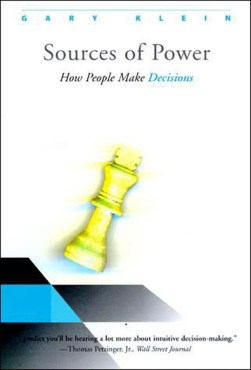
Gary Klein is one of the developers of the naturalistic decision-making approach, which views people as inherently skilled and experienced. It documents human strengths and capabilities that have been downplayed or ignored so far.


Lees verder “Sources of Power”

PreMortem

Method of Risk Assessment

Jack Kruf | December 2007

According to Klein (2007), “Projects fail at a spectacular rate. One reason is that too many people are reluctant to speak up about their reservations during the all-important planning phase. By making it safe for dissenters who are knowledgeable about the undertaking and worried about its weaknesses to speak up, you can improve a project’s chances of success.”

The Harvard Business Review article: “In a premortem, team members assume that the project they are planning has just failed—as so many do—and then generate plausible reasons for its demise. Those with reservations may speak freely at the outset, so that the project can be improved rather than autopsied.” Lees verder “PreMortem”

Back to the Future

Temporal perspective in the explanation of events

Deborah J. Mitchell, J. Edward Russo, Nancy Pennington | March 1989

Prospective hindsight involves generating an explanation for a future event as if it had already happened; i.e., one goes forward in time, and then looks back. This research found that “imagining that an event has already occurred, increases the ability to correctly identify reasons for future outcomes by 30%”  (Klein, 2007)

In order to examine how shifts in perspective might influence people’s perceptions of events, we investigated two possible factors: temporal perspective (whether an event is set in the future or past) and uncertainty (whether the event’s occurrence is certain or uncertain).

Lees verder “Back to the Future”

Risk and Reason

Safety, Law, and the Environment

Cas R. Sunstein | April 2002, Cambridge University Press

Risk and Reason presents a sensible system for reducing risks to save lives and money. What should be done about aeroplane safety and terrorism, global warming, polluted water, nuclear power, and genetically engineered food? Risks to safety, health, and the environment are a subject of intense interest worldwide. Too often, we fear the wrong things.

Sometimes we make the situation even worse. Rather than investigating the facts, we respond to temporary fears. The result is a situation of hysteria and neglect – and unnecessary illness and death. Lees verder “Risk and Reason”

Judgment under Uncertainty: Heuristics and Biases

Biases in judgments reveal some heuristics of thinking under uncertainty

Amos Tversky and Daniel Kahneman | 1974

This article described three heuristics that are employed in making judgments under uncertainty: (i) representativeness, which is usually employed when people are asked to judge the probability that an object or event A belongs to class or process B; (ii) availability of instances or scenarios, which is often employed when people are asked to assess the frequency of a class or the plausibility of a particular development; and (iii) adjustment from an anchor, which is usually employed in numerical prediction when a relevant value is available.

These heuristics are highly economical and usually effective, but they lead to systematic and predictable errors. A better understanding of these heuristics and the biases they lead to could improve judgments and decisions in situations of uncertainty.

Lees verder “Judgment under Uncertainty: Heuristics and Biases”

The Kyoto Protocol

United Nations | December 1997

The Kyoto Protocol was adopted on 11 December 1997 and entered into force on 16 February 2005. Owing to a complex ratification process, it currently has 192 Parties. The treaty follows the main principles agreed upon in the 1992 convention.

It operationalizes the United Nations Framework Convention on Climate Change by committing industrialized countries and economies in transition to limit and reduce greenhouse gas (GHG) emissions in accordance with agreed-upon individual targets. The Convention itself only asks those countries to adopt mitigation policies and measures and report periodically.

Lees verder “The Kyoto Protocol”

The Politics of Policymaking

In Introduction

Arjen Boin and Martin Lodge | April 2024, Sage Publications

Never has good policy been so important. The challenges we face are complex and global, from unemployment and a lack of affordable housing to regulating cryptocurrencies and protecting against cybersecurity threats. The text explains how policymaking works, using examples from around the world, from the emergence of policy ideas to deciding between cutting-edge solutions, from evaluating policies to improving policymaking practices.

Open up the black box of government to see where policies are made. This introductory text takes you beyond theory and into the messy world of policymaking, offering a toolkit for making better policy. Drawing from insights earned through years of interactions with policymakers and extensive teaching experience, Boin and Lodge offer a comprehensive introduction to the inner workings of government and how to produce policies that address societal problems of today and tomorrow.

Lees verder “The Politics of Policymaking”