The Wizard and the Prophet

Two Remarkable Scientists and Their Dueling Visions to Shape Tomorrow’s World

Charles C. Mann | 2019, Pan Macmillan

In forty years, the Earth’s population will reach ten billion. Can our world support so many people? What kind of world will it be? In this unique, original and essential book, Charles C. Mann illuminates the four grand challenges we face—food, water, energy, and climate change—through an exploration of the crucial work and wide-ranging influence of two little-known twentieth-century scientists, Norman Borlaug and William Vogt.

Vogt (the Prophet) was the intellectual forefather of the environmental movement. He believed that if we use more than the planet has to give, our prosperity will bring us to ruin. Borlaug’s research in the 1950s led to the development of modern high-yield crops that have saved millions from starvation. The Wizard of Mann’s title he believed that science would continue to rise to the challenges we face.

Lees verder “The Wizard and the Prophet”

Rethinking Public Governance

Jacob Torfing* | 2023, Edward Elgar Publishing

In this innovative book, Jacob Torfing, a leading scholar, critically evaluates emerging ideas, practices and institutions, transforming how public governance is perceived, theorised and conducted in practice.

A novel rethinking of how current societies are governed, this book will inspire students, scholars and practitioners of political science, public policy, regulation and governance, and public administration management to reconsider how public governance and administration may be organised in the future to present innovative solutions to societal problems.

Identifying cutting-edge developments in public governance, this incisive book analyses new forms of political leadership, public management, public organisation, administrative steering, cross-boundary collaboration, public regulation and societal problem-solving. Examining some of the most significant instances of public governance transformation, chapters explore the effects of transformations from sovereign to interactive political leadership, from national to multi-level governance, and from hard to soft power.

With a novel focus on producing innovative public value outcomes, the book considers how these developments interact with and are influenced by new digital technologies and increasing globalisation. Torfing concludes with a reflection on how best to comprehend, study and take advantage of current and future transformations in public governance.

Quote from Introduction

Torfing: “This book argues that public governance is changing so rapidly and profoundly that public administration research is struggling to keep up and to keep track of the changes and their various implications. A broad range of well-established principles, perceptions and forms of governing in the public sector are being challenged by new ideas, concepts and practices that, when taken together, are transforming the modus operandi of public governance. Hence, new and emerging forms of political leadership, public management, public organization, administrative steering, cross-boundary collaboration, public regulation and societal problem-solving are being combined with new digital technologies and a novel focus on the production of innovative public value outcomes.

The pace of governance changes has accelerated in recent decades. After half a century of an almost undisputed reign of liberal democracy and public bureaucracy, New Public Management (NPM) reforms swept the world beginning in the late 1970s. Despite their positive impact and results, these NPM practices soon gave rise to an array of criticisms that, in the subsequent decades, spurred the proliferation of several new governance paradigms. Hence, public administration researchers started talking about the Neo-Weberian State (Pollitt & Bouckaert 2011), Digital Era Governance (Dunleavy 2006), Public Value Management (Benington & Moore 2010) and New Public Governance (Osborne 2010). In many cases, the new ideas about public governance triggered reforms, resulting in new practices. While it is difficult to explain the growing pace of public governance reforms, globalization, new technologies, growing citizen demands and the recognition of the planetary limits seem to have disrupted the established forms of public governance and have engaged elected politicians, public managers and an army of private consultants in experimentation, learning and innovation diffusion. In other words, changes in the public sector reflect both external societal change and internal agency-based learning and entrepreneurship.”

Contents

Introduction

    1. The public governance orthodoxy
    2. From sovereign to interactive political leadership
    3. From policy program implementation to public value creation
    4. From control- to trust-based governance and management
    5. From the efficient use of existing resources to the mobilization of new ones
    6. From unicentric to pluricentric coordination
    7. From national- to multi-level governance
    8. From hard to soft power
    9. From intra-organizational to inter-organizational leadership
    10. From stability and continuous improvement to innovation
    11. From spectator and counter-democracy to interactive democracy
    12. Reinvigorating public governance studies

Recommendations

‘With a clarity that belies the difficulty of his task, Jacob Torfing manages to get the whole complex and nettlesome world of public governance into focus. Rethinking Governance demonstrates Torfing’s gift for showing us where we have come from and where we must go.’
– Chris Ansell, University of California, Berkeley, US

‘Rethinking Public Governance offers a masterful account of the origins, current difficulties, and possible vibrant futures for the governance of liberal democracies. The book is a must-read tour de force that integrates across disciplines in a theoretically rich, practically useful way and presents an ambitious agenda for future work.’
– John M. Bryson, University of Minnesota, US

‘Scholars and practitioners alike will benefit from this book’s well-informed, comprehensive, and topical overview of current orthodoxies and transformations in public governance. It identifies drivers and features of cutting-edge collaborative and democratic governance innovations and provides direction and inspiration for advancing both these practices and the study of public governance.’
– Joop Koppenjan, Erasmus University Rotterdam, the Netherlands

Bibliography

Torfing, J. (2023) Rethinking Public Governance. Cheltenham, UK: Edward Elgar Publishing.

About the author

Jacob Torfing is a Professor of Politics and Institutions at the Department of Social Sciences and Business, Roskilde University, Denmark and the Faculty of Social Sciences, Nord University, Norway.

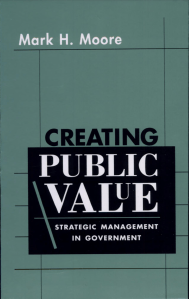
Creating Public Value

Strategic management in government

Mark H. Moore | 1995

Public Value is a theory for public management advanced by Professor Mark Moore of the Harvard Kennedy School. Over the previous two decades, staff and students at Harvard’s Kennedy School of Government, where Moore taught, engaged in conversations about producing excellence in public management.

“Public value refers to the value created by the government through laws, regulations, services and any other action. In a democratic society, this value is defined by the public themselves. Value is determined by citizens preferences expressed in a variety of ways and thus it provides a rough yard stick against which to gauge the public institutions and government policies.”

A seminal figure in the field of public management, Mark Moore presents his summation of fifteen years of research, observation, and teaching about what public sector executives should do to improve the performance of public enterprises.

This book is useful for both practising public executives and those who teach them. It explicates some of the richest of several hundred cases used at Harvard’s Kennedy School of Government and illuminates their broader lessons for government managers.

Moore addresses four questions that have long bedevilled public administration: What should citizens and their representatives expect and demand from public executives? What sources can public managers consult to learn what is valuable for them to produce? How should public managers cope with inconsistent and fickle political mandates? How can public managers find room to innovate?

Moore’s answers respond to the well-understood difficulties of managing public enterprises in modern society by recommending specific, concrete changes in the practices of individual public managers: how they envision what is valuable to produce, how they engage their political overseers, and how they deliver services and fulfil obligations to clients.

Following Moore’s cases, we witness dilemmas faced by a cross-section of public managers from the Environmental Protection Agency, the Department of Youth Services, the Park Plaza Redevelopment Project, the swine flu scare, the Houston Police Department, and the Boston Housing Authority. Their work and Moore’s analysis reveal how public managers can achieve their true goal of producing public value.

Bibliography

Moore, M. (1995) Creating Public Value: Strategic management in government. Cambridge, Massachusetts, United States: Harvard University Press.

Read Chapter 3 (source Harvard University Education).

Prospect Theory

An analysis of decision under risk

Daniel Kahneman and Amos Tversky | 1979

This paper presents a critique of expected utility theory as a descriptive model of decision making under risk, and develops an alternative model, called prospect theory.

Choices among risky prospects exhibit several pervasive effects that are inconsistent with the basic tenets of utility theory. In particular, people underweight outcomes that are merely probable in comparison with outcomes that are obtained with certainty. This tendency, called the certainty effect, contributes to risk aversion in choices involving sure gains and to risk seeking in choices involving sure losses.

Lees verder “Prospect Theory”

Myopic Voters and Natural Disaster Policy

Andrew Healy, Loyola Marymount University, and Neil Malhotra, Stanford University | 2009

In our democratic system, citizens vote for their representative politicians, elected councils, public leaders, governors, and governing councils. But what about citizens’ perceptions of how risks are handled by their leaders, and what about citizens’ appreciation of proactive thinking by councillors related to public risks when it comes to voting?

Quote: “Do voters effectively hold elected officials accountable for policy decisions? Using data on natural disasters, government spending, and election returns, we show that voters reward the incumbent presidential party for delivering disaster relief spending, not investing in disaster preparedness spending. These inconsistencies distort the incentives of public officials, leading the government to underinvest in disaster preparedness, thereby causing substantial public welfare losses.”

“We estimate that $1 spent on preparedness is worth about $15 in terms of the future damage it mitigates.”

“By estimating both the determinants of policy decisions and the consequences of those policies, we provide more complete evidence about citizen competence and government accountability.”

Bibliography

Healy, A. and Malhotra, N. (2009) Myopic Voters and Natural Disaster Policy. American Political Science Review: Vol. 103, No. 3 August

Download the scientific article.


Thinking in Systems

Donella Meadows, Diana Wright (ed.) | 2008

In the years following her role as the lead author of the International bestseller Limits to Growth – the first book to show the consequences of unchecked growth on a finite planet – Donella Meadows remained a pioneer of environmental and social analysis until her untimely death in 2001.

“So, what is a system? A system is a set of things—people, cells, molecules, or whatever—interconnected in such a way that they produce their own pattern of behavior over time. The system may be buffeted, constricted, triggered, or driven by outside forces. But the system’s response to these forces is characteristic of itself, and that response is seldom simple in the real world.”

– Donella Meadows (2008)

Thinking in Systems is a concise and crucial book offering insight into problem-solving from personal to global scales. Edited by the Sustainability Institutes Diana Wright, this essential primer brings systems thinking out of the realm of computers and equations and into the tangible world, showing readers how to develop the systems-thinking skills that thought leaders across the globe consider critical for 21st-century life.

Some of the biggest problems facing the world, including war, hunger, poverty, and environmental degradation, are system failures. They cannot be solved by fixing one piece in isolation from the others because even seemingly minor details have enormous power to undermine the best efforts of too-narrow thinking. While readers will learn the conceptual tools and systems thinking methods, the book’s heart is grander than the methodology.

“Managers are not confronted with problems that are independent of each other, but with dynamic situations that consist of complex systems of changing problems that interact with each other. I call such situations messes. . . . Managers do not solve problems, they manage messes.”

– Russel L. Ackoff (1979)

Donella Meadows was known as much for nurturing positive outcomes as she was for delving into the science behind global dilemmas. She reminds readers to pay attention to what is important, not just what is quantifiable, to stay humble, and to stay a learner. In a world growing ever more complicated, crowded, and interdependent, Thinking in Systems helps readers avoid confusion and helplessness, the first step toward finding proactive and effective solutions.

Bibliography

Ackoff, R. (1979) ‘The Future of Operational Research Is Past’. Journal of the Operational Research Society 30, no. 2: 93–104.

Meadows, D. (Wright, D. ed) (2008) Thinking in Systems. Vermont, US: Chelsea Green Publishing Co.

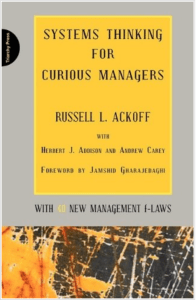
Systems Thinking for Curious Managers

With 40 new Management f-LAWS 

Russell L. Ackoff | 2009

This gem of a book introduces the extraordinary world of systems thinking and its ‘Dean’, Russell L. Ackoff, to curious and enquiring managers, teachers, business people – anyone, anywhere who works in an organisation.

Finished just before Professor Ackoff’s death late in 2009, “Systems Thinking for Curious Managers” opens the door to a joined-up way of thinking about things that have profoundly influenced thinkers and doers in the fields of business, politics, economics, biology, and psychology.

Lees verder “Systems Thinking for Curious Managers”