The Limits to Growth

Club of Rome | 1972

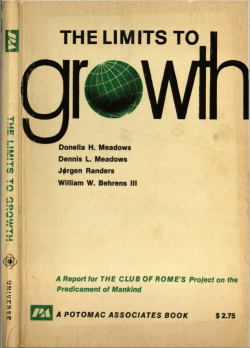
In March 1972, a report by a group of young scientists at the Massachusetts Institute of Technology (MIT) commissioned by Aurelio Peccei, founder of The Club of Rome, shook the world. The report excels in system thinking and modelling and in that it is more actual than ever.

Today, 50 years after its publication, “The Limits to Growth” is considered one of the most important and controversial environmental books of all time and it continues to influence conversations around sustainability and our continued existence on this finite planet. Below is the story behind this ground-breaking publication.

Published 1972 – The message of this book still holds today: The earth’s interlocking resources – the global system of nature in which we all live – probably cannot support present economic and population growth rates much beyond the year 2100, if that long, even with advanced technology. In the summer of 1970, an international team of researchers at the Massachusetts Institute of Technology began a study of the implications of continued worldwide growth.

They examined the five basic factors that determine and, in their interactions, ultimately limit growth on this planet-population increase, agricultural production, nonrenewable resource depletion, industrial output, and pollution generation. The MIT team fed data on these five factors into a global computer model. Then it tested the model’s behaviour under several sets of assumptions to determine alternative patterns for mankind’s future. The Limits to Growth is the nontechnical report of their findings.

The book also contains a message of hope: Man can create a society in which he can live indefinitely on earth if he imposes limits on himself and his production of material goods to achieve a state of global equilibrium with population and production in carefully selected balance.


The Limits to Growth, 1972 – key messages:

    • With existing policies, the physical limits to growth would likely be exceeded within one generation.
    • The most likely outcome of reaching these limits would be overshooting them, followed by systems decline.
    • The findings, however, also suggested a viable alternative to these outcomes – one in which population growth and material production could be brought into balance with planetary limits.
    • The fourth conclusion was that it would realistically take 50 to 100 years, or even more, to make this alternative outcome a reality.
    • Finally, the team found that every year action is delayed toward reaching the alternative outcome, decreasing the number of options available to avoid overshoot and collapse.

Bibliography

Meadows, D. H., Meadows, D. L., Randers, J. & Behrens, W. W. (1972). The limits to growth: A report for the Club of Rome’s project on the predicament of mankind. New York: Universe Books.

Limits to Growth (digital scan version, source: https://donellameadows.org)

Short History

ISO 31000

The International Organization for Standardization | November 2009

The International Organization for Standardization (ISO) in Genève started in 2005 the development of a guidance standard on risk management. An ISO working group was established to develop a Committee Draft called ISO CD31000. The standard “gives generic guidelines for the principles and the adequate implementation of risk management. It is not intended to be used for the purposes of certification.”

ISO 31000 seeks to provide a universally recognised paradigm for practitioners and companies employing risk management processes, replacing the myriad of existing standards, methodologies, and paradigms that differ between industries, subject matters, and regions. For this purpose, the recommendations provided in ISO 31000 can be customized to any organisation and its context.

In some respects, ISO 31000 is similar to ISO 9000 and other broad-based international standards. Though it is not certifiable, it is a concise and comprehensive statement which can, in a practical sense, contribute to the awareness and implementation of risk management.

Global Risks Report 2008

World Economic Forum | 2008

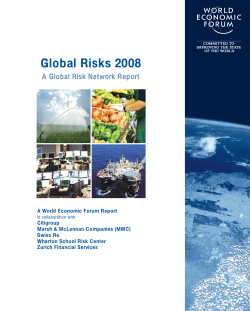
“Over the last year, a series of risk issues – from the liquidity crisis in the financial markets to the emerging concerns over the long-term security of food supply – have focused global attention on the fragility of the global system. An awareness of risk and risk management is increasingly viewed as a prerequisite for effective control in both the private and public sectors.

This year will be no different. Uncertainty about the short- and medium-term future is as high as it has been for a decade. Economically, the uncertainty centres on how the global economy will respond to the spreading liquidity crunch of 2007. The mispricing of financial risk, a central theme of Global Risks 2007, may have further to unwind. Geopolitically, uncertainty is focused on the possibility of an escalation in tensions with Iran and concerns over the long-term integrity of the states of Iraq and Afghanistan.

The result of uncertainty could be inaction in dealing with other, less immediate, global risks. Action to mitigate climate change, for example, may be put in danger should the global economy weaken substantially – even though many of the political, economic and investment decisions which will shape the future path of global climate will need to be made in the next five years. Proactive management of globalization to ensure its long-term sustainability may be derailed by the prevailing currents of uncertainty. But inaction on long-term risks will only weaken the global capacity to manage future challenges.

Under conditions of global stress, one core question of global risk management will become more salient than ever: who owns the risk? Without a shared understanding of ownership, achieving the trade-offs which may be necessary to mitigate global risk equitably and sustainably will be extremely difficult.

Without clarity on who is responsible for managing global risk, turning aspirations into actions will be impossible. Without frameworks which connect ownership of risk with the responsibility to mitigate it, and which share the upside and downside of risk among stakeholders efficiently, the market mechanisms for managing risk will fail to improve our aggregate global resilience in the face of inevitable risk events. And without leadership from the business and political communities on all of these issues, we may find our global future shaped more by risk events than by our power to anticipate, manage and mitigate them.

The present report looks at global risks from a range of different perspectives

The first part of the report focuses on four emerging issues that are shaping the global risk landscape: systemic financial risk, food security, supply chains and the role of energy. On systemic financial risk, we put current market turmoil in the historical context and ask how the transformation of the global financial system over the last two decades may require us to rethink our expectations and understanding of systemic risk in the future. On food security, we discuss how the subject has moved from the periphery of the global risk landscape to its centre, and ask whether the world is ready to cope with the various trade-offs that the new food economy is generating. On supply chains, we investigate a potentially hidden set of vulnerabilities in the global economy to supply chain disruptions. Finally, on energy, we outline the emergence of a range of energy-related risks and ask if the world can move towards secure and sustainable energy.

The second part of the report presents our collective assessment of global risks in 2008, based on a revised taxonomy of risk, and building on the assessments of past years. In the third part, we look at the methodological hurdles around the representation of interconnectedness and demonstrate how risk “squeezing” and homogenization of risk are changing the way we perceive risk globally. In the fourth part of the report, we examine the role of financial markets as tools of risk transfer and risk mitigation for an increasingly broad range of global risks. Finally, in the fifth part, we take forward our discussions on the construction of risk mitigation coalitions and country risk management, establishing a set of principles for country risk management which the Global Risk Network will develop in 2008-2009.

The Global Risk Network, part of the World Economic Forum since 2005, will continue to generate discussion and dialogue between the corporate and public sectors. In 2008-2009, the World Economic Forum and partners of the Global Risk Report – Citigroup, Marsh & McLennan Companies, Swiss Re, the Wharton School Risk Center and Zurich Financial Services – will broaden the participation of the global business and policy community.”

Global Risks Report 2008

Risk Management at the Edge of Three Worlds

City management in the perspective of ‘risk’

Jack P. Kruf | 2007

In this article, I want to focus on the specific characteristics of the role and position of local authority CEOs and city managers in relation to the three worlds of politics, society, and management. A specific focus on the role of risk management in supporting the CEO and the process of discussing these issues should be made to emphasise that risk management belongs on the strategic agenda and demands a holistic approach.

The “best” job

Some might say it is the most attractive and fascinating job there is: serving as CEO in local public management (or city manager or secretary). Why? Because it is at the very heart of dynamic society, close to politics and government, at the centre of the world of “power and influence”, and at the top of the management pyramid. This person is at the junction of necessary skills, ambitions, rights, stakes, and interests. He or she is, via society, close to disasters, successes, poverty, and environmental challenges, and, via politics, to elected officials like the mayor and local alderman, but always in close contact with officials in higher government and very close to the professionals in within the organisation. Local government leadership is a very exciting job.

“It is clear that risk management should be seen as a core competence for every public leader.”

The CEO is a generalist, not a specialist. One might say that a realistic comparison of the job would be with the decathlon. As with decathletes, the CEO must be well-rounded, competitive and competent in many areas. 

Furthermore, the CEO cannot operate in isolation but has to be open to the world, always authentic, and able to act like a chameleon. A phrase that has always appealed to me is being able to walk the web as a spider and be familiar with the rules of chess. This broad spectrum makes the role challenging, very attractive, and influential, but also very vulnerable. And it is here where risk management comes into play. 

Risk management 

As the demands of the city manager job are diverse but inter-connected, so must be the management approach: the manager must possess a broad, non-panicky and non-dogmatic perspective on risk and risk management – one which stresses usability in relation to a wide range of public risk issues, as well as to risks in public organisations. 

Such an approach requires a holistic, opportunistic and dialogue-oriented form of risk management, which seeks to harvest the value added, the ethical, resilient, and innovative potential in risk management as a natural part of public governance. 

Managing risks is among the most challenging issues for the public sector today. Whether risks arise from the physical environment, economic environment, or even from changes in voter preferences, public institutions are responsible for assessing and addressing the risks that impact the community they serve and their organisation. For example, what risks are possible when investing in a new IT system? Which risk elements are to be analysed when decisions about building a new school are made? Which risk elements are to be assessed to prevent vandalism and break-ins on municipal buildings? And which risks emerge from decisions made by higher governmental institutions? 

Risk management should be seen as a core competence for every public leader. But what is risk management? Generally, it is a way of approaching business, a sound attitude towards and style in managing people, projects, processing, and reaching goals. It comprises tools and techniques but, more than that, a smart, honest, and externally oriented approach that is open and authentic. Risk management leads to an effective and efficient way of reaching goals. It is the road to success. Let me focus on the three domains; society, politics and management. 

“One of the major goals for the public sector worldwide is a continuous building and rebuilding of public trust in close combination with sustainable development.” 

The three worlds 

The worlds of society, politics, and management always overlap and are connected. This fact requires a new risk management approach. It should consist of more than just preventing losses and reducing costs. Increasingly, risk management can be defined as the coordinated management of all risks. In this regard, modern risk management is a general management function that permeates an organisation, is linked to the organisation’s overall strategic plan and enables the achievement of political and organisational goals and objectives. 

One of the major goals for the public sector worldwide is the continuous building and rebuilding of public trust in close combination with sustainable development. Risk management is thus a most valuable management concept and tool in today’s complex and globalised world with increasing demands on governance and compliance. 

Risks in society 

The attacks on the World Trade and the Madrid trains, the Indian Ocean tsunami, the financial scandals of Enron and Worldcom, increasing poverty, climate change, increasing problems in the supply of clean water, unexpected riots in the suburbs of our cities, the murder of a Dutch politician, the Danish cartoon controversy, and the massacre at Virginia Tech University – all tell us how fragile society is. This underlines the urgency of and demands the control of risks, not only on a global but certainly also on a local level. 

Risk management requires knowledge of what is happening in society and how it develops in our streets, neighbourhoods, villages, suburbs, and cities. Knowing requires measuring and monitoring stress, satisfaction, trust, and safety; that is, perceptions of risk as well as objective and factual measures of risk. Monitoring and diagnosing society is important. Understanding relevant trends and developments is critical. 

Risk management also asks us to understand how and to what extent institutions in society really cooperate, where they should and why they don’t. This chain of interrelated institutions should be working if we want to be in control. Only the right information can lead to the right conclusions and the right things to do. So, sensing society and its institutions is a form of risk management.

 Of course, we receive some social feedback from citizens during elections. But I believe we need to develop a more consistent and permanent way of monitoring and sensing the state or health of society and its risks. This will contribute to an overall improvement in the quality of federal and local policies. If set up internationally, which it should be, it will lead to more exchange of knowledge and experience between local authorities worldwide.

Risks in politics 

The CEO’s task is to advise his local politicians as effectively as possible to prevent and protect them from risks. This boundary between politics and management requires special attention. Politicians often have a different view of risks than specialists and professionals. The approach here is to invest in the awareness of risks and to put it on the common strategic agenda. This seems so easy, but actually, it is not. Politicians and managers do not always speak each other’s language. On the other hand, the local government is an entity committed to developing policies and legislation by politicians on a regional, national and European level. Yes, there is the fact these are sometimes difficult to implement or, if so, against high costs and with intense efforts from municipal organisations. 

Risk management compels us to consciously calculate the risks and bring them forward. National organisations should play a key role in this. In my view, we should invest in partnerships between the different governmental layers. The other approach is to share your experiences in implementation and synchronisation and cooperate in this as much as possible. In the long term, higher levels of government should involve lower levels of government in policy development and implementation. The best form of risk management is a true partnership. 

Another factor that local government has to deal with is the lack of cooperation on a higher level. Central governmental institutions and ministries are organised by sector: traffic, environment, agriculture, economic, social, legal, et cetera. An integrated approach to specific areas, projects, problems, target groups, and even individuals is often literally blocked by this compartmentalisation. And this fact itself leads to higher risks for “control” of society. For example, the result is inconsistent legislation that may even be contradictory at the local level. 

“Mind you, another factor that local government has to deal with is the lack of cooperation on a higher level.”

Introducing risk management here implies bridging the gap between the government’s compartmentalised nature and the need for integration, which is truly a challenge for the city manager, generalist, process engineer, chameleon, or spider, as he or she may be. 

However, reducing the risks of a noncongruent and consistent approach on a local level caused by compartmentalisation is often very difficult and frequently impossible. Most power and influence, laws, regulations, and project budgeting are organised along such sectoral lines. This causes high risks for society. Bridging those gaps may be one of the highest forms of risk management. 

In general, it is very clear that a broader approach to risk management can lead to successful projects and policies and, from there, to successful local politics and politicians. While this seems obvious, it has not always been that way. Indeed, risk management is often seen as an obstacle to political goals and ambitions. I would simply argue here that risk management enables the fulfilment of goals, and if it isn’t happening in an organisation, risk management is not being effectively practised.

“Introducing risk management here implies bridging the gap between the compartmentalised nature of government and the need for integration…”

Risks in management 

The CEO is, in general, responsible for the management of the municipal organisation. Every manager has to be perfectly in control and, therefore, be able to realise the political targets. In this, the CEO, along with the mayor and alderman, is also responsible for the mistakes/faults of the local organisation. In this context, risk management has much to do with minimising errors, mistakes and accidents. Preventing crises and disasters and, if they occur, doing the right things. 

Another factor is that good news always travels fast to the top, but the bad news often stays hidden. Most employees never enter the executive room to tell the top manager that a decision is risky and will lead to trouble. This would be, as they say, not a good career move. That is why it should be the CEO who puts risk management high on the strategic agenda as an invitation and a request to employees in the organisation to come forward. Beyond that, he or she has to develop a safe and open culture for employees to discuss risks and, more importantly, reduce them. Most CEOs today delegate directly to others. But it is my opinion that this is a risk in itself. Risk management requires the involvement of all management team members, and it requires that they all explicitly share the risks. 

Another important aspect of the job of the CEO is realising political targets. This demands a management style focused on results. Defining the goals and auditing the risks of not realising them can give an enormous stimulus to develop and focus employees on those results. This is a risk management pursuit and can assure success and improved control. In this regard, the CEO needs to be open and transparent in his approach to facing risks. In my view, the process of reducing risks and uncertainties is often too implicit, sometimes even hidden and not visible. 

To prevent the organisation itself from approaching risks sectorally, it is worthwhile considering the “bundling” of control in the organisation in one place, of course, with the checks and balances embedded and incorporated. Legal, IT, financial and quality officers often don’t talk with each other because they have their own specialisms. The city manager also has to develop an integrated approach, as it will improve the quality of political advising, address the needs of society and foster higher-quality decisions. 

The necessity of sharing 

In my judgment, all preceding comments underscore the importance of sharing—that is, sharing ideas, techniques, and strategies among public sector managers. For reasons that escape me, we do not see the level of sharing (between local authorities, between local and central governments, and – yes – between governments of various nations). But sharing is necessary, in significant part because of globalisation. We can learn a lot more if we are prepared to look around us and learn from each other, as well as share our experiences and approaches. 

A new visionary and comprehensive risk management organisation for public risk management on a CEO level has been set up to encourage and facilitate the goal of sharing. It is called the Public Risk Management Organisation (PRIMO). It is an international association that strives to establish an influential transnational network for creating awareness, setting up networks, connecting people, and developing and disseminating well-founded, solid, useful, and cutting-edge knowledge on public risk management for the benefit of society, the citizens, and the public organisations. 

Just get started 

Risk management has a good scientific basis, though it is relatively young in the public sector. However, there are sufficient tools and techniques available to start. Put risk management high on the strategic agenda. Start the debate about the most experienced risks, and create a safe atmosphere and culture where it is possible to share and bring risks forward. Identifying the risks is a start in itself and the first step in reducing risks and uncertainties on projects, advising, and processes. And I want to underscore this final point; it has to be the city manager who sets the example and leads the way.

Stern Review on the Economics of Climate Change

HM Treasury UK | 2006

“The scientific evidence is now overwhelming: climate change presents serious global risks and demands an urgent global response. This independent Review was commissioned by the Chancellor of the Exchequer, who reports to both the Chancellor and the Prime Minister, to contribute to assessing the evidence and building an understanding of the economics of climate change.

The Review first examines the evidence on the economic impacts of climate change itself and explores the economics of stabilizing greenhouse gases in the atmosphere. The second half of the Review considers the complex policy challenges involved in managing the transition to a low-carbon economy and in ensuring that societies can adapt to the consequences of climate change that can no longer be avoided.

The Review takes an international perspective. Climate change is global in its causes and consequences, and international collective action will be critical in driving an effective, efficient and equitable response on the scale required. This response will require deeper international cooperation in many areas – most notably in creating price signals and markets for carbon, spurring technology research, development and deployment, and promoting adaptation, particularly for developing countries.

Climate change presents a unique challenge for economics: it is the greatest and widest-ranging market failure ever seen. The economic analysis must therefore be global, deal with long time horizons, have the economics of risk and uncertainty at centre stage, and examine the possibility of major, non-marginal change. To meet these requirements, the Review draws on ideas and techniques from most of the important areas of economics, including many recent advances.

The benefits of strong, early action on climate change outweigh the costs

The effects of our actions now on future changes in the climate have long lead times. What we do now can have only a limited effect on the climate over the next 40 or 50 years. On the other hand what we do in the next 10 or 20 years can have a profound effect on the climate in the second half of this century and in the next.

No-one can predict the consequences of climate change with complete certainty; but we now know enough to understand the risks. Mitigation – taking strong action to reduce emissions – must be viewed as an investment, a cost incurred now and in the coming few decades to avoid the risks of very severe consequences in the future. If these investments are made wisely, the costs will be manageable, and there will be a wide range of opportunities for growth and development along the way. For this to work well, policy must promote sound market signals, overcome market failures and have equity and risk mitigation at its core. That essentially is the conceptual framework of this Review.

The Review considers the economic costs of the impacts of climate change, and the costs and benefits of action to reduce the emissions of greenhouse gases (GHGs) that cause it, in three different ways:

    • Using disaggregated techniques, in other words considering the physical
      impacts of climate change on the economy, on human life and on the environment, and examining the resource costs of different technologies and strategies to reduce greenhouse gas emissions.
    • Using economic models, including integrated assessment models that
      estimate the economic impacts of climate change, and macro-economic
      models that represent the costs and effects of the transition to low-carbon
      energy systems for the economy as a whole.
    • Using comparisons of the current level and future trajectories of the ‘social
      cost of carbon’ (the cost of impacts associated with an additional unit of
      greenhouse gas emissions) with the marginal abatement cost (the costs
      associated with incremental reductions in units of emissions).

From all of these perspectives, the evidence gathered by the Review leads to a
simple conclusion: the benefits of strong, early action considerably outweigh the costs.

The evidence shows that ignoring climate change will eventually damage economic growth. Our actions over the coming few decades could create risks of major disruption to economic and social activity, later in this century and in the next, on a scale similar to those associated with the great wars and the economic depression of the first half of the 20th century. And it will be difficult or impossible to reverse these changes. Tackling climate change is the pro-growth strategy for the longer term, and it can be done in a way that does not cap the aspirations for growth of rich or poor countries. The earlier effective action is taken, the less costly it will be.

At the same time, given that climate change is happening, measures to help people adapt to it are essential. And the less mitigation we do now, the greater the difficulty of continuing to adapt in future.

Download Stern Executive Summary

Visit National UK Archives

Global Risks Report 2006

World Economic Forum | 2006

Towards a more sophisticated understanding of global risks, this document summarises the output of a collaboration between the World Economic Forum, MMC (Marsh & McLennan Companies, Inc.), Merrill Lynch and Swiss Re, in association with the Risk Management and Decision Processes Center of the Wharton School at the University of Pennsylvania, on the topic of Global Risks. The purpose of this collaboration, building on work undertaken in 2004, was to:

    • Identify and assess current and emerging global risks in the 2006 and 2015 time horizons.
    • Study the links between them and assess their likely effect on different markets and industries.
    • Advance the thinking around more effective mitigation of global risks.

Lees verder “Global Risks Report 2006”

Global Risks to the Business Environment

World Economic Forum | 2005

Global Risks to the Business Environment: “This paper, the output of two workshops organised by the World Economic Forum in collaboration with Merrill Lynch, reviews major, global risks facing business leaders today, and examines how those risks differ from the challenges of the past. Some key points:

1) Global Risks and Business

At a time when risks not specific to business are having an unprecedented effect on the corporate world, it is crucial for business leaders to understand the environment in which their business operates, in order to survive, remain competitive and grasp opportunities.

2) An Increasingly Turbulent and Complex World

Today’s risks are much more interconnected than in the past. They are much more volatile and can disrupt markets throughout the world with almost instantaneous precision. Such risks can be difficult to anticipate and respond to, even for the most seasoned business leaders.

3) The Global Risks

We identify 36 “global” risks, classified into four categories: economic, geopolitical, societal and environmental. This report details the prevailing consensus reached at our workshop discussions as to the ten risks most likely to have a major or extreme impact on business:
• Instability in Iraq
• Terrorism
• Emerging fiscal crises
• Disruption in oil supplies
• Radical Islam
• Sudden decline in China’s growth
• Pandemics – infectious diseases
• Climate change
• Weapons of mass destruction (WMD)
• Unrestrained migration and related tensions

4) Risk Mapping – Connecting the “Dots” and Spotting the Patterns

In an interconnected world, global risks should not be considered on a stand-alone basis; it is important to understand how they can trigger, amplify or buffer one another.

5) Dealing with Global Risks

Seldom can global risks be addressed by a single business entity, industry or country, and many institutional mechanisms are proving fairly ineffectual as they struggle to cope with the challenge. There is also a large discrepancy between the immediate time horizon employed by most business and political leaders and the long-term approach required to tackle risks on a global scale. As a result, our capacity to address risk is jeopardized; a myopic tendency – or worse, denial – prevails. Finally, of equal concern is the problem that some major risks are being passed on to those least able to solve them – or with least responsibility for creating them.”

Global Risks to the Business Environment