Jamie Dimon, Chairman and Chief Executive Officer | April 2026
“Dear Fellow Shareholders, In 2026, America is celebrating its 250th anniversary. Also, this year we are celebrating the 227th anniversary of JPMorgan Chase, which was founded in April 1799. This is the perfect time to rededicate ourselves to the values that made this great nation of ours — freedom, liberty, and opportunity — and to recognize that we all stand on our country’s shoulders.
The challenges we all face are significant. The list is long but at the top are the terrible ongoing war and violence in Ukraine, the current war in Iran and the broader hostilities in the Middle East, terrorist activity and growing geopolitical tensions, importantly with China. Our hearts go out to those whose lives are profoundly affected by these crises. We sincerely hope these global conflicts are properly resolved and that one day all of Europe and the Middle East will attain long-term stability and prosperity. Even in troubled times, we have confidence that America will do what it has always done — look to the values that have defined our singular nation and sustained our leadership of the free world…”
A comprehensive risk maturity model for Dutch municipalities
Ignacio Jose Cienfuegos Spikin | 2013
Risk management is a trend in almost every sector. Public organisations such as local authorities are lagging behind in this area, but they now have a new support model at their disposal. Ignacio Cienfuegos Spikin, originally from Chile and a PhD graduate of the University of Twente in 2013, investigated the state of risk management within local authorities. He tested a ‘Risk maturity model’ he had developed across 72 local authorities. “The model provides valuable information to decision-makers”.
Ignacio Jose Cienfuegos Spikin: “Following the trend of organizations from almost every sector now, public entities such as municipalities have also started to develop risk management awareness in the last decades. Related to the pressure of a more demanding environment and the incidents that these organizations have experienced, this process has led to the development of special standards and the design of risk management policies by central governments.
Marie-Gemma Dequae (ed.) with HBR Analytics Services for FERMA, Zurich and PRIMO | 2013
THE C-SUITE IS taking a stronger role in leading the risk management effort at major primarily European companies, underscoring the higher priority risk has assumed in the wake of several years of financial and economic turmoil. Congruently, companies are underscoring the need for strong board involvement to facilitate decision-making regarding strategic and enterprise-wide risks and to encourage acceptance of a culture of risk management further down in the organization. Companies are struggling, however, to create a wider role for the risk function as a participant in strategic planning and transformational initiatives. And European executives express concern about the robustness of their risk management processes and channels of communication.
Vast changes in how business is done, sparked by the technology revolution and globalization, are meanwhile raising concerns about company and brand risk. These and other challenges are prompting companies to devote more resources to defining their risk appetite and to tracking, measuring, and analyzing risk through such tools as “heat maps,” key risk indicator scorecards, scenario analysis, and loss forecasting. The challenge, however, some executives said, is still to make sure that risk is “owned” at appropriate levels of the organization and that risks are communicated efficiently, such that top management and the board can make timely, fact-based decisions about how to address them.
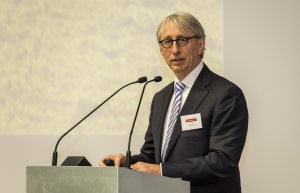
During the Local Government Risk Conference on 17 January 2018 at the Provincial Government Building in Utrecht, a group of experts discussed the key aspects of governance and control as they relate to municipal organisations.
Jack P. Kruf during his keynote speech at the Provincial Government Building in Utrecht. (2018), Risk & Compliance Platform Europe
In his keynote, Jack Kruf advocated for a much stronger link between policy content and policy direction. Given the multitude of interests and stakeholders, the segmentation of expertise and levels of government, as well as the fragmentation of knowledge surrounding issues, he believes that local authorities would be wise to take more time for an ex ante governance clause.
What council would not want its programme to be implemented optimally and effectively? According to him, this does, however, require genuine dialogue and engagement with all stakeholders at the outset. So not just more programme adoptions that focus purely on content, but also explicitly highlight their governance.
Governance in itself – in programmes and agreements by councils and executive bodies – therefore demands our full attention. The quality of public governance has become part of the quality of the public sphere and, consequently, of the public debate. We can no longer avoid explicitly addressing and embedding governanceex ante.
According to Kruf, this governance section is much more than the current ‘risk management and resilience’ section. The latter merely lifts a corner of the veil, and even then only in financial terms. Not unimportant, but resilience is no longer exclusive; it is often purely financially focused, written from a defensive and safeguarding perspective, and does not really address other relevant governance variables, relationships, and connections that play a role in the genuine administration and management of the city, its innovation, and development.
Resilience is good, but not inspiring enough and, moreover, technically wholly inadequate to enable us to discover and dare to explore new paths and set out on them. He quotes a councillor and a mayor from the network:
“Resilience is a theoretical exercise that paints a false picture of reality. I’ve never understood it. More than once, it has served as a smokescreen under which a project was sold.” – Councillor.
“Resilience serves to enable the council to account for its actions in broad terms, rather than to steer them. In practice, other forces – including political ones – determine whether a project is or should be feasible.” – Mayor.
According to Kruf, the new, much broader governance section should describe and (administratively) set out how the council’s programme itself can be steered and managed, and what specific roles the council, the executive committee, and the civil service organisation play in this, alongside social actors and institutions. The section should highlight all elements of governance necessary for performance, results and success. According to him, there are five elements that must be present simultaneously for this to be effective. These are:
Sound financial design and compliance, going hand in hand and, above all, realistic.
A focus by the administration and senior management on the target group (the citizen, the neighbourhood, the young person), on the objective and on the actual delivery of products and services.
Public leadership and stewardship that connects and stands up for its cause.
Tools and organisational capacity to bring plans to fruition.
Focus on the environment: horizontally towards fellow local authorities, market parties and relevant interest groups; vertically towards higher-level authorities, towards sections of society and towards the natural environment and its carrying capacity.
When launching a new programme, a municipal executive could ask its municipal secretary and group controller to draw up a proposal for this governance section. As leading experts in command and control, they are ideally placed to advise the executive on this matter. Indeed, they may be better suited to do so, as they understand the entire landscape. In this section, the five points mentioned above are linked to the executive’s programme.
It goes without saying that governance itself also requires investment. The world is changing, as are the players, and so too must governance. Sometimes this involves the appropriate structuring of a project, process or programme, but it may also concern the development of new roles, thinking in terms of new scenarios, the reorganisation of organisational units, entering into different forms of collaboration or contractual arrangements, or communicating differently with citizens and businesses. Governance itself must then also be budgeted for, regarded as a critical success factor, and embedded. Quality governance costs money, but it also delivers greater returns and can no longer be regarded as merely an afterthought to the substance.
The governance section is, in anticipation of the council’s own in-control statement to be issued in the near future, actually a logical concept. Governance itself thus becomes a fully-fledged factor within the political and administrative sphere. Something that was sorely needed, however contradictory this may sound. Governance too often appears to be a stepchild, resulting in significant public risks.
Kruf cites several examples in his argument. He also quotes from the World Economic Forum’s Global Risks Report 2018, published on the same day. The governance section could broaden the basis for lawful action, both administratively and within the civil service. After all, every euro of taxpayers’ money must be handled with care. And good governance helps with that, he is convinced.
In Kruf’s view, a council programme with a sound and widely supported governance section serves as an inspiration for the success not only of the municipality as an organisation, its executive or council, but also of the municipality as a community of citizens, businesses and institutions, as well as the municipality as a geographical area. In his view, ‘control’ will take on a much more proactive role than it currently does. The reactive role is ‘out’, the proactive role is ‘in’. Control should be able and allowed to play that role. In the coming years, the field of control could evolve into that of governance architecture.
This calls for a new mindset among managers, namely the willingness to bring this knowledge to the forefront of the process. That is not the case at present. Utilising the knowledge, insights, expertise, and skills of (group) controllers and managing directors may well be essential for developing the necessary management capacity. The link between substance and integrated business management, in other words. More, therefore, than just finance and compliance. This is not only challenging but, in fact, calls for a broad reassessment of the expertise of both command and control.
The world has entered a new dynamic. And we know – as Herman Gorter opened his 1889 book ‘Mei’: “A new spring and a new sound…”. In this new spring, substance and governance must be much better linked. The integrated governance section can help with this.
Kruf, J. (2018). PRIMO bepleit Besturingsparagraaf: Van weerstandsparagraaf naar corporate sturing. In J.P. Kruf & E.J. Frank. Publiek Risico: Essays, Stichting Civitas Naturalis, 2020,pp. 708–713.
In het kader van de verantwoording van het rijk publiceert de Algemene Rekenkamer haar bevindingen. Deze zijn zeer kritisch, soms zelfs alarmerend. Vanuit het perspectief van PRIMO Res publica blijkt dat het vak publiek risicomanagement, zijnde het ex ante zorgvuldig bestuderen en vervolgens hierop handelen inzake na te streven publieke waarden en doelen en mogelijke schades die zich hier kunnen voordoen, niet of nauwelijks een plek heeft binnen de rijksoverheid. De rijksoverheid heeft nota bene in 2003 de lagere overheden bestookt met stringente wetgeving inzake weerstandsparagrafen en introductie van risico-analyses en -verantwoordingen, maar blijft zelf (wederom) ernstig in gebreke.
“Ministers melden weinig resultaten van beleid. Wat maatregelen van ministers bijdragen aan het halen van kabinetsdoelen, kan het parlement moeilijk volgen. De rijksoverheid kampt verder met ernstige problemen in de bedrijfsvoering bij 3 ministeries: Justitie en Veiligheid, Defensie en Buitenlandse Zaken. Bij twee ministers heeft de Algemene Rekenkamer volgens de wettelijke procedure bezwaar aangetekend. Andere ministeries slagen er soms wel in om hardnekkige problemen op te lossen.
De gemeenten hebben te maken met druk op hun financiële middelen, waardoor ze nog beter moeten nadenken over de uitgaven. Die situatie is versterkt door de decentralisatie van de AWBZ, gezondheidszorg, jeugdzorg et cetera. Daardoor worden de gemeenten verantwoordelijk gemaakt voor de uitvoering van een aantal taken voor de burgers, terwijl de rijksoverheid, onder de opvatting dat de lokale overheid beter de situatie in kan schatten en daardoor ook beter kan bepalen wat nodig is, ook een flinke financiële bezuiniging heeft doorgevoerd.
Voor haar burgers betekent dit dat de gebruikelijke ondersteuning nu nog maar ten dele kan worden aangeboden; hetgeen ontevredenheid bij de inwoners van die gemeenten voorspelbaar maakt. Onder deze omstandigheden, waarbij gemeenten na moeten denken of ze de door de rijksoverheid beschikbaar gestelde middelen aanvullen uit eigen middelen staan ook de middelen voor de taken met betrekking tot de omgeving onder druk.
Zo’n 10 jaar geleden publiceerde PRIMO Nederland mijn artikel ‘Is het einde van risicomanagement nabij?’ Ook toen hamerden consultants en softwareleveranciers erop dat het onmisbaar is om doelstellingen te realiseren.
Marinus de Pooter
In Quaterna Publica sprak ik mijn verbazing erover uit dat leidinggevenden niet massaal afkomen op risicomanagement trainingen en congressen. De meesten van hen zijn niet achterlijk. Als die discipline inderdaad zo goed helpt om succesvol te worden, waarom zitten zij dan niet op de voorste rijen om gretig kennis te nemen van al dat nuttigs?
Gaandeweg ontstond bij mij het inzicht dat risicomanagement vooral floreert in compliance gedreven omgevingen. Er zijn toezichthouders die gerustgesteld willen worden. Bij hun opleidingen wordt hen geleerd om te vragen naar de top tien risico’s. De bestuurders die deze vraag vervolgens op hun bord krijgen geven controllers of consultants opdracht om deze vraag te beantwoorden. Zij gaan naarstig aan de slag om hele registers te vullen met zaken waar de leidinggevenden allemaal van wakker liggen. Daarnaast brengen ze in kaart wat er tegen al die mogelijke onheilen wordt en zou moeten worden gedaan. Dit mondt uit in periodieke rapportages die de status van de belangrijkste risico’s weergeven.



 PRIMO Res Publica