Benjamin R. Barber | 2013
The world’s nations seem paralysed by the challenges of our time—climate change, terrorism, poverty, and the trafficking of drugs, guns, and people. The problems are too big, entrenched, and divisive for the nation-state. Is the nation-state, once democracy’s best hope, dysfunctional and obsolete today? According to Benjamin R. Barber, author of this book, the answer is yes.
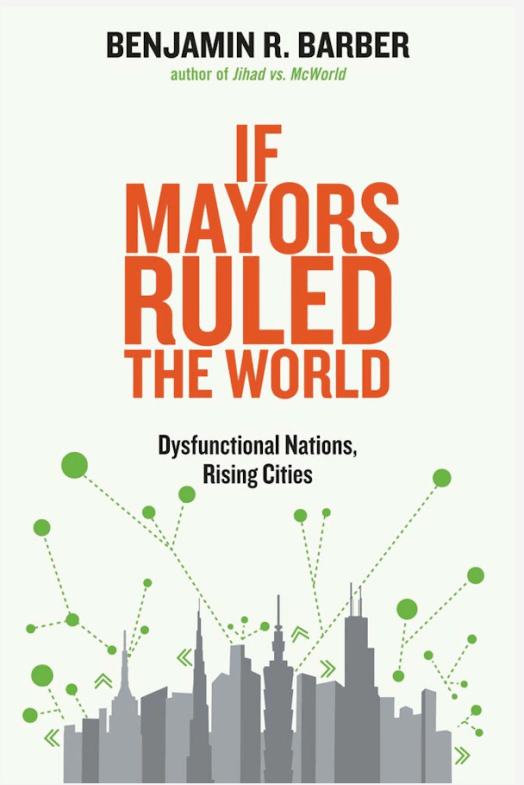
Barber asserts that cities, and the mayors that run them, offer the best new forces of good governance: “Why cities? Cities already occupy the commanding heights of the global economy. They are home to more than half of the world’s population, a proportion which will continue to grow.
They are the primary incubator of the cultural, social, and political innovations which shape our planet. And most importantly, they are unburdened with the issues of borders and sovereignty which hobble the capacity of nation-states to work with one another.”
In his TedTalk in Edinburg, Scotland, he outlines his argument for this new approach.
“Democracy is in trouble. No question about that. And it comes in part from a deep dilemma in which it is embedded. It is increasingly irrelevant to the kind of decisions we face that have to do with global pandemics (a cross-border problem), with HIV (a transnational problem with markets in immigration, something that goes beyond national borders), with terrorism, with war. All now cross-border problems all now. In fact we live in a 21st century world of interdependence and interdependent approval, interdependent problems.
And when we look for solutions in politics and democracy we are faced with political institutions designed four hundred years ago. Autonomous, sovereign nation-states with jurisdictions and territories separate from one another, each claiming to be able to solve the problem of its own people—21st Century transnational world of problems and challenges the seventeenth century world of political institutions.
In that dilemma lies the central problem of democracy. And like many others, I’ve been thinking about what can one do about this. This asymmetry between 21st-century challenges and archaic and increasingly dysfunctional political institutions like nation-states.”
Bibliography
Barber, B. (2013). If Mayors Ruled the World: Dysfunctional Nations, Rising Cities. New Haven, US: Yale University Press.
 PRIMO Res Publica