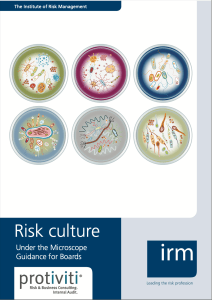
Risk Culture

Under the Microscope Guidance for Boards

The Institute of Risk Management | 2012

Richard Anderson, Chairman of The Institute of Risk Management: “For over 25 years, the Institute of Risk Management has provided leadership and guidance to the emerging risk management profession with a unique combination of academic excellence and practical relevance. The Institute’s profile continues to grow internationally with heightened interest in the management of risk across government, public and business domains. 

This board guidance on risk culture is our latest contribution to thought leadership in the field. Although essential, the continuing parade of organisational catastrophes (and some notable successes) demonstrates that frameworks, processes and standards for risk management are insufficient to ensure that organisations reliably manage their risks and meet their strategic objectives. What is missing is the behavioural element: why do individuals, groups and organisations behave the way they do, and how does this affect all aspects of the management of risk?

“Problems with risk culture are often blamed for organisational difficulties but, until now, there was very little practical advice around on what to do about it.”

Problems with risk culture are often blamed for organisational difficulties, but until now, there has been very little practical advice on what to do about it. This paper seeks to give guidance in this area, drawing upon the wealth of practical experience and expert knowledge across the Institute. It aims to provide advice to organisations wanting a greater understanding of their own risk cultures and to give them some practical tools that they can then use to drive change. It should be of interest to board members, executives and non-executives, risk professionals, HR professionals, regulators, and academics.

This short document summarises our approach to risk culture for those working at the board level. There is also a longer companion document – Risk Culture: Resources for Practitioners – which covers the detailed thinking behind the concepts and models we found helpful. This remains a developing area, and we do not consider that we have written the last word on the subject – we expect to see more models and tools and, in particular, sector and issue-specific work emerging in the future.”

Risicomanagement in kleine gemeenten

Implementatie hoeft geen belemmering te zijn

Frank Janse en A.H. Schreuders | 2006

Sinds de invoering van het Besluit Begroting en Verantwoording 2004 (BBV 2004) is risicomanagement bij gemeenten volop in beweging. De structurele verankering van risicomanagement vraagt echter om blijvende aandacht en omvat meer dan het uitvoeren van een eenmalig ‘kunstje’ of het opstellen van een weerstandsparagraaf.

De vraag is hoeveel inspanning het kost om risicomanagement in goede banen te leiden. Veel kleinere gemeenten vragen zich dan ook af waarom er, gelet op de eenvoudige structuur van de organisatie, een heel systeem moet worden ingericht, terwijl de risico’s in de weerstandsparagraaf zijn benoemd. In dit artikel zal worden beschreven hoe het proces van risicomanagement eruit ziet en waarom het belangrijk is om dit bij elke gemeente toe te passen. Lees verder “Risicomanagement in kleine gemeenten”

Nieuw model helpt gemeenten bij risicomanagement

Over de zoektocht naar de volwassenheid van het vak risicomanagement

Ignacio Jose Cienfuegos Spikin | 2013

Risicomanagement is een trend in bijna elke sector. Publieke organisaties zoals gemeenten blijven achter op dit terrein, maar zij hebben nu een nieuw hulpmodel in handen. De uit Chili afkomstige Ignacio Cienfuegos Spikin, in 2013 gepromoveerd aan de Universiteit Twente, onderzocht de status van risicomanagement bij gemeenten. Hij toetste een door hem ontwikkeld ‘Risk maturity model’ bij 72 gemeenten. “Het model biedt waardevolle informatie aan besluitvormers”. Lees verder “Nieuw model helpt gemeenten bij risicomanagement”

The Power of Organizations

A New Approach to Organizational Theory: How organizations developed in history, how they operate, and how research on them has evolved.

Heather A. Haveman | 2022

Organizations are all around us: government agencies, multinational corporations, social-movement organizations, religious congregations, scientific bodies, sports teams, and more. Immensely powerful, they shape all social, economic, political, and cultural life. They are critical for planning and coordinating every activity, from manufacturing cardboard boxes to synthesizing new drugs and reducing greenhouse gas emissions. To understand our world, we must understand organizations.

The Power of Organizations defines the features of organizations, examines how they operate, traces their rise throughout a millennium, and explains how research on organizations has evolved from the mid-nineteenth century to today.

Heather Haveman shows how almost all contemporary research on organizations fits into three general perspectives: demographic, relational, and cultural. She offers constructive criticism of existing research, showing how it can be remade to be both more interesting and influential. She examines how we can use existing theories to understand the changes wrought by digital technologies, and she argues that organizational scholars can and should alter the impact that organizations have on society, particularly societal and global inequality, formal politics, and environmental degradation.

The Power of Organizations demonstrates the benefits and dangers of these ubiquitous foundations of modern society.

Bibliography

Haveman, H. (2022) The Power of Organizations: A New Approach to Organizational Theory. Princeton, New Jersey: Princeton University Press.

Is het einde van risicomanagement nabij?

Tijd voor een collectieve herbezinning!

Marinus de Pooter | 2014

Voor wie zijn oor te luisteren legt in uiteenlopende sectoren doemt spoedig het beeld op dat risicomanagement in de praktijk maar beperkt aanslaat. En dat ondanks alle gedane investeringen en de energie die er in de afgelopen jaren in is gestoken. Als risicomanagement inderdaad zoveel goeds brengt (zoals gewoonlijk wordt beweerd), hoe kan het dan dat lijnmanagers niet massaal afkomen op trainingen en congressen? Waarom staan zij niet in de rij om meer te leren over al die prachtige concepten en instrumenten (inclusief de vele indrukwekkende software applicaties)? Is het als managementsysteem zo slecht verkocht of kan het gewoon niet waar maken wat er wordt beloofd? Wellicht is het een combinatie van beide. 

Marinus de Pooter

Het is tijd voor iets beters. Wat mij betreft is het einde van conventioneel risicomanagement nabij. Ik doel op de instrumentele benadering vanuit een aparte staffunctie. Het beperkte enthousiasme voor deze gebruikelijk opzet komt volgens mij door meerdere factoren. Ik noem een aantal observaties vanuit de adviespraktijk.

Lees verder “Is het einde van risicomanagement nabij?”

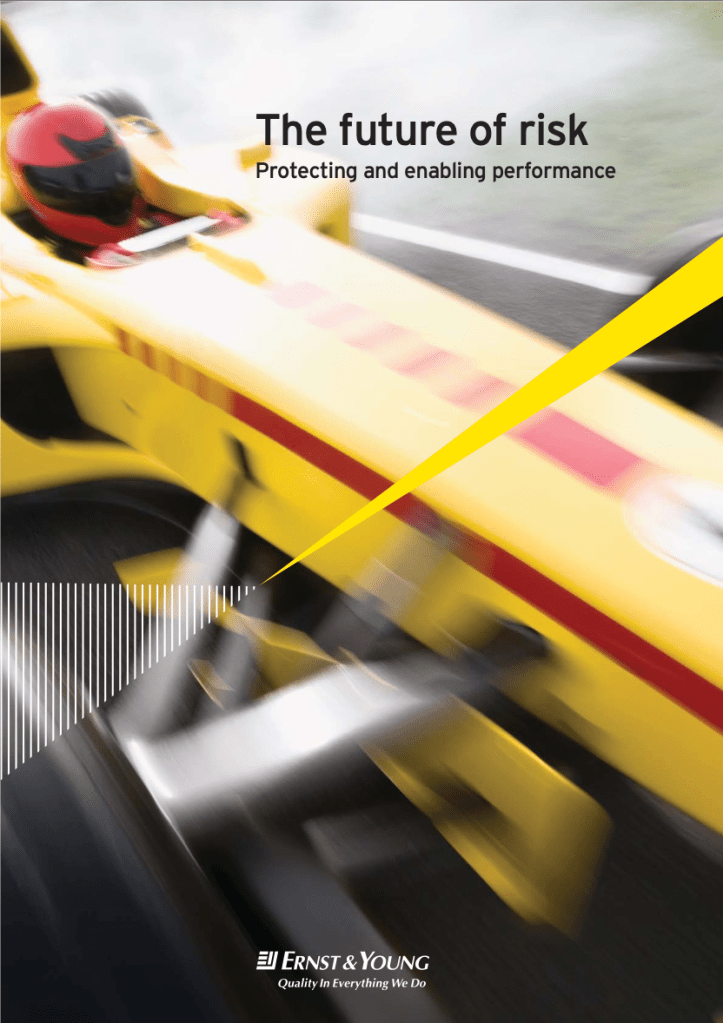
The future of risk

Ernst & Young | 2009

Protecting and enabling performance: albeit painful, progress ultimately results from crisis. The current downturn is causing companies to challenge their risk management processes and ask how they can further improve their risk management efforts.

Against this backdrop, we conducted a survey to provide a snapshot of the current risk environment and to understand organizational attitudes toward enterprise risk management. We were also interested in understanding how recent events have impacted approaches to risk management and organizations’ abilities to identify and manage different types of risk. Never has there been a more critical time to define a path forward for the “future of risk”.

We believe that the recent economic challenges were, in part, more difficult to predict and manage due to the increasing complexity of risk management processes. Over the past few decades, the number of risk management functions has grown to the point where most large companies have seven or more separate risk functions — not counting their independent financial auditor.

As the number of risk functions increases, coordination becomes more difficult

This has created inefficiencies and resulted in a degree of fatigue on the business. As the number of risk functions increases, coordination becomes more difficult and often results in coverage gaps and overlapping responsibilities. The demands and various reporting requirements placed on the business by these risk functions can become significant and burdensome. The number of risk functions and the various communications from these functions can be a challenge for executives and the board of directors to manage and understand.

As complexity has increased, so has company spending on risk management. Based on a previous survey we conducted last year of Fortune 1000 companies, we estimate that the average company spends about 4% of revenue on risk management activities. We believe the answer to these challenges can be found by carefully considering how to balance risk, cost and value across the enterprise.

Considering the events of the past 12 months, it is not surprising that 96% of our recent survey respondents believe that their risk management programs could be improved. Furthermore, only 1% of companies intend to reduce their risk management resources. Given the current cost-conscious mentality, the fact that nearly all companies want to improve their risk management efforts and intend to maintain or increase their current levels of investment underscores the growing awareness of the value of sound risk management.

Moreover, 46% agreed that committing more resources to risk management would help to create a competitive advantage. Clearly, organizations recognize the importance of risk management. Leading organizations acknowledge that risk management is more than simply protecting existing assets; it is also about enabling performance to create future value.

However, the reality is that most risk functions will be asked to do more with the same or limited additional resources. There is a strong drive to improve risk coverage through better use of existing resources and to deliver more value from their respective functions.

The challenge for most organizations will be to find increased efficiencies in the way their risk management functions operate

The challenge for most organizations will be to find increased efficiencies in the way their risk management functions operate and define the improvements that create the greatest value. We believe the answer to these challenges can be found by carefully considering how best to balance risk, cost and value across the enterprise. Companies that effectively address this challenge are more likely to outperform their competitors.

Summarising conlusions

Risk management has grown increasingly complex over the years, prompting organizations to increase the size, magnitude and reach of their risk management functions. However, an increase in risk management activities does not always correlate to more effective risk management. Recent events have revealed this vulnerability and provided a much needed “wake-up call.”

Many organizations had committed significant resources and investment in risk management but had not worked to connect their processes. Kingdoms or silos were developed, but the levels of interaction, shared reporting, data exchange and coordination was minimal.

While there has been a maturing of risk management, there is still considerable opportunity for improvement. Organizations need to constantly challenge their approach to risk management. This is especially true now, when risk functions are being asked to do more with the same — or limited additional — resources. More than ever, organizations need to rethink their approach to risk management in order to balance risk, cost and value. Our research shows the most commonly identified areas for improvement are:

  • Improving the risk assessment approach to better anticipate, identify and understand risks.
  • Aligning risk management focus with business objectives to drive greater value and focus on the risks most likely to affect the business.
  • Enhancing coordination of risk and control groups to achieve greater efficiencies and eliminate redundancies, duplication and gaps among risk activities.

Organizations that improve their risk management activities will not only provide better protection for their businesses, but also improve their business performance, improve their decision- making and, ultimately, increase their competitive advantage.

Download: Future of risk 2009

[pdf-embedder url=”https://civitasnaturalis.com/wp-content/uploads/2022/05/083ef-future_of_risk_rapport_2009.pdf” title=”future_of_risk_rapport_2009″]

[su_note note_color=”#E2E2E2″]

This publication is part of the web-book Public Risk Canon

[/su_note]

COSO

Committee of Sponsoring Organizations (COSO) | 1985

This Internal Control—Integrated Framework was developed by the Committee of Sponsoring Organizations (COSO) of the Treadway Commission.

The American Accounting Organization (AAA), American Institute of Certified Public Accountants (AICPA), Financial Executives International (FEI), Institute of Internal Auditors (IIA), and Institute of Management Accountants (IMA) Organizations seeking to scale find that this framework offered an approach to enterprise risk management (ERM) sensitive to variability from one organization to the next.

Lees verder “COSO”