PRIMO Vlaanderen (2009) is preparing for a promotional campaign right after the summer period. We recently had a first presentation of PRIMO Vlaanderen during an AXA-hosted seminar on adequate prevention policy in our local administrations, compared to what already exists in several companies.
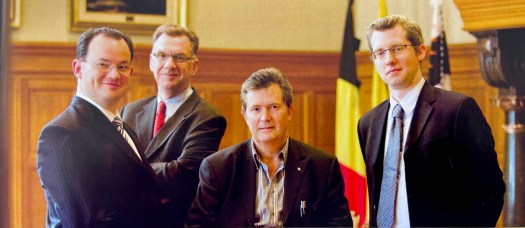
From left to right: Tom Wustenberghs, Ronny Frederickx, Luc Verhulst en Karl Vanderplaetse.
Although it doesn’t seem obvious to imply that political decision makers should think about preventive risk management (often referred to as a waste of time), this aspect might be valuable for developing the association in Flanders as a key information network on risk management.
The new association wants to highlight the importance of preventive risk management over existing crisis planning. Such a policy can only help improve the organisation’s quality (quality management) and reduce costs by diminishing risks.
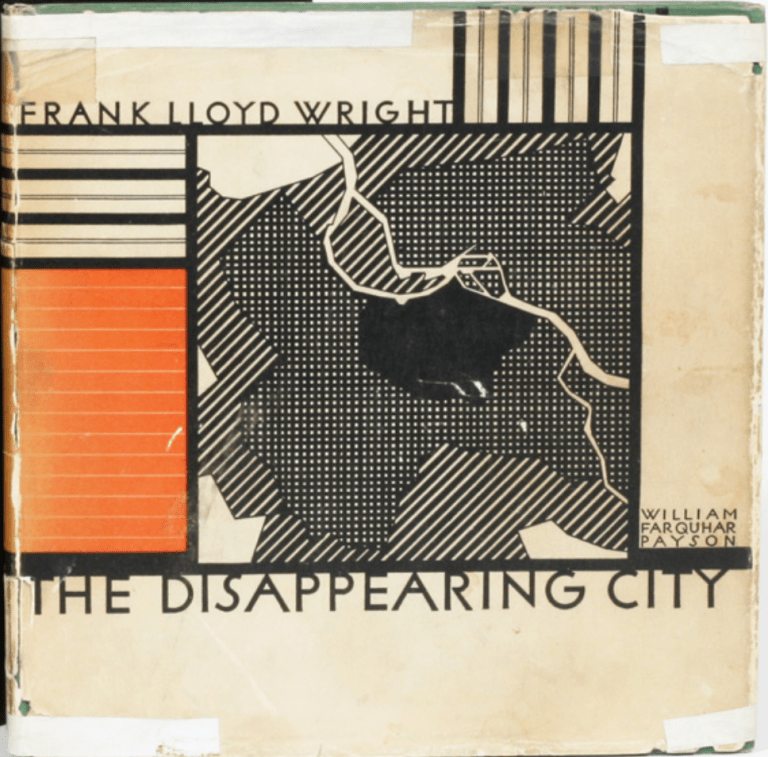
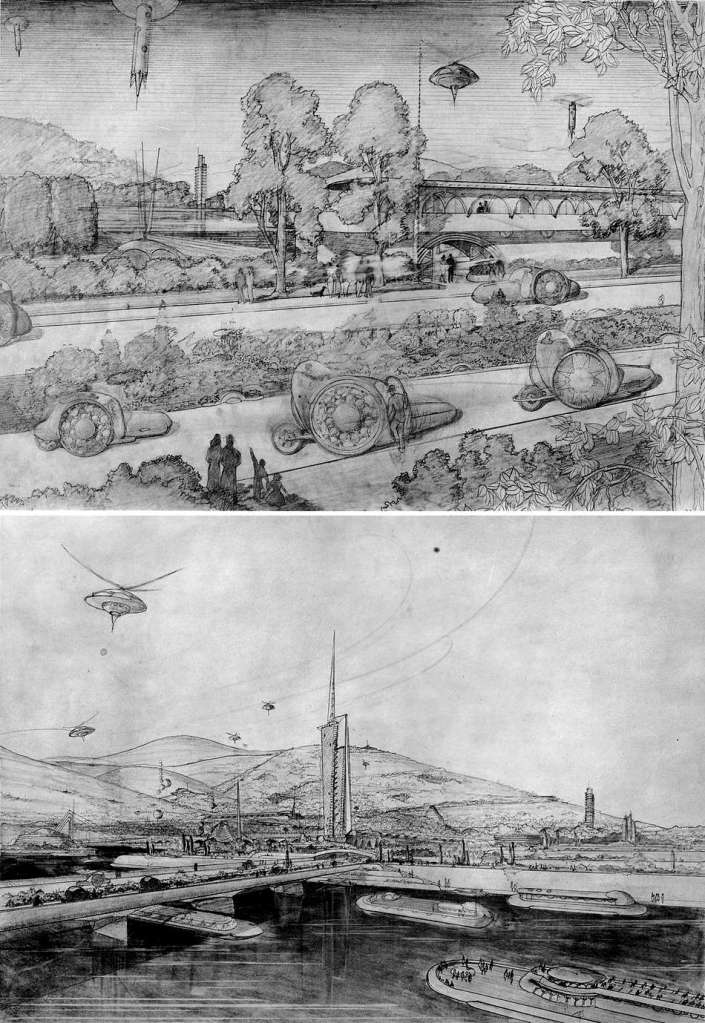
“The principles set forth in The Disappearing City Frank Lloyd Wright’s advocacy of creating cities built to human scale, of planning the open spaces, making possible both community places and truly private places, of decentralizing the structure of our civilization – found their most thoughtful expression in his Broadacre City, an idea that grew from the 1932 book into a highly influential theory of city planning – and a radical critique, not only of the unhealthy, unwieldy American city but of his European contemporaries’ coldly rational urban warehouses for humans” (Fowler, Frank Lloyd Wright: Graphic Artist).
On Earth
“The value of this earth, as man’s heritage, is pretty far gone from him now in the cities centralization has built. And centralization has over-built them all. Such urban happiness as the properly citified citizen knows consists in the warmth and pressure or the approbation of the crowd. Grown Argus-eyed and enamoured of “whirl” as a dervish, the surge and mechanical roar of the big city turns his head, fills his ears as the song of birds, the wind in the trees, animal cries and the voices and songs of his loved ones once filled his heart.
But as he stands, out of machines he can create nothing but machinery.
The properly citified citizen has become a broker dealing, chiefly, in human frailties or the ideas and inventions of others: a puller of levers, a presser of the buttons of a vicarious power, his by way of machine craft.
A parasite of the spirit is here, a whirling dervish in a whirling vortex. Perpetual to and from excites and robs the urban individual of the meditation, imaginative reflection and projection once his as he lived and walked under clean sky among the growing greenery to which he was born companion. The invigoration of the Book of Creation he has traded for the emasculation of a treatise on abstraction. Native pastimes with the native streams, woods and fields, this recreation he has traded for the taint of carbon-monoxide, a rented aggregate of rented cells up-ended on hard pavements, “Paramounts”, “Roxies” and nightclubs, speakeasies. And for this he lives in a cubicle among cubicles under a landlord who lives above him, the apotheosis of rent, in some form, in some penthouse.
The citizen, properly citified, is a slave to herd instinct and vicarious power as the medieval laborer, not so long before him, was a slave to his pot of “heavy wet.” A cultural weed of another kind.
The weed goes to seed. Children grow up, herded by thousands in schools built like factories, run like factories, systematically turning out herd-struck morons as machinery turns out shoes.
Men of genius, productive when unsuccessful, “succeed,” become vicarious, and except those whose metier is the crowd, these men, who should be human salvage, sink in the city to produce, but create no more. Impotent.
Life itself is become the restless “tenant” in the big city. The citizen himself has lost sight of the true aim of human existence and accepts substitute aims as his life, unnaturally gregarious, tends more and more toward the promiscuous blind adventure of a crafty animal, some form of graft, a febrile pursuit of sex as “relief” from factual routine in the mechanical uproar of mechanical conflicts. Meantime, he is struggling to maintain, artificially, teeth, hair, muscles and sap; sight growing dim by work in artificial light, hearing now chiefly by telephone; going against or across the tide of traffic at the risk of damage or death. His time is regularly wasted by others because he, as regularly, wastes theirs as all go in different directions on scaffolding, or concrete or underground to get into another cubicle under some other landlord. The citizen’s entire life is exaggerated but sterilized by machinery–and medicine: were motor oil and castor oil to dry up, the city would cease to function and promptly perish.
The city itself is become a form of anxious rent, the citizen’s own life rented, he and his family evicted if he is in “arrears” or “the system” goes to smash. Renting, rented and finally the man himself rent should his nervous pace slacken. Should this anxious lock-step of his fall out with the landlord, the moneylord, the machinelord, he is a total loss.
And over him, beside him and beneath him, even in his heart as he sleeps is the taximeter of rent, in some form, to goad this anxious consumer’s unceasing struggle for or against more or less merciful or merciless money increment. To stay in lockstep. To pay up. He hopes for not much more now. He is paying his own life into bondage or he is managing to get the lives of others there, in order to keep up the three sacrosanct increments to which he has subscribed as the present great and beneficent lottery of private capital. Humanity preying upon humanity seems to be the only “economic system” he knows anything about…”
The Broadacre City
We are concerned here in the consideration of the future city as a future for individuality in this organic sense: individuality being a fine integrity of the human race. Without such integrity there can be no real culture whatever what we call civilization may be. We are going to call this city for the individual the Broadacre City because it is based upon a minimum of an acre to the family.
And, we are concerned for fear systems, schemes, and “styles” have already become so expedient as civilization that they may try to go on in Usonia as imitation culture and so will indefinitely postpone all hope of any great life for a growing people in any such city the United States may yet have.
To date our capitalism as individualism, our eclecticism as personality has, by way of taste, got in the way of integrity as individuality in the popular understanding, and on account of that fundamental misunderstanding we, the prey of our culture-monger, stand in danger of losing out chance at this free life our charter of liberty originally held out to us.
I see that free life in the Broadacre City.
As for freedom, we have-prohibition because a few fools can’t carry their liquor; Russia has communism because a few fools couldn’t carry their power; we have a swollen privatism because a few fools can’t carry their “success” and money must go on making money.
If instead of an organic architecture we have a style formula in architecture in America, it will be because too many fools have neither imagination nor the integrity called individuality. And we have our present overgrown cities because the many capitalistic fools are contented to be dangerous fools.
A fool ordinarily lacks significance except as a cipher has it. The fool is neither positive nor negative. But by way of adventitious wealth and mechanical leverage he and his satellites – the neuters – are the overgrown city and the dam across the stream flowing toward freedom.
It is only the individual developing in his own right (consciously or unconsciously) who will go, first, to the Broadacre City because it is the proper sense of the dignity and worth of the individual, as an individual, that is building that city. But after those with this sense the others will come trailing along into the communal-individuality that alone we can call Democracy.
But before anything of significance or consequence can happen in the culture of such a civilization as ours, no matter how that civilization came to be, individuality as a significance and integrity must be a healthy growth or at least growing healthy. And it must be a recognized quality of greatness.
In an organic modern architecture, all will gladly contribute this quality, as they may, in the spirit that built the majestic cathedrals of the middle-ages. That medieval spirit was nearest the communal, democratic spirit of anything we know. The common-spirit of a people disciplined by means and methods and materials, in common, will have – and withno recognized formula – great unity.”
Times are changing. This will happen in every society and has to be recognised. However difficult it is to say goodbye to the past, we must realise that the past is behind us. Of course, we have to learn from it, but we must also look forward and prepare society for the constantly changing future. Of course, this also happens in governmental structures—slowly, but it does happen.
The responsibilities of the governmental levels will change throughout the years as a result of changes in society, the needs and questions of inhabitants, new technologies, et cetera. All of these changes, therefore, require more expertise from governmental organisations: expertise which can be found in cooperation, but also, for instance, in the merging of municipalities and their organisations of civil servants. Larger organisations will offer more opportunities for civil servants to invest in their knowledge and skills. These aspects, including the talents of the other category of civil servants, are needed to handle the changes in these larger organisations.
Come senators, congressmen Please heed the call Don’t stand in the doorway Don’t block up the hall For he that gets hurt Will be he who has stalled There’s a battle outside And it is ragin’ It’ll soon shake your windows And rattle your walls For the times they are a changin’
– Bob Dylan, 1963
In several countries in Europe, the merging of municipalities is a subject of governmental discussion. In Belgium, for instance, the Flemish Government recently decided to open a discussion on governmental reform at the local level.¹ In Denmark, a reform was completed in 2007, and in The Netherlands, there has been an ongoing discussion about the scale of municipalities.
In this article you will be taken through the world of merging, a process of wondering, obstacles and standing by your vision. Four aspects of merging will be discussed. First: before we can walk into the future we need a vision (macro). The way we walk into the future, when a decision to merge has been taken, needs a micro vision (second), and can be by (third) a ‘big bang’ method, or the (fourth) ‘tailor-made’ method.
Macro Vision
Merging municipalities is ‘hot’. In many countries, merging occurs, or discussions take place about merging. The reasons are different. Sometimes, the reasons are finance, quality, less bureaucracy, and fewer representatives; however, there will also be other reasons, depending on the specific situation. Formulating a vision of how to handle the structure of public government is becoming increasingly important.
It is impossible to form an opinion on merging municipalities without discussing their position within the governmental structure. Where do municipalities stand, and what do we expect from politicians and civil servant organisations? It is, therefore, necessary to have an opinion about society and to know what the future could bring us—‘could’ because no one has a crystal ball to predict the future exactly.
But still, it is necessary to make a prediction of what society might look like in the next 10-20 years. The technological developments will be huge. We cannot possibly imagine what will be possible at that point in the future.If we look back on the last 20 years, we will see the beginning of the computer area. We had no words to describe what could be possible, but look at the situation today; the possibilities are almost endless. However, it is not only regarding the technical side of the future; we also have to look at the reality of what all those developments will mean for society itself. People will be behaving differently –their needs will be different. What they demand from the government will change, but also how they want to contact the government.
Within this framework, we will have to build political systems and governmental organisations that function with the idea that there is always change. Nothing stays the same. The next step is to realise that we need modern information technology. Within that framework, we need highly educated staff and perhaps politicians. In the last category, there is the concern that politicians must not lose contact with society.
The ideal situation would be that politicians are able, supported by well-educated civil servants, to do their job as representatives of their inhabitants in a country, region, or municipality. Within this way of thinking, it will be normal to discuss the functioning of (local)government. Is the scale of municipalities enough for the future? Is there enough (governmental) power to carry out the tasks they have to do well? Are municipalities ready for the future?
It’s my strong opinion that within this timeframe, merging will be necessary to provide an answer to these developments. Of course, in some cases, alternatives such as cooperation will provide the solution. Still, at a certain moment, the legibility of control by a democratically chosen government will make a merger necessary. For instance, cooperation in the field of ICT is a very logical thought. But never forget that this will require decisions regarding an enormous sum of money. It is logical that politicians want to have an influence on those decisions and do not want to have proposals from a relatively external organisation where they only have to say yes or no.
Another circumstance is the development of a ‘United States of Europe’. Europe as an identity is a fact. Most countries in the EU have three levels of government. It seems that an extra top level will have consequences for the levels of government in the different countries. Perhaps, in some cases, one of the three levels will disappear. Local government will stay, but increasing the number of municipalities will be necessary in that case, combined with all forms of local decentralisation, to stay close to the inhabitants.
Micro Vision
The vision must not be restricted to the national and/or regional level regarding the question of how many municipalities we must have and, more importantly, their tasks and size. The reform procedure can start if these questions are answered in a vision. Within this framework, there will be new municipalities. A micro vision is necessary to see how these municipalities will be organised and how they will work.
Moreover, the most ideal situation would be if this vision was created by inhabitants, entrepreneurs, companies, culture societies et cetera of the new municipality.² A vision of that kind can tell the new politicians what society expects from the responsible people of the new municipality and what they expect from the organisation of civil servants. The organigram can thus be built by using the outcome of such a vision. It makes the start of the new organisation a little bit easier.
However, this is one of the most difficult steps in building a new organisation because no politicians from the new municipality can take responsibility for such a process. If this cannot be realized, an organisation will be built on the information and visions of consultants and/or other persons or institutes.
Much can be said about merging municipalities at every level of government, but when the decision has been made to merge, the procedure has to start. Therefore, two options are available: the ‘Big Bang ’ and the ‘Tailor-made’ one. Both options require the full attention of those responsible for carrying out the merging decision. Procedures must be carried out, and people must be consulted as much as possible about the expectations for the new municipality.
Big Bang
For the ‘big bang’ solution, we can look at the reforms in Denmark. The decision was made at the national level that the municipalities were too small for their future tasks. This choice resulted from a State Committee’s conclusion in 2002. They were not able to perform their tasks at the required high level. At least 20.000 inhabitants were needed, and up to 30.000 inhabitants were needed for a forced partnership. Through an interactive debate in the country, followed by local referenda and national elections, the law for the merging was realised on 23 June 2005. On 1 January 2007, the number of municipalities decreased from 278 to 98.
After a ‘Big Bang’ operation, the discussion about merging municipalities will fade away for the time being. Scientific research shows that the first year was relatively chaotic because of removal, personnel, phone and IT problems. For a while, the municipalities were not able to issue building permits, for instance. After one year, the situation stabilised. Nowadays, the differences in cultures are still a problem. Some investigations in the second year showed that there were severe cuts in budgets at the national level. There was almost no efficiency profit; the national government was still dominant. The costs for the inhabitants had increased a little, and there was a lack of transparency. And most of all, the service level did not increase.³
Tailor-made
In the Netherlands, merging is often realised through’ tailor-made’ solutions. The difference from the situation in Denmark is that the most powerful governmental level for merging is the regional level (Provinces). Of course, the national level has an opinion about merging (MacroVision almost changes with every new cabinet contract, which does not favour sustainability), which they can use when a Province sends a merging proposal to the Ministry for the law procedure.
This is also the case with merging, which is the initiative of two or more municipalities (voluntary merging). To act on merging in this way, a long process of reducing the number of municipalities and constant discussion about this theme is required. The noise about merging will not fade away for some time.
On the other hand, it is always possible to work with the latest knowledge, and the solution will be more fitting to the concrete situation. The law process in the Netherlands leads to the fact that the final political decision is mostly made about three months before the merging has to be realised; and a period of three months is far too short for a good implementation of a merging.⁴
Due to the fact that some municipalities merge every year in the Netherlands, some scientific research has been undertaken over the years. The outcome of this research is almost the same as that of Denmark. It takes several years to find a new balance. However, one of the most important conclusions was that a merger often does not have the promised financial benefit. Due to several circumstances, it will take 5-10 years before old contracts fade away and the real situation can be seen.⁵
Resistance
One of the most important aspects of merging is that there will always be resistance, even when it is voluntary. The resistance comes mostly from the inhabitants who are afraid of losing, for example, the identity of a village. They use the argument of increasing costs for inhabitants, while the governmental institutions often claim that a merger is profitable. As mentioned, investigations have shown that this has been untrue for at least 5-10 years. It is very important to tell the true story, namely that it will cost money but that a merging is necessary based on the Macro Vision. Use the knowledge of inhabitants in writing the Micro Vision and find in cooperation with them forms of decentralisation within the new municipality to end the feeling of loss of identity.
Conclusions
Let the (macro) Vision not be: ‘We merge municipalities because of the merging.’ Then, the goal of merging has become the vision. Merging must be a result of a vision developed in cooperation with stakeholders. It gives politicians the possibility to explain why a merger is necessary.
Realise that working on the vision is sometimes one of the small steps towards the future; sometimes, a hold is necessary. Strong cooperation between municipalities before a merger is a temperate and acceptable solution. Even after a merger, cooperation can be necessary (for instance, in the field of ICT).
Based on the vision, choose the method ‘big bang’ or ‘tailor-made’ at the national level.
Realise that there will always be resistance based on emotions. Allow room for this to be expressed.
Take the merging steps with the participation of stakeholders (micro vision).
Let political decisions be made before the merging of civil servant organisations takes place.
Finally, tell the truth. Not only will the financial benefits not be there in the first 5-10 years, but the (macro) vision will make merging municipalities necessary.
Bibliography
Vlaamse Regering, Witboek interne staatshervorming, 8 April 2011. (Macro Vision)
Royal Haskoning, ‘Aanzet voor een maatschappelijke agenda voor Goeree-Overflakkee’, een slagvaardige gemeente voor een economisch vitaal eiland. 13 May 2011. Discussion document for the merging of municipalities on the Island Goeree-Overflakkee in the Netherlands. (Micro Vision)
Laheij, B.M.A., Masterscriptie aan de Universiteit van Tilburg, 24 July 2009.
Wet Algemene Regelen Herindeling. Law in the Netherlands about Merging governmental organisations.
Universiteit van Groningen/Berenschot, Effecten van gemeentelijke herindelingen in de provincie Zuid-Holland, June 2008.
* Seconded National Expert at European Institute of Public Administration (EIPA), former City Manager of Middelharnis/Goedereede, The Netherlands and Public Governance Expert at PRIMO Europe. He writes this article with a personal title.
In popular imagination, rocket science is the totemic example of scientific complexity. As Britain’s leading academic expert on risk, I will argue here that risk management is in fact much more complex. To put it another way, the scientist studying turbulence “the clouds do not react to what the weatherman or physicist says about them”. The risk manager must, however, deal not only with risk perceived through science, but also with virtual risk – risks where the science is inconclusive and people are thus “liberated to argue from, and act upon, pre-established beliefs, convictions, prejudices and superstitions.”
Professor John Adams
The affluent world is drowning in risk assessments. Almost everyone now has a “duty of care” to identify formally all possible risks to themselves, or that they might impose on others, and to demonstrate that they have taken all reasonable steps to “control” them. It is not clear that those imposing this duty of care appreciate the magnitude and difficulty of the task they have set.
In 2004 I participated in a conference on terrorism, World Federation of Scientists’ International Seminar on Terrorism, Erice, Sicily. Most of the other participants were eminent scientists, and I found myself in a workshop entitled Cross-disciplinary challenges to the quantification of risk. Lord Kelvin famously said:
“Anything that exists, exists in some quantity and can therefore be measured.”
This dictum sits challengingly alongside that of another famous scientist, Peter Medewar who observed:
“If politics is the art of the possible, research is the art of the soluble. Both are immensely practical minded affairs. Good scientists study the most important problems they think they can solve [my emphasis]. It is, after all, their professional business to solve problems, not merely to grapple with them.”
Terrorism undoubtedly exists, and some of its consequences can be quantified. One can count the numbers killed and injured. With the help of insurance companies one can have a stab at the monetary value of property destroyed and, for those with business continuity insurance, the value of business lost. But what units of measurement might be invoked to calculate the impact of the terror that pervades and distorts the daily life of someone living in Chechnya, or Palestine, or Darfur or …. ? Or the loss of civil liberties resulting from the anti-terrorism measures now being imposed around the world.
The problem becomes more difficult when one moves on to the challenge of quantifying the risk of terrorism. Risk is a word that refers to the future. It has no objective existence. The future exists only in the imagination. There are some risks for which science can provide useful guidance to the imagination. The risk that the sun will not rise tomorrow can be assigned a very low probability by science. And actuarial science can estimate with a high degree of confidence that the number of people killed in road accidents in Britain next year will be 3500, plus or minus a hundred or so. But these are predictions, not facts. Such predictions rest on assumptions; that tomorrow will be like yesterday; that next year will be like last year; that future events can be foretold by reading the runes of the past. Sadly, the history of prediction contains many failures – from those of stock market tipsters to those of vulcanologists seeking to predict eruptions, earthquakes and tsunamis.
Type “risk” into an Internet search engine and you will get over 100 million hits. You need sample only a small fraction to discover many unnecessary, and often acrimonious, arguments. Risk is a word that means different things to different people. It is a word that engenders a sense of urgency because it alludes to the probability of adverse, sometimes catastrophic, outcomes. Much of the acrimonious urgency, or the urgent acrimony, that one uncovers searching for “risk” on Google, stems from a lack of agreement about the meaning of the word. People are using the same word, to refer to different things, and shouting past each other.
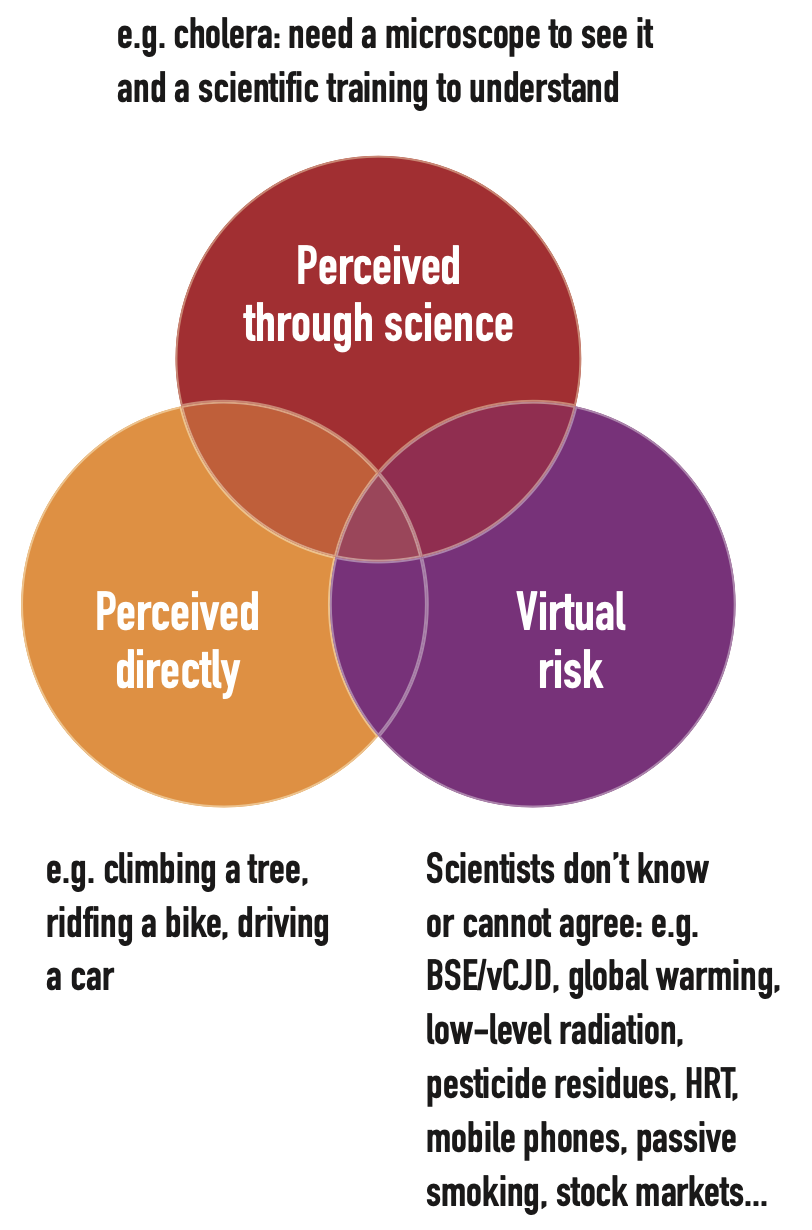
Figure 1 is proffered in the hope of clearing away some unnecessary arguments.
Figure 1.
Directly perceived risk (much operational risks) are dealt with using judgement – a combination of instinct intuition and experience. One does not undertake a formal, probabilistic, risk assessment before crossing the road. Crossing the road in the presence of traffic involves prediction based on judgement. One must judge vehicle speeds, the gaps in traffic, one’s walking speed, and hope one gets it right, as most of us do most of the time.
Most of the published literature on risk management falls into the category of risk perceived through science. Here one finds not only biological scientists in lab coats peering through microscopes, but physicists, chemists, engineers, doctors, statisticians, actuaries, epidemiologists and numerous other categories of scientist who have helped us to see risks that are invisible to the naked eye. Collectively they have improved enormously our ability to manage risk – as evidenced by the huge increase in average life spans that has coincided with the rise of science and technology.
But where the science is inconclusive we are thrown back on judgement. We are in the realm of virtual risk. These risks are culturally constructed – when the science is inconclusive people are liberated to argue from, and act upon, pre-established beliefs, convictions, prejudices and superstitions. Such risks may or may not be real but they have real consequences. In the presence of virtual risk what we believe depends on whom we believe, and whom we believe depends on whom we trust.
A participant at the conference on terrorism was one of the world’s foremost experts on turbulence, notoriously the most intractable problem in science. In the mythology of physics Werner Heisenberg is reported as saying:
“When I meet God, I am going to ask him two questions: Why relativity? And why turbulence? I really believe he will have an answer for the first.”
I would trust the physicist I met at the conference to tell me the truth about turbulence, so far as he knew it. But the problems he is studying are simple compared to those of the risk manager, because the clouds do not react to what the weatherman or physicist says about them.
We are all risk managers. Whether buying a house, crossing the road, or considering whether or not to have our child vaccinated, our decisions will be influenced by our judgement about the behaviour of others, and theirs by their judgements about what we might do. The world of the risk manager is infinitely reflexive. In seeking to manage the risks in our lives we are confronted by a form of turbulence unknown to natural science, in which every particle is trying to second guess the behaviour of every other. Will the vendor accept less in a falling market? Will the approaching car yield the right of way? Will enough other parents opt for vaccination so that my child can enjoy the benefits of herd immunity while avoiding the risks of vaccination? And, increasingly, if things go wrong, who might sue me? Or whom can I sue? The risk manager is dealing with particles with attitude.
Another participant at the conference, alert to the strict limits of natural science in the face of such turbulence, warned that we were in danger of becoming the drunk looking for his keys, not in the dark where he dropped them, but under the lamp post where there was light by which to see.
This caution prompted the re-drawing of Figure 1. Figure 2 is an attempt to highlight the strict limits to the ability of science to foretell the future.
Fig. 2. Three types of risk (re-draw). An attempt to highlight the strict limits to the ability of science to foretell the future.
In the area lit by the lamp of science one finds risk management problems that are potentially soluble by science. Such problems are capable of clear definition relating cause to effect and characterized by identifiable statistical regularities. On the margins of this area one finds problems framed as hypotheses and methods of reasoning, such as Bayesian statistics, which guide the collection and analysis of further evidence. As the light grows dimmer the ratio of speculation to evidence increases. In the outer darkness lurk unknown unknowns. Here lie problems with which, to use Medawar’s word, we are destined to “grapple”.
As the light of science has burned brighter most of the world has become healthier and wealthier and two significant changes have occurred in the way in which we grapple with risk. We have become increasingly worried about more trivial risks, and the legal and regulatory environments in which we all must operate as individual risk managers have become more turbulent. As the likelihood of physical harm has decreased the fear, and sometimes the likelihood, of being sued has increased.
As the light of science has burned brighter most of the world has become healthier and wealthier and two significant changes have occurred in the way in which we grapple with risk. We have become increasingly worried about more trivial risks, and the legal and regulatory environments in which we all must operate as individual risk managers have become more turbulent.
Perhaps the clearest demonstration of this can be found in the increase in the premiums that doctors must pay for insurance, and the way this varies according to the type of medicine practiced. The Medical Protection Society of Ireland has four categories of risk: low, medium, high and obstetricians. Between 1991 and 2000 the premium charged to those in the low category increased by 360 percent to €9854, and that charged to obstetricians increased by 560 percent to € 54567.
Measured in terms of its impact on peri-natal mortality rates, obstetrics and gynecology can claim a major share of the credit for the huge increases in average life expectancy over the last 150 years. This most successful medical discipline is now the most sued – so successful that almost every unsuccessful outcome now becomes a litigious opportunity. I don’t know of any risk assessment that predicted that.
There is a distinction, frequently insisted upon in the literature on risk management, between “hazard” and “risk”. A hazard is defined as something that could lead to harm, and a risk as the product of the probability of that harm and its magnitude; risk in this literature is hazard with numbers attached. So, relating this terminology to Figures 1 and 2, it can be seen that risk can be placed in the circle “perceived through science” while the other two circles represent different types of hazard.
Typing “hazard management” into Google at the time of writing yielded 70,000 hits; “risk management” 12 million. The number of potential harms in life to which useful numbers can be attached is tiny compared to the number through which we must navigate using unquantified judgement. The Kelvinist, rocket-science approach to virtual risks, with its emphasis on the quantitatively soluble, threatens to divert attention from larger, more complicated, more urgent problems with which we ought to be grappling.
Bibliography
Adams, J. (2007). Risk Management: It’s Not Rocket Science – It’s Much More Complicated, Public Risk Forum, Edition May 2007, pp. 9-11.
The PRIMO Risk Management Awardwas launched in 2007 by the PRIMO Europe board to recognise the efforts and standards being achieved across our cities and regions in creating and implementing risk management mechanisms for safer and more efficient environments.
PRIMO Risk Management Award
The award is for innovative approaches to risk management that demonstrate real benefits in terms of improved processes, cost reduction, and embedding risk management within an organisation. The Award will be made irrespective of the organisation’s size, level of financial investment, or amount of resources devoted to the project or initiative.
With this award, consisting of a statue and a laudatio, PRIMO would like to encourage governors and managers in the public domain to enter this award to support our association in promoting and highlighting risk management across Europe, and to showcase the considerable work and effort that goes into this field on a daily basis.
The statue consists of a stylised representation, symbolising the importance of connecting power and the ability to share knowledge (arch part and ‘European’ stars) by humans and organisations to achieve good governance and success. It was designed and crafted by Louise Kruf and is based on the PRIMO logo.




 PRIMO Res Publica