Chronic Risks Analysis

Cabinet Office and Government Office for Science, United Kingdom | | 8 July 2025

The Chronic Risks Analysis (CRA) is the UK Government’s first bespoke risk assessment for medium to long term risks. It complements the National Risk Register (NRR), which focuses on the UK’s most serious acute risks. The 26 chronic risks identified by the UK Government cover seven themes, spanning across Security, Technology and Cybersecurity, Geopolitical, Environmental, Societal, Biosecurity and Economic issues.

The Rt Hon Pat McFadden MP, Chancellor of the Duchy of Lancaster: “The world order is shifting at breakneck speed. A once-in-a-generation pandemic, war on the continent of Europe, a cost of living crisis, fluctuations in global energy and financial markets – all within the past decade. But in this period of upheaval, the first duty of any Government remains the same: keeping the public safe.

No Government or business can afford to sit idly as the world changes around us. This Chronic Risks Analysis should act as a practical tool to help businesses, academia, Government and civil society to plan for the future. While the National Risk Register outlines the more immediate, acute risks confronting us all, this assessment details long-term challenges that pose a sustained threat to our way of life.

Lees verder “Chronic Risks Analysis”

Kaleidoscope

Education for good public governance*

PRIMO | April 2012

Introduction

Kaleidoscope is an internationally developed education program providing a holistic, dialogue-oriented approach to public risk. Discussing relevant themes as cybersecurity, social cohesion, city management, adaptation to climate change, proper water management, and synergy through partnership, and getting familiar with the best concepts, methods, and techniques to manage risk, and learning from authoritative scientists and practitioners. 

The program provides insight into how public values and risks intersect, as well as how to design effective governance mechanisms. The education program consists of three main perspectives and is offered in a modular format with capita selecta:

  1. Craftsmanship of risk management (general overview of risks, drivers, frameworks, techniques).
  2. Establishment and governance of specific values (i.e., topic-related approach of risk, resilience, scenarios, from the organisation and client perspective).
  3. Personal skills (how to act, interact, communicate, learn, and develop yourself).
Lees verder “Kaleidoscope”

Public Governance

Marjolein van Asselt and Ortwin Renn | 2011

The term ‘governance’ has been used in political science to describe the multitude of actors and processes that lead to collective binding decisions. The term ‘risk governance’ involves the translation of the substance and core principles of governance to the context of risk‐related decision‐making. Does it involve a major change on how risks are conceptualized, managed, and communicated, or it is just a new fashion?

In this paper, we aim to delineate the genesis and analytical scope of risk governance. In our view, risk governance pertains to the various ways in which many actors, individuals, and institutions, public and private, deal with risks surrounded by uncertainty, complexity, and/or ambiguity.

It emphasizes that not all risks are simple; they cannot be calculated as a function of probability and effect. It is more than a descriptive shorthand for a complex, interacting network in which collective binding decisions are taken around a particular set of societal issues.

The ambition is that risk governance provides a conceptual as well as normative basis for how to deal responsibly with uncertain, complex, and/or ambiguous risks in particular. We propose to synthesize the body of scholarly ideas and proposals on the governance of systemic risks in a set of principles: the communication and inclusion principle, the integration principle, and the reflection principle.

This set of principles should be read as a synthesis of what needs to be seriously considered in organizing structures and processes to govern risks.

Bibliography

Van Asselt, M., & Renn, O. (2011). Risk governance. Journal of Risk Research14(4), 431–449. https://doi.org/10.1080/13669877.2011.553730

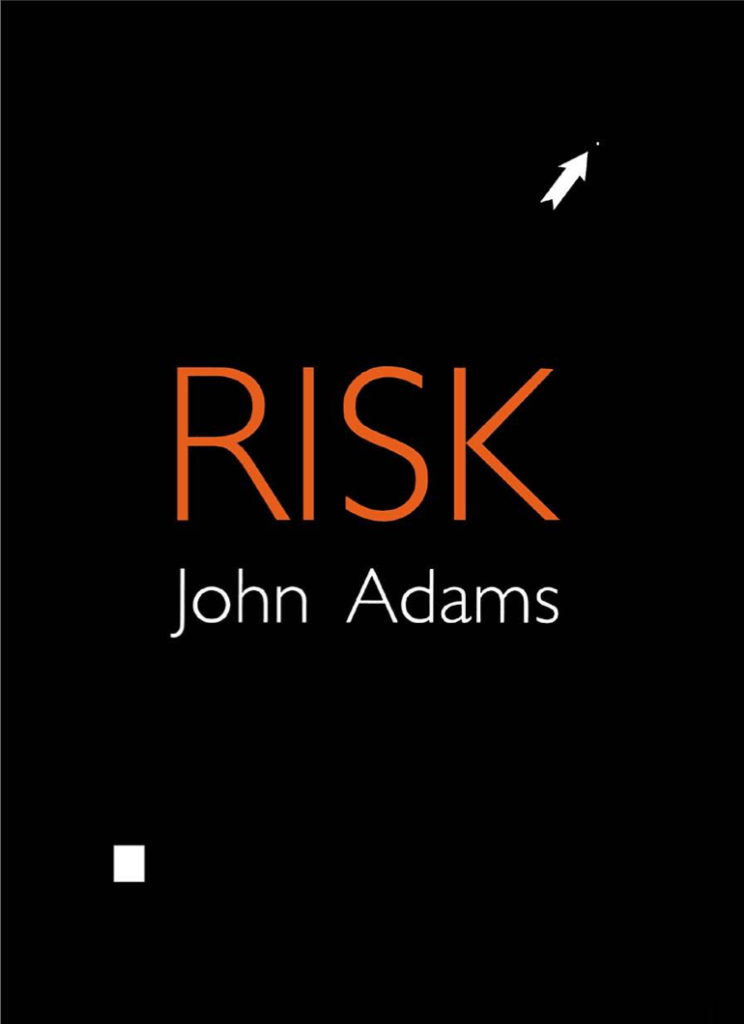
Risk

The Policy Implications of Risk Compensation and Plural Rationalities

John Adams | 1995

Quote from prologue: “This book began as a collaborative venture with Michael Thompson. For over 15 years my research into risk, mainly on the road, was focused on the theory of “risk compensation”. This theory accords primacy in the explanation of accidents to the human propensity to take risks. The theory postulates that we all come equipped with “risk thermostats” and suggests that safety interventions that do not affect the setting of the thermostat are likely to be frustrated by behavioural responses that reassert the level of risk with which people were originally content. My research had noted that there were large variations in the settings of individual thermostats, but had little to say about why this should be so.

About ten years ago I read Michael’s article “Aesthetics of risk” (Thompson 1980), and about five years later met the man himself. His research into risk over the past 20 years has been central to the development of a perspective that has come to be known as “cultural theory” (Thompson et al. 1990). Risk, according to this perspective, is culturally constructed; where scientific fact falls short of certainty we are guided by assumption, inference and belief. In such circumstances the deterministic rationality of classical physics is replaced by a set of conditional, probabilistic rationalities.

Lees verder “Risk”

About ‘Public Risk’

Board of PRIMO Europe | April 2020

Introduction

During the founding of the idea of PRIMO in Strasbourg on the 1st of April 2005, the need for design principles related to the governance of public risk was extensively discussed. We, to be precise the executive committee of the European Association of Local Chief Executives UDITE, defined it as a form or way of working towards the prevention and reduction of possible hazards and risks (i.e. a measure of hazard) in our (European) cities, to build public trust on values like safety, quality of life, protection and coherence in society. Anno 2020 we reflect on and specify these principles.

A myriad to deal with

Based on experiences in this network we conclude that most of the public leaders and managers we meet – and if we ask them in our Public Risk Forum, round tables and thinktanks -, define risk all in their own way. It is a myriad of definitions and perceptions. We guess there are 100 different definitions of risk around, all based on unique principles, perspectives, angles, and driven towards further segmentation by a myriad of advisors, trainers, scientists (o, yes), and software developers.

All created in and by their own approaches, leading to a highly segmented and fragmented landscape of risk and risk management. Moreover, this landscape is widened through the attempts of rebranding this craftsmanship towards success management, value management, business continuity management, success management, performance management, risk leadership management, chances management, quality management. “In fact”, is said, “risk is not about risk, but about something else, about the risk of something.” We think too. How to proceed and promote a common language and understanding from here? And how exactly to contribute to this?

Lees verder “About ‘Public Risk’”

National Risk Register 2025

HM Government, UK | 16 January 2025

The National Risk Register (NRR) is the external version of the National Security Risk Assessment (NSRA), which is the government’s assessment of the most serious risks facing the UK. It provides the government’s updated assessment of the likelihood and potential impact of a broad range of risks that may directly affect the UK and its interests. 

The NRR is aimed at risk and resilience practitioners, including businesses and voluntary and community sector organisations. The NSRA now operates as a dynamic assessment process, with risks reassessed on a more regular basis to reflect the changing risk landscape. This version of the National Risk Register is the first to align with that dynamic process, drawing from the latest risk information available.

Lees verder “National Risk Register 2025”

Flying start PRIMO Vlaanderen

PRIMO Vlaanderen (2009) is preparing for a promotional campaign right after the summer period. We recently had a first presentation of PRIMO Vlaanderen during an AXA-hosted seminar on adequate prevention policy in our local administrations, compared to what already exists in several companies.

From left to right: Tom Wustenberghs, Ronny Frederickx, Luc Verhulst en Karl Vanderplaetse.

Although it doesn’t seem obvious to imply that political decision makers should think about preventive risk management (often referred to as a waste of time), this aspect might be valuable for developing the association in Flanders as a key information network on risk management.

The new association wants to highlight the importance of preventive risk management over existing crisis planning. Such a policy can only help improve the organisation’s quality (quality management) and reduce costs by diminishing risks.

Lees verder “Flying start PRIMO Vlaanderen”