The PRIMO Risk Management Award 2008

The award goes to the city of Saint-Étienne.

Gérard Combe | 2008

The city of Saint-Étienne has taken a renewing initiative to arm itself (the workforce) against the risk of a pandemic flu. This initiative is a pilot, a remedy to improve the processes. The initiative can be fully integrated into all running projects. Such a system aims to maintain an optimal level of services and simultaneously protect the workforce despite the risk of a lack of functioning.

Coat of Arms City of Saint-Étienne.

The challenge of this project consists of the ability of the employees to deal with a shortage of personnel. Moreover, the workforce has to anticipate being overburdened by the crises and a decrease in the risk of an epidemic spreading by leaving affected people at home. Communities are the first to deal with the consequences of such a crisis.

Lees verder “The PRIMO Risk Management Award 2008”

COVID-19: A Failure in Risk Management

David Zaruk as Ris-Monger | March 2020

The longer the Risk-Monger gets in the tooth, the more global mass panic events he has witnessed. Every crisis is a learning opportunity and as I had written in mid February, 2020. COVID-19, the Wuhan-originated coronavirus, has created a rich pedagogic environment.

When a train crashes, authorities are on the scene to determine the cause. The COVID-19 coronavirus is fast becoming a global train wreck and unless we quickly assess the mistakes leading up to this tragedy, more trains will pile into the station.

David Zaruk

Lessons are, unsurprisingly, being learnt the hard way with more mistakes sending the public health situation deeper into disaster. Worse, as our communications methods move from an expert-based model to a bottom-up citizen-based community model, our friends on social media become our main source of information.

The authorities in the West responsible for managing public health risks were made aware of the threat from a novel coronavirus at the beginning of January 2020. Most “leapt into action” in the middle of March by applying precautionary measures (lockdowns, social distancing, travel bans…). Was this the only possible risk management action? What should they have done in those two and a half months to have alleviated such a massive denial of social benefits and stress on humanity? 

Lees verder “COVID-19: A Failure in Risk Management”

Public Sector Report 2009

The effects of the downturn

Philippe Auzimour, Sabrina Boshuizen en Jack Kruf | July 2009

In mid-2009, Alarm, Marsh, and PRIMO Europe joined forces by presenting the results of different surveys and round tables, which focused on the public risks companies and governments faced due to the downturn. This article combines this report’s highlights (selected by the editor). The extended survey gave an in-depth look at perceptions and actual risks directly after a massive financial crisis emerged.

The survey shows that the complexity of risks has increased: over 75% of the participants responded that the volume and the complexity of the risks within their organisation have increased over the last 5 years. 700 Organisations were interviewed, spanning twelve countries and seven industry sectors. Of these organisations, 101 were in public entities. PRIMO Europe interviewed several people from public entity organisations and sent out a survey to public entities, to which 112 people responded. Also, two round tables were held, one in Amsterdam and one in Bournemouth. The results of all the interviews, survey responses, and round tables are included in this report.

Lees verder “Public Sector Report 2009”

A Brief History of Public Risk Management 

Towards a holistic approach 

Finn Kjaer Jensen | February 2007

It certainly is true that governments have practiced risk management, in a general sense of the term, for thousands of years. Ancient cities that built walls to keep out invaders were practicing an elementary (but sound) form of risk management. Indeed, risk management is a fundamental purpose of government – government is, to a considerable degree, risk management. Further, there are numerous activities in the public sector that can be characterized as risk management (immunization programs, defense policy), but which are entwined with other functions of government.

The Categories of Public Sector Risk Management 

To better appreciate the historical process that has led to the present risk management environment, it is useful to first understand the general framework of risk management in the public sector. 

As an interesting point of reference, the UK central government (the Cabinet Office’s Strategy Unit) issued a statement in 2002 that characterized public sector risk management as possessing three facets 1) managerial, 2) regulatory, and 3) stewardship. These facets reflected the fact that risk management sometimes was a direct part of the management of public institutions, but that often it involved less direct activities – for example, regulating the behavior of other private and public organisations and influencing other sectors or taking a leadership role to address public concerns beyond the reach of an individual public entity. The main focus of this article is on the “managerial” domain. This facet of public risk management is known as ORM (Organisation Risk Management, or, with increasing frequency, ERM or Enterprise Risk Management). 

Lees verder “A Brief History of Public Risk Management “

The Financial Crisis

An opportunity for balancing risks in Infrastructure Projects and Public-Private Partnerships?

Philippe Auzimour and Sabrina Boshuizen | December 2009

Partnership risk is seen as one of the main risks by Public Entities in the Risk Survey Marsh and PRIMO Europe conducted in the third quarter of 2009. The survey shows that 59% of participants rate partnership risk significant, a similar amount as for public liability and business continuity risks.

All over Europe, unsuccessful projects have increased by the downturn. As a result the number of transactions and the total value has gone down. The companies bidding for projects now find it difficult to raise the capital and finance to carry them out, and public entities have their own problems in this regard, as the institutions funding their debt are running into trouble. These issues will all have impact on the time it takes for a project to reach its financial close and will increase partnership risk, whatever the contractual arrangement.

Lees verder “The Financial Crisis”

PRIMO Risk Management Award 2009

The Darlington Borough Council received the PRIMO Risk Management Award 2009. The borough’s approach demonstrates a holistic view of public values and their risks and government services to citizens. It links the government to its partners, is excellent at working, and is highly effective in delivering success. In Darlington, an innovative model has proved popular and introduced a common approach to managing risk within the Authority and all partnerships. It has also raised the risk management profile within the decision-making process for partnerships and improved service delivery.

One Darlington, Perfectly Placed

Interview with George Cornforth, Risk and Insurance Manager Darlington Borough Council

Inge Sebregts | December 2009

Partnership working and building relationships to improve the future is now fundamental in public service delivery. ‘One Darlington: Perfectly Placed’, Darlington’s Sustainable Community Strategy sets out a vision for Darlington, with partnership working key to its delivery. However, partnership working involves risks as well as opportunities and embedding risk management within the culture of partnerships and developing effective governance arrangements are therefore vital for their success.

Lees verder “PRIMO Risk Management Award 2009”

Cooperation PRIMO Europe and UDITE 2013-2014

Brussels, October 2012

UDITE and PRIMO have signed a partnership agreement for 2013 and 2014. Cooperation on administrative issues is necessary to provide the European network of municipal secretaries with practical solutions. Knowledge exchange and dialogue are crucial.

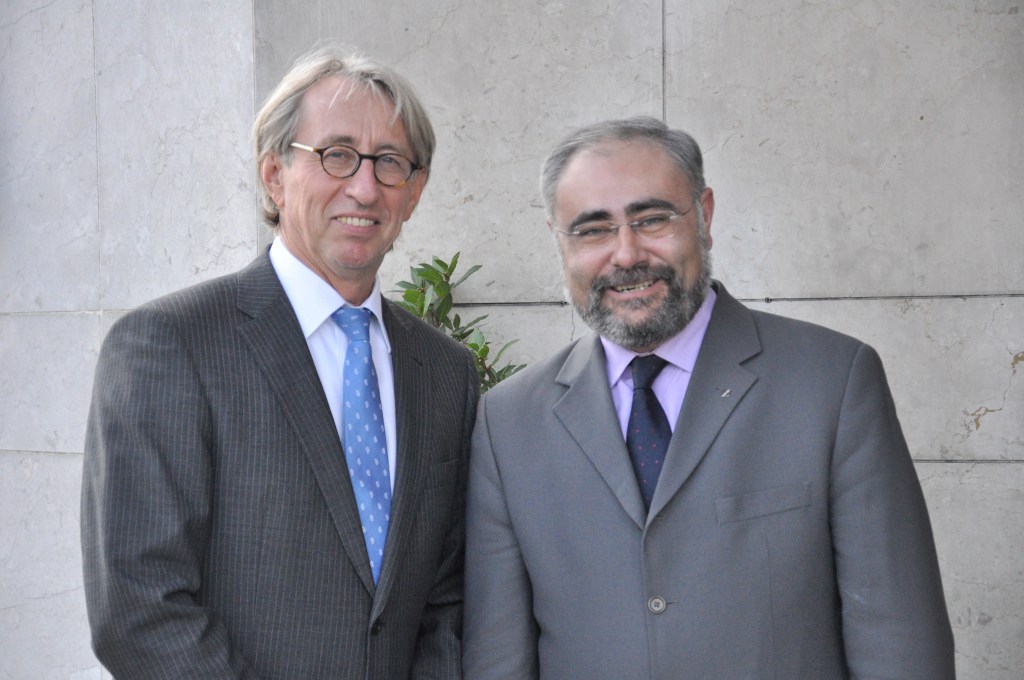
In Brussels, the Union des Dirigeants Territoriaux de l’Europe (UDITE, the European association of municipal secretaries), represented by its president Eulalio Ávila Cano, who is also president of COSITAL (Consejo General de Colegios Oficiales de Secretarios, Interventores y Tesoreros de Administración Local, the Spanish association of municipal secretaries, controllers, and financial managers), and the Public Risk Management Organisation (PRIMO) Europe, represented by John O’Dea (secretary general of PRIMO Europe and president of PRIMO Malta) and Jack Kruf (president of PRIMO Europe).

Jack Kruf (left) and Eulalio Ávila Cano

The collaboration will have a renewed focus: strengthening the administrative capacity of local government (enhanced public governance) in general and public-private partnerships in particular.

Lees verder “Cooperation PRIMO Europe and UDITE 2013-2014”