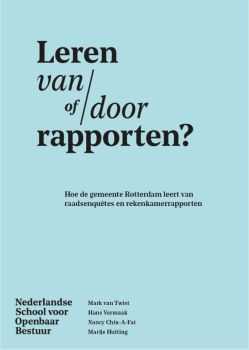
Leren van of door rapporten

Hoe de gemeente Rotterdam leert van raadsenquêtes en rekenkamerrapporten

Mark van Twist, Hans Vermaak, Nancy Chin-A-Fat en Marije Huiting | 2021, NSOB

Herkent u dat? Er verschijnt over uw organisatie een rapport met aanbevelingen hoe van alles beter moet. De bedoeling is dat dat doorwerkt en effect sorteert. Maar toch werkt dat niet altijd zo uit…

Betrokkenen kunnen ervaren dat het rapport er (een beetje) naast zit of te negatief uitpakt. Of ze vinden het rapport goed, maar het (b)lijkt lastig om al die aanbevelingen op te volgen. Of als je ze opvolgt, krijg je er dan wel een sterkere organisatie of beter werk van?
Lees verder “Leren van of door rapporten”

Publiek Risico: Essays

Dit e-boek bevat een collectie van Nederlandstalige essays met betrekking tot de publieke besturing van waarden en risico’s. Het is een caleidoscopisch overzicht van essays in het taalgebied van Nederland en Vlaanderen. Het bestrijkt de periode 1995-2020.
De essays zijn eerder verschenen als losse artikelen op website, als verslag van een bijeenkomst, als brochure, als onderdeel van een magazine of als losse publicatie.

Dit e-boek wordt uitgebracht voor bestuurders, managers, adviseurs, wetenschappers, docenten en studenten, op het grensvlak van corporate en public governance. Het initiatief voor deze publicatie is genomen om overzicht te bieden, vanuit een onafhankelijke en een non-profit benadering.

Er is de afgelopen decennia veel geschreven hoe de kwaliteit van publiek bestuur en management kan worden verbeterd. In deze uitgave concentreren wij ons op de essays, die het naar onze overtuiging waard zijn om samen te brengen. Het accent ligt daarbij op publiek risicomanagement als relatief nieuw vakgebied binnen het bredere perspectief van public governance.

De selectie vertegenwoordigt een spreiding over de diverse aspecten van en perspectieven op dit vakgebied.

Publieke Risico Essays, versie 1.02, 30 augustus 2020

Surroundings: A History of Environments and Environmentalisms

Etienne S. Benson

Given the ubiquity of environmental rhetoric in the modern world, it’s easy to think that the meaning of the terms environment and environmentalism are and always have been self-evident.  But in Surroundings, we learn that the environmental past is much more complex than it seems at first glance. In this wide-ranging history of the concept, Etienne S. Benson uncovers the diversity of forms that environmentalism has taken over the last two centuries and opens our eyes to the promising new varieties of environmentalism that are emerging today.

Through a series of richly contextualized case studies, Benson shows us how and why particular groups of people—from naturalists in Napoleonic France in the 1790s to global climate change activists today—adopted the concept of environment and adapted it to their specific needs and challenges. Bold and deeply researched, Surroundings challenges much of what we think we know about what an environment is, why we should care about it, and how we can protect it.

Visit website of Etienne Benson.

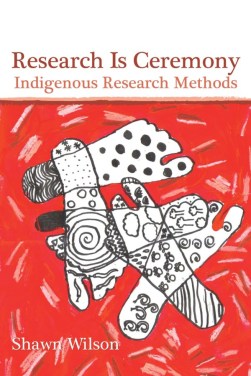
Research is Ceremony

Swan Wilson | 2008

In onze zoektocht naar onderzoeksmethoden of wijzen van denken die verbindend kunnen zijn om vraagstukken integraal en holistisch te benaderen, lijkt de inheemse benadering handvatten te bevatten.
Tenminste gaan inheemse onderzoekers uit van de diepere kennis van de complexiteit, de fysieke samenhang der dingen en de interacties van het land, waar zij ook van zijn. Een fascinerend boek door Swan Wilson, Opaskwayak Cree van Noord Manitoba.

Lees verder “Research is Ceremony”

Thorbecke voorbij: Lokale sturing op complexe opgaven

Delft, 20 januari 2022. De tweede Professor dr.ir. Roelof A.A. Oldeman Lezing* door Mr. J. (Hans) Krul, gemeentesecretaris en algemeen directeur van de Gemeente Delft.

Hij belicht vanuit zijn functie en rol in het knooppunt van het gemeentelijk verkeer, hoe vanuit lokaal perspectief voorliggende complexe opgaven kunnen worden benaderd. Thorbecke en Oldeman zijn daarbij behulpzaam in denken en handelen.

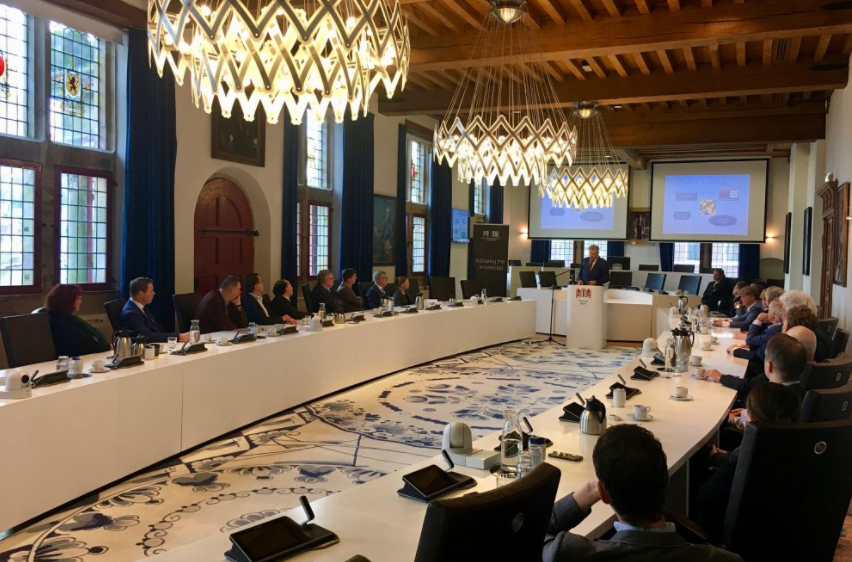
Hans Krul spreekt de 2e Professor Oldemanlezing uit in de raadszaal van de gemeente Delft.

De lezing

“Hartelijk welkom in de raadszaal van dit mooie historische stadhuis van Delft, een van de jongste leden van het PRIMO netwerk. Het is een eer dat ik vandaag in deze voor mij zo vertrouwde omgeving van de Delftse raadszaal de Oldeman Lezing uit mag spreken.

Ik ga dan ook mijn uiterste best doen u niet teleur te stellen waarbij ik in de eerste plaats terugval op mijn ruim 40-jarige werkervaring bij de overheid. Mijn lezing zal zich via de volgende stations voltrekken:

Lees verder “Thorbecke voorbij: Lokale sturing op complexe opgaven”

Transdisciplinarity: Synthesis towards a modular approach

Ortwin Renn

Abstract (quote): “The need to cope with future challenges posed by major transformations such as digitalization and sustainable development has led to several approaches to establish new concepts and methods of science and research. Scientific studies are supposed to provide background knowledge, to facilitate the desired transformations towards a sustainable future and to help resolving complex problems that accompany societies in transition. Concepts such as transformative, transdisciplinary or co-creative approaches elucidate the direction in which scientific research strives for its new role(s).

Based on the discussion of these concepts and their different roots, the article proposes a modular concept for a transdisciplinary scientific approach combining and integrating curiosity driven research with goal oriented (advocacy) knowledge generation and catalytic, process-oriented expertise. This integration promises to address some of the deficits of the existing concepts and is particularly suitable for future studies comprising orientation, strategies and reflection for designing policies for transformations.”

Highlights (quote)

    • A thorough review of concepts and approaches for interdisciplinary research with an emphasis on European traditions.
    • An analysis of the merits, problems and shortcomings of these approaches.
    • A new approach based on the combination of curiosity-driven, goal-oriented and catalytic research concepts.
    • A brief case study illustrating the new approach.

Summary (quote)

“Policymaking for dealing with wicked and complex problems requires a robust knowledge base for the assessment of the likely consequences of each policy option and is based on balancing conflicting goals considering the diversity of interests, preferences and values of society. This requires a better integration of scientific expertise for informing policymaking, so that the relevant knowledge base can be used in the preparation of evidence-informed, socially acceptable and morally substantiated decisions.

The best way to inform policymaking is by implementing transdisciplinary research methods. Transdisciplinarity becomes manifest in the systematic integration of classic curiosity-driven research (disciplinary and interdisciplinary), goal-oriented strategic research (impact assessment of different options); and process-related catalytic research (deliberative integration of knowledge, values, interests, and preferences). The defining characteristics of transdisciplinarity, namely, the systematic perspective, the orientation on complex real-world problems and the inclusion of non-scientific knowledge, are inherent to this kind of research process (Despres et al., 2004: 472; Jahn et al., 2012: 8; Pohl, 2011: 619; Thompson Klein, 2013: 190; Zscheischler & Rogga, 2015: 29).

To meet these characteristics requires an organic synthesis of the three research concepts described in this article. The curiosity-driven concept brings in the systematic insights to make policy options effective, the goal-oriented concept develops strategies to achieve the desired objectives or to constructively address problems that need public attention, and the catalytic concept delivers the institutional architecture and communicative design necessary to successfully conduct a deliberative discourse between and among the various knowledge carriers and users of knowledge.

The synthesis of these three concepts into an integrative approach of building bridges between knowledge and collective action corresponds to the transdisciplinary mission of science. Transdisciplinary approaches integrate process-related, factual, and strategy-related knowledge and ideally lead to a problem resolution that is factually convincing, argumentatively consistent, morally substantiated, and, in principle, acceptable to all.”


Bibliography

Renn, O.(2021). Transdisciplinarity: Synthesis towards a modular approach. Futures, Volume 130, 102744. https://doi.org/10.1016/j.futures.2021.102744

Zooming out, getting the picture

One of the crucial skills of public leaders and managers is to be able to get the bigger picture of society, and from there to connect things and to act accordingly. Mayors and city managers among others need to keep the main focus on the bigger picture, while aldermen and directors have their specific discipline, craftsmanship and portfolio.

Overview and content go hand in hand, both complementary pieces of the puzzle of public governance. Zooming out is a form of art, necessary to understand the city as an ecosystem. For this art, Alexander von Humboldt and Roelof A.A. Oldeman have been of great inspiration. The ability of zooming out is the essential skill for true knowledge, they say. Two quotes.

Naturalist, explorer and geographer Alexander von Humboldt (1856) concluded that zooming out leads to more overview and offers the possibility to interconnect things (and even sciences). Von Humboldt gave guidance on the relation between ecosystems and abiotic factors. At the beginning of the 19th century, he came to this fascinating conclusion, actually revolutionary for that time.

“Physical geography…, elevated to a higher point of view, … embraces the sphere of organic life…”. – Humboldt (1856).

He saw the connection between the life in the ecosystems and the constraints of soil, water, energy and climate. Nobody before him had done this. Also in cities these connections between in fact habitats and communities are all over the place. So we can learn here from the discoveries of Von Humboldt.

“The principle impulse by which I was directed was the earnest endeavour to comprehend the phenomena of physical objects in their general connection, and to represent nature as one great whole, moved and animated by internal forces. Without an earnest striving to attain to a knowledge of special branches of study, all attempts to give a grand and general view of the universe would be nothing more than vain illusion.” – Von Humboldt (1856)

Connection between sciences seems to be necessary to find the real answers. It is about the ability of sharpening one’s view from different angles and principles. Oldeman et al. (1990) underlined, in cross-border studies of forests, the need for such an holistic approach in diagnosis. He always encouraged, within the fragmented landscape of sciences, the necessity to cross the by individual universities so heavily guarded boundaries. For most of the city challenges, the process of policy making and service delivery needs to be based on a cross-border view, to come to well-founded decisions.

“The group that was responsible for the forest components theme decided to accelerate the process by starting an ambitious project, the writing of a common book. There is no way in which cooperation can be stimulated better, but this way has to be learned and practised too. The result is now before you. The book is not yet ideal in our opinion because it still contains too many traces of the old University tradition of researchers working, each apart, on such narrow subjects as they know best.

This way of executing the research of course is necessary to reach sufficient depth. But it carries the risk of loss of vision of the whole system, parts of which are studied. Still a little bit unbalanced, but on its way to improve along lines that are more clear now, this presentation in a pluridisciplinary way is a first step, however, to overcome both the limits of individual researchers and the shallowness of groups. We trust, however, that it is exactly this wrestling with integration of broad views versus the deepening of restricted views that may be as interesting to the reader as the facts, figures, conclusions and hypotheses on forests and their components which are presented in the following pages.” – Oldeman et al. (1990)

Von Humboldt and Oldeman are inspiring in this cross-scientific and pluridisciplinary discovery. Zooming out is crucial to get the picture.


Bibliography
Humboldt, Alexander von (1856). Kosmos: A Sketch of a Physical Description of the Universe, Volume 1. New York: Harper & Brothers Publishers. 406 pp.

Oldeman, R.A.A., P. Schmidt and E.J.M. Arnolds (1990). Forest components. Wageningen: Aricultural University, 111 pp.