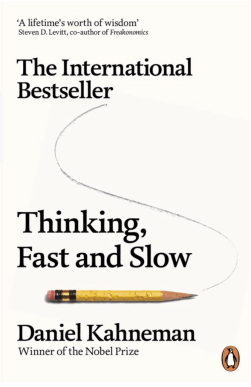
Thinking, Fast and Slow

Daniel Kahneman | 2013

In this fascinating treatise by a giant in the field of decision research, the mind is a hilariously muddled compromise between incompatible modes of thought.

Psychologist Kahneman positions a brain governed by two clashing decision-making processes. The largely unconscious System 1, he contends, makes intuitive snap judgments based on emotion, memory, and hard-wired rules of thumb and the painfully conscious System 2 laboriously checks the facts and does the math but is so “lazy” and distractible that it usually defers to System 1.

Kahneman uses this scheme to frame a scintillating discussion of his findings in cognitive psychology and behavioural economics and of the ingenious experiments that tease out the irrational, self-contradictory logics that underlie our choices.

All the factors described play a direct and indirect role in public governance. All public leaders and managers should be aware of the thoroughly described systems of our brains and behaviour. They make things clear and understandable. The book is an epiphany.

Bibliography

Kahneman, D. (2013) Thinking, Fast and Slow. New York: Farrar, Straus and Giroux

The Limits to Growth

Club of Rome | 1972

In March 1972, a report by a group of young scientists at the Massachusetts Institute of Technology (MIT) commissioned by Aurelio Peccei, founder of The Club of Rome, shook the world. The report excels in system thinking and modelling and in that it is more actual than ever.

Today, 50 years after its publication, “The Limits to Growth” is considered one of the most important and controversial environmental books of all time and it continues to influence conversations around sustainability and our continued existence on this finite planet. Below is the story behind this ground-breaking publication.

Published 1972 – The message of this book still holds today: The earth’s interlocking resources – the global system of nature in which we all live – probably cannot support present economic and population growth rates much beyond the year 2100, if that long, even with advanced technology. In the summer of 1970, an international team of researchers at the Massachusetts Institute of Technology began a study of the implications of continued worldwide growth.

They examined the five basic factors that determine and, in their interactions, ultimately limit growth on this planet-population increase, agricultural production, nonrenewable resource depletion, industrial output, and pollution generation. The MIT team fed data on these five factors into a global computer model. Then it tested the model’s behaviour under several sets of assumptions to determine alternative patterns for mankind’s future. The Limits to Growth is the nontechnical report of their findings.

The book also contains a message of hope: Man can create a society in which he can live indefinitely on earth if he imposes limits on himself and his production of material goods to achieve a state of global equilibrium with population and production in carefully selected balance.


The Limits to Growth, 1972 – key messages:

    • With existing policies, the physical limits to growth would likely be exceeded within one generation.
    • The most likely outcome of reaching these limits would be overshooting them, followed by systems decline.
    • The findings, however, also suggested a viable alternative to these outcomes – one in which population growth and material production could be brought into balance with planetary limits.
    • The fourth conclusion was that it would realistically take 50 to 100 years, or even more, to make this alternative outcome a reality.
    • Finally, the team found that every year action is delayed toward reaching the alternative outcome, decreasing the number of options available to avoid overshoot and collapse.

Bibliography

Meadows, D. H., Meadows, D. L., Randers, J. & Behrens, W. W. (1972). The limits to growth: A report for the Club of Rome’s project on the predicament of mankind. New York: Universe Books.

Limits to Growth (digital scan version, source: https://donellameadows.org)

Short History

Comparative risk analysis of technological hazards (a review)

Robert W. Kates and Jeanne X. Kasperson | 1983

Hazards are threats to people, and what they value, and risks are measures of hazards. Comparative analyses of the risks and hazards of technology can be dated to Starr (1969) but are rooted in recent trends in the evolution of technology, the identification of hazards, the perception of risk, and the activities of society.

These trends have spawned an interdisciplinary quasi-profession with new terminology, methodology, and literature. A review of 54 English-language monographs and book-length collections published between 1970 and 1983 identified seven recurring themes:

i. Overviews of the field of risk assessment.

ii. Efforts to estimate and quantify risk.

iii. Discussions of risk acceptability.

iv. Perception.

v. Analyses of regulation.

vi. Case studies of specific technological hazards.

vii. Agenda for research.

Within this field, science occupies a unique niche, for many technological hazards transcend the realm of ordinary experience and require expert study. Scientists can make unique contributions to each area of hazard management, but their primary contribution is in the practice of basic science.

Hazards are threats to people, and what they value, and risks are measures of hazards.

Beyond that, science needs to further risk assessment by understanding the more subtle processes of hazard creation, establishing conventions for estimating risk and presenting and handling uncertainty.

Scientists can enlighten the discussion of tolerable risk by setting risks into comparative contexts, studying the evaluation process, and participating as knowledgeable individuals, but they cannot decide the issue. Science can inform the hazard management process by broadening the range of alternative control actions and modes of implementation and devising methods to evaluate their effectiveness.

Bibliography

Kates, R. W., & Kasperson, J. X. (1983). Comparative risk analysis of technological hazards (a review). Proceedings of the National Academy of Sciences, 80(22), 7027-7038.https://doi.org/10.1073/pnas.80.22.7027

Starr, C. (1969). Social benefit versus technological risk: what is our society willing to pay for safety?. Science, 165(3899), 1232-1238.

Risk Management at the Edge of Three Worlds

City management in the perspective of ‘risk’

Jack P. Kruf | 2007

In this article, I want to focus on the specific characteristics of the role and position of local authority CEOs and city managers in relation to the three worlds of politics, society, and management. A specific focus on the role of risk management in supporting the CEO and the process of discussing these issues should be made to emphasise that risk management belongs on the strategic agenda and demands a holistic approach.

The “best” job

Some might say it is the most attractive and fascinating job there is: serving as CEO in local public management (or city manager or secretary). Why? Because it is at the very heart of dynamic society, close to politics and government, at the centre of the world of “power and influence”, and at the top of the management pyramid. This person is at the junction of necessary skills, ambitions, rights, stakes, and interests. He or she is, via society, close to disasters, successes, poverty, and environmental challenges, and, via politics, to elected officials like the mayor and local alderman, but always in close contact with officials in higher government and very close to the professionals in within the organisation. Local government leadership is a very exciting job.

“It is clear that risk management should be seen as a core competence for every public leader.”

The CEO is a generalist, not a specialist. One might say that a realistic comparison of the job would be with the decathlon. As with decathletes, the CEO must be well-rounded, competitive and competent in many areas. 

Furthermore, the CEO cannot operate in isolation but has to be open to the world, always authentic, and able to act like a chameleon. A phrase that has always appealed to me is being able to walk the web as a spider and be familiar with the rules of chess. This broad spectrum makes the role challenging, very attractive, and influential, but also very vulnerable. And it is here where risk management comes into play. 

Risk management 

As the demands of the city manager job are diverse but inter-connected, so must be the management approach: the manager must possess a broad, non-panicky and non-dogmatic perspective on risk and risk management – one which stresses usability in relation to a wide range of public risk issues, as well as to risks in public organisations. 

Such an approach requires a holistic, opportunistic and dialogue-oriented form of risk management, which seeks to harvest the value added, the ethical, resilient, and innovative potential in risk management as a natural part of public governance. 

Managing risks is among the most challenging issues for the public sector today. Whether risks arise from the physical environment, economic environment, or even from changes in voter preferences, public institutions are responsible for assessing and addressing the risks that impact the community they serve and their organisation. For example, what risks are possible when investing in a new IT system? Which risk elements are to be analysed when decisions about building a new school are made? Which risk elements are to be assessed to prevent vandalism and break-ins on municipal buildings? And which risks emerge from decisions made by higher governmental institutions? 

Risk management should be seen as a core competence for every public leader. But what is risk management? Generally, it is a way of approaching business, a sound attitude towards and style in managing people, projects, processing, and reaching goals. It comprises tools and techniques but, more than that, a smart, honest, and externally oriented approach that is open and authentic. Risk management leads to an effective and efficient way of reaching goals. It is the road to success. Let me focus on the three domains; society, politics and management. 

“One of the major goals for the public sector worldwide is a continuous building and rebuilding of public trust in close combination with sustainable development.” 

The three worlds 

The worlds of society, politics, and management always overlap and are connected. This fact requires a new risk management approach. It should consist of more than just preventing losses and reducing costs. Increasingly, risk management can be defined as the coordinated management of all risks. In this regard, modern risk management is a general management function that permeates an organisation, is linked to the organisation’s overall strategic plan and enables the achievement of political and organisational goals and objectives. 

One of the major goals for the public sector worldwide is the continuous building and rebuilding of public trust in close combination with sustainable development. Risk management is thus a most valuable management concept and tool in today’s complex and globalised world with increasing demands on governance and compliance. 

Risks in society 

The attacks on the World Trade and the Madrid trains, the Indian Ocean tsunami, the financial scandals of Enron and Worldcom, increasing poverty, climate change, increasing problems in the supply of clean water, unexpected riots in the suburbs of our cities, the murder of a Dutch politician, the Danish cartoon controversy, and the massacre at Virginia Tech University – all tell us how fragile society is. This underlines the urgency of and demands the control of risks, not only on a global but certainly also on a local level. 

Risk management requires knowledge of what is happening in society and how it develops in our streets, neighbourhoods, villages, suburbs, and cities. Knowing requires measuring and monitoring stress, satisfaction, trust, and safety; that is, perceptions of risk as well as objective and factual measures of risk. Monitoring and diagnosing society is important. Understanding relevant trends and developments is critical. 

Risk management also asks us to understand how and to what extent institutions in society really cooperate, where they should and why they don’t. This chain of interrelated institutions should be working if we want to be in control. Only the right information can lead to the right conclusions and the right things to do. So, sensing society and its institutions is a form of risk management.

 Of course, we receive some social feedback from citizens during elections. But I believe we need to develop a more consistent and permanent way of monitoring and sensing the state or health of society and its risks. This will contribute to an overall improvement in the quality of federal and local policies. If set up internationally, which it should be, it will lead to more exchange of knowledge and experience between local authorities worldwide.

Risks in politics 

The CEO’s task is to advise his local politicians as effectively as possible to prevent and protect them from risks. This boundary between politics and management requires special attention. Politicians often have a different view of risks than specialists and professionals. The approach here is to invest in the awareness of risks and to put it on the common strategic agenda. This seems so easy, but actually, it is not. Politicians and managers do not always speak each other’s language. On the other hand, the local government is an entity committed to developing policies and legislation by politicians on a regional, national and European level. Yes, there is the fact these are sometimes difficult to implement or, if so, against high costs and with intense efforts from municipal organisations. 

Risk management compels us to consciously calculate the risks and bring them forward. National organisations should play a key role in this. In my view, we should invest in partnerships between the different governmental layers. The other approach is to share your experiences in implementation and synchronisation and cooperate in this as much as possible. In the long term, higher levels of government should involve lower levels of government in policy development and implementation. The best form of risk management is a true partnership. 

Another factor that local government has to deal with is the lack of cooperation on a higher level. Central governmental institutions and ministries are organised by sector: traffic, environment, agriculture, economic, social, legal, et cetera. An integrated approach to specific areas, projects, problems, target groups, and even individuals is often literally blocked by this compartmentalisation. And this fact itself leads to higher risks for “control” of society. For example, the result is inconsistent legislation that may even be contradictory at the local level. 

“Mind you, another factor that local government has to deal with is the lack of cooperation on a higher level.”

Introducing risk management here implies bridging the gap between the government’s compartmentalised nature and the need for integration, which is truly a challenge for the city manager, generalist, process engineer, chameleon, or spider, as he or she may be. 

However, reducing the risks of a noncongruent and consistent approach on a local level caused by compartmentalisation is often very difficult and frequently impossible. Most power and influence, laws, regulations, and project budgeting are organised along such sectoral lines. This causes high risks for society. Bridging those gaps may be one of the highest forms of risk management. 

In general, it is very clear that a broader approach to risk management can lead to successful projects and policies and, from there, to successful local politics and politicians. While this seems obvious, it has not always been that way. Indeed, risk management is often seen as an obstacle to political goals and ambitions. I would simply argue here that risk management enables the fulfilment of goals, and if it isn’t happening in an organisation, risk management is not being effectively practised.

“Introducing risk management here implies bridging the gap between the compartmentalised nature of government and the need for integration…”

Risks in management 

The CEO is, in general, responsible for the management of the municipal organisation. Every manager has to be perfectly in control and, therefore, be able to realise the political targets. In this, the CEO, along with the mayor and alderman, is also responsible for the mistakes/faults of the local organisation. In this context, risk management has much to do with minimising errors, mistakes and accidents. Preventing crises and disasters and, if they occur, doing the right things. 

Another factor is that good news always travels fast to the top, but the bad news often stays hidden. Most employees never enter the executive room to tell the top manager that a decision is risky and will lead to trouble. This would be, as they say, not a good career move. That is why it should be the CEO who puts risk management high on the strategic agenda as an invitation and a request to employees in the organisation to come forward. Beyond that, he or she has to develop a safe and open culture for employees to discuss risks and, more importantly, reduce them. Most CEOs today delegate directly to others. But it is my opinion that this is a risk in itself. Risk management requires the involvement of all management team members, and it requires that they all explicitly share the risks. 

Another important aspect of the job of the CEO is realising political targets. This demands a management style focused on results. Defining the goals and auditing the risks of not realising them can give an enormous stimulus to develop and focus employees on those results. This is a risk management pursuit and can assure success and improved control. In this regard, the CEO needs to be open and transparent in his approach to facing risks. In my view, the process of reducing risks and uncertainties is often too implicit, sometimes even hidden and not visible. 

To prevent the organisation itself from approaching risks sectorally, it is worthwhile considering the “bundling” of control in the organisation in one place, of course, with the checks and balances embedded and incorporated. Legal, IT, financial and quality officers often don’t talk with each other because they have their own specialisms. The city manager also has to develop an integrated approach, as it will improve the quality of political advising, address the needs of society and foster higher-quality decisions. 

The necessity of sharing 

In my judgment, all preceding comments underscore the importance of sharing—that is, sharing ideas, techniques, and strategies among public sector managers. For reasons that escape me, we do not see the level of sharing (between local authorities, between local and central governments, and – yes – between governments of various nations). But sharing is necessary, in significant part because of globalisation. We can learn a lot more if we are prepared to look around us and learn from each other, as well as share our experiences and approaches. 

A new visionary and comprehensive risk management organisation for public risk management on a CEO level has been set up to encourage and facilitate the goal of sharing. It is called the Public Risk Management Organisation (PRIMO). It is an international association that strives to establish an influential transnational network for creating awareness, setting up networks, connecting people, and developing and disseminating well-founded, solid, useful, and cutting-edge knowledge on public risk management for the benefit of society, the citizens, and the public organisations. 

Just get started 

Risk management has a good scientific basis, though it is relatively young in the public sector. However, there are sufficient tools and techniques available to start. Put risk management high on the strategic agenda. Start the debate about the most experienced risks, and create a safe atmosphere and culture where it is possible to share and bring risks forward. Identifying the risks is a start in itself and the first step in reducing risks and uncertainties on projects, advising, and processes. And I want to underscore this final point; it has to be the city manager who sets the example and leads the way.

Rising above water

en•

Marta Jiménez | Utrecht University

Sea levels are rising, and the rate of rise is accelerating. All over the world, many of today’s dikes, sea walls and flood barriers won’t be enough to hold back the water in the future. This will be particularly a problem in countries that lack the resources to maintain or fund extensive engineering projects to protect their citizens. But we can all learn from alternative, more affordable and flexible approaches that adapt to the rising water currently emerging all around the world. Rather than only battling to keep ever-rising seas out, these natural solutions aim to help rebuild land above sea level. Researchers from Utrecht University are testing which of these strategies will work for specific regions to help tame the tide. And they’re also thinking ahead: how can we minimise the damage and ensure people have somewhere safe to go when the water does come?

Ransomware: An insurance market perspective

en•[nl•]

Source: Geneva Association

  • New Geneva Association report highlights the important role of private re/insurers, alongside governments, in boosting society’s resilience to ransomware and ensuring the full benefits of digitalisation can be realised.
  • The report explores the significant value add of cyber insurance beyond risk transfer, amid ongoing debate on whether to ban ransom payments or associated insurance coverage.
  • Governments should do more to counter ransomware attacks: disrupt cybercriminal business models, fight illicit use of cryptocurrencies and promote cyber hygiene throughout business and society.

ZURICH, 20 July 2022 – The frequency of ransomware attacks, a form of cyber extortion, is increasing, along with the size and nature of ransom demands. Cybercriminals are deploying more sophisticated approaches to target governments, businesses and individuals, with serious and costly effects. The growth of the ransomware-as-a-service (RaaS) business model has also enabled threat actors with limited technical skills to launch highly disruptive attacks.

Cyber insurance provides vital financial protection and operational support in the event of an attack, but ransomware has contributed to the recent deterioration in cyber insurers’ underwriting performance. Ransomware accounted for 75% of all cyber insurance claims in 2020 (AM Best) and is also likely to have been the costliest loss event category in 2021 (WTW).

The Geneva Association’s report analyses the complex policy issues surrounding ransomware and possible solutions to counter this epidemic in cybercrime, including the contribution of insurance to boosting firms’ cyber resilience. The report’s key messages include the following:

  • Cyber insurance does more than provide cover for ransoms: Cyber insurance may also cover a range of first- and third-party losses incurred by victims of ransomware (e.g. business interruption, data and system recovery, forensics and legal assistance), as well as arrange expert support in managing incidents. Insurance also helps organisations identify and address cybersecurity vulnerabilities and adopt better risk prevention in a fast-changing landscape.
  • Banning ransom payments would be a blunt, potentially ineffective policy instrument: An outright ban on the payment of ransoms or their reimbursement by re/insurers could backfire by driving transactions underground and encouraging ransomware attackers to engage in new, more malicious forms of extortion.
  • Governments and regulators must do more to counter ransomware attacks: Public policies should be aimed at deterring ransomware attacks, disrupting cybercriminals’ business models and illicit use of cryptocurrencies, and better preparing organisations for intrusion.

Managing Director of The Geneva Association, Jad Ariss, said: “With ransomware we see an example of the important ‘prevention and mitigation’ role insurers play as risk managers. They control a critical lever with their ability to incentivise customers to maintain strong cybersecurity controls and standards, helping to reduce firms’ vulnerability to attack and boost their cyber resilience. Governments and regulators have their levers, too, and as our report highlights, they need to rein in the illegal use of cryptocurrencies and do more to ensure information exchange about incidents as well as improve international cooperation among law enforcement.”

The Geneva Association’s Director of Cyber and Evolving Liability and author of the report, Darren Pain, said: “The ransomware landscape is now highly evolved and sophisticated, especially with the development of ransomware-as-a-service. Such ransomware attacks are driving significant increases in insurance claims and, as a consequence, premiums. Would banning ransom payments be a viable solution? According to our study, insurance companies do not think so. Prohibiting ransom payments or their reimbursement by insurers would likely drive transactions underground, forfeiting the ability of the authorities to record and analyse incidents and prosecute criminals. Furthermore, the last thing we should do is take steps that might discourage smaller firms from taking out cyber insurance, the benefits of which go well beyond reimbursing ransoms.”

____

nl• De frequentie van ransomware-aanvallen, een vorm van cyberafpersing, neemt toe, samen met de omvang en aard van de losgeldeisen. Cybercriminelen zetten meer gesofisticeerde benaderingen in om overheden, bedrijven en individuen te treffen, met ernstige en kostbare gevolgen. De groei van het ransomware-as-a-service (RaaS)-bedrijfsmodel heeft bedreigers met beperkte technische vaardigheden ook in staat gesteld zeer ontwrichtende aanvallen uit te voeren, zo blijkt een repport van de Geneva Association.

Cyberverzekeringen bieden essentiële financiële bescherming en operationele ondersteuning in het geval van een aanval, maar ransomware heeft bijgedragen tot de recente verslechtering van de acceptatieprestaties van cyberverzekeraars. Ransomware was in 2020 goed voor 75% van alle cyberverzekeringsclaims (AM Best) en zal in 2021 waarschijnlijk ook de duurste verliescategorie zijn geweest (WTW). Overheden moeten meer doen om ransomware-aanvallen tegen te gaan: verstoor bedrijfsmodellen van cybercriminelen, bestrijd illegaal gebruik van cryptocurrencies en bevorder cyberhygiëne in het hele bedrijfsleven en de hele samenleving.

Het rapport van de Geneva Association analyseert de complexe beleidskwesties rond ransomware en mogelijke oplossingen om deze epidemie van cybercriminaliteit tegen te gaan, waaronder de bijdrage van verzekeringen aan het vergroten van de cyberweerbaarheid van bedrijven. Het rapport benadrukt de belangrijke rol van private herverzekeraars, naast overheden, om de samenleving weerbaarder te maken tegen ransomware en ervoor te zorgen dat de voordelen van digitalisering ten volle kunnen worden benut. De belangrijkste boodschappen van het rapport zijn onder meer de volgende:

  • Cyberverzekeringen bieden meer dan alleen dekking voor losgeld: Cyberverzekeringen kunnen ook een reeks eerste- en derde-verliezen dekken die slachtoffers van ransomware oplopen (bijv. bedrijfsonderbreking, herstel van gegevens en systemen, forensisch onderzoek en juridische bijstand), evenals deskundige ondersteuning regelen bij het beheer van incidenten. Verzekeringen helpen organisaties ook kwetsbaarheden op het gebied van cyberbeveiliging te identificeren en aan te pakken en betere risicopreventie toe te passen in een snel veranderend landschap.
  • Het verbieden van losgeldbetalingen zou een bot en mogelijk ondoeltreffend beleidsinstrument zijn: Een algeheel verbod op de betaling van losgeld of de vergoeding ervan door herverzekeraars/verzekeraars kan averechts werken doordat transacties ondergronds worden gedreven en aanvallers van ransomware worden aangemoedigd om nieuwe, meer kwaadaardige vormen van afpersing toe te passen.
  • Regeringen en regelgevers moeten meer doen om ransomware-aanvallen tegen te gaan: Overheidsbeleid moet gericht zijn op het afschrikken van ransomware-aanvallen, het verstoren van de bedrijfsmodellen van cybercriminelen en het illegale gebruik van cryptocurrencies, en het beter voorbereiden van organisaties op inbraak.

Managing Director van The Geneva Association, Jad Ariss, zei: “Met ransomware zien we een voorbeeld van de belangrijke ‘preventie en mitigatie’-rol die verzekeraars spelen als risicomanagers. Zij hebben een cruciale hefboom in handen door hun vermogen om klanten te stimuleren sterke cyberbeveiligingscontroles en -normen te handhaven, waardoor zij bedrijven minder kwetsbaar maken voor aanvallen en hun cyberweerbaarheid vergroten. Overheden en regelgevende instanties hebben ook hun hefbomen, en zoals ons rapport benadrukt, moeten zij het illegale gebruik van cryptocurrencies beteugelen en meer doen om de uitwisseling van informatie over incidenten te waarborgen, evenals de internationale samenwerking tussen rechtshandhavingsinstanties verbeteren.”

Darren Pain, directeur Cyber and Evolving Liability van de Geneefse Vereniging en auteur van het rapport, zegt: “Het ransomware-landschap is nu sterk geëvolueerd en gesofisticeerd, vooral met de ontwikkeling van ransomware-as-a-service. Dergelijke ransomware-aanvallen zorgen voor een aanzienlijke stijging van het aantal verzekeringsclaims en, als gevolg daarvan, van de premies. Zou een verbod op losgeldbetalingen een levensvatbare oplossing zijn? Volgens onze studie denken verzekeringsmaatschappijen van niet. Het verbieden van losgeldbetalingen of de vergoeding ervan door verzekeraars zou de transacties waarschijnlijk ondergronds drijven, waardoor de autoriteiten de incidenten niet meer zouden kunnen registreren en analyseren en criminelen niet meer zouden kunnen vervolgen. Bovendien is het laatste wat we moeten doen het nemen van maatregelen die kleinere bedrijven kunnen ontmoedigen om cyberverzekeringen af te sluiten, waarvan de voordelen veel verder gaan dan het vergoeden van losgeld.”


About robust governance and temporal strategies

en•[nl•]

Source: Wiley Public Administration

Abstract

Today the world is confronted with dual crises: creeping and acute threats unfolding at the same time — for example, the manifestation of extreme weather events such as drought and flooding and the creeping crisis of climate change. To cope with dual crises, this article develops a novel temporal perspective that offers policy actors a repertoire of interrelated strategies for enhancing the robustness of institutional efforts. The repertoire consists of five temporal strategies that policy actors can use to navigate the twin challenges of immediate and latent threats in conjunction: strategic coupling of short-term shocks and creeping crises, crafting time horizons, molding the pace of public problem-solving, mobilizing anticipatory capacity through futuring techniques, and adaptive iteration of policy decisions. We illustrate the practical application of these strategies in an exploratory case study of adaptive water management in the Netherlands.

Samenvatting

De wereld wordt geconfronteerd met duale crises: sluipende en acute dreigingen op hetzelfde moment, zoals extreme weersgebeurtenissen als droogte of watersnood tegelijkertijd met de sluipende crisis van klimaatverandering. Om te reageren op duale crises, ontwikkelt dit artikel een nieuw repertoire van vijf temporele strategieën voor beleidsmakers om de robuustheid van overheidssystemen te vergroten. Dit repertoire bestaat uit de volgende strategieën: strategische koppeling van onverwachte korte termijn schokken en sluipende crises, tijdshorizonnen creëren, het tempo aanpassen van implementatie, het mobiliseren van anticiperende capaciteit door middel van scenariotechnieken, en de adaptieve iteratie van beleidsbeslissingen. We illustreren de werking van deze vijf strategieën aan de hand van een uitgewerkt voorbeeld van adaptief watermanagement in Nederland: de invoering van het programma Ruimte voor de Rivier.